









Urban Sketchers Deep Dive
What the Community Thinks About Urban Sketchers
Urban Sketchers arrived quietly in 2024 from DMZ Games, but reviewers across multiple channels have been struck by how much substance lies beneath its accessible exterior. The game sparked genuine enthusiasm, with reviewers consistently noting that it delivers far more than its appearance suggests. The consensus centers on smart design that balances tactical decision-making with strategic depth, beautiful production, and the rare quality of playing much smoother than it teaches. That said, player count matters significantly; the community voices align on recommending two or three players over four, where turn wait times and analysis paralysis can undermine the experience.
Core Mechanics That Define Urban Sketchers
Dice Drafting and Placement
At its heart, Urban Sketchers uses a dice drafting and placement system that reviewers repeatedly praise for creating genuine tension. Players roll a shared pool of dice each round and draft them one at a time, placing each die on action spaces. The die's value determines which actions become available or how powerful the result is. What makes this mechanism sing is the addition of player interaction through cost: if another player has already placed a die on your chosen action, you owe them the difference between your die and theirs. Money becomes a scarce, contested resource, and every placement decision carries negotiation weight. This creates what one reviewer called "great tension" in action selection, where you're constantly weighing your own needs against the likelihood of being sniped or forced to pay premiums. The system forces players to think at least two or three turns ahead while remaining responsive to available dice, merging strategic planning with tactical adaptation.
Set Collection with Publishing Rewards
The second pillar is set collection through publishing. Players collect cards representing sketches, organized by continent and theme, then publish sketchbooks when complete. Each published sketchbook triggers a multi-step reward sequence. You score points based on sketchbook size, advance on a track that unlocks ongoing bonuses, and crucially, collect icon tokens that form an end-game scoring matrix. Whoever accumulates the most of each token type scores significant bonus points, creating incentive for diverse collection strategies. This "drip feed of bonuses" across the game keeps the sensation of reward constant, and the publishing peaks provide narrative rhythm to the experience. Players quickly learn that publishing isn't just about the immediate points; the tokens become a hidden value generator that more experienced players begin targeting from game start.
The Urban Sketchers Experience
Tight and Satisfying Efficiency Puzzles
Urban Sketchers delivers what reviewers describe as a relentless efficiency puzzle. Money is tight enough to matter; every action has an opportunity cost. Players find themselves constantly calculating: travel for one more card, or save money for sketching? Publish now or hold for a higher-value set? Upgrade bonuses or pursue the icon tokens? The game never lets you do everything you want, which is precisely why it works. This constraint creates the sensation of a puzzle coming together rather than a deck of dominoes falling. When a player sequences actions correctly, watches bonuses multiply, and publishes a valuable sketchbook with a strong bonus chain, the payoff feels earned. The experience sits at that sweet spot where the game is challenging enough to remain engaging across replays but accessible enough that early players don't feel paralyzed.
Beautiful Art and Serene Atmosphere
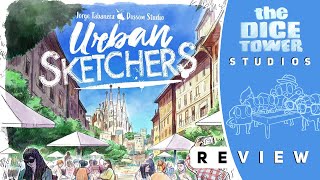
The production design deserves its own recognition. Urban Sketchers employs a sketched illustration style across every component that immediately establishes its thematic identity. Reviewers singled out the art as a standout element, describing it as "gorgeous" and calling it the best art of its month. The theme isn't pasted on; the sketched aesthetic reinforces that you're an artist developing a portfolio. The game communicates its intent through its visual language, and players report that this thematic coherence makes the rule teach smoother than it initially appears. One reviewer noted the surprising disconnect between how heavy the game feels during teaching and how fluidly it plays once everyone has seen one or two turns. The beautiful production and cohesive art direction account for much of that smoothness; the game looks like it plays.
What Makes Urban Sketchers Stand Out
Exceptional Decision Density with Minimal Downtime at Proper Player Count
Urban Sketchers packs serious decision-making into a compact turn structure when played at two or three players. Reviewers emphasized that there are meaningful choices at every step: drafting the right die, spending resources strategically, planning which cards to collect and when to publish. The game delivers what one reviewer called "a lot of interaction between the players," not through direct conflict but through shared action space competition and the cost-payment mechanics that affect everyone. With two or three players, turns move at a good clip, the board state shifts in interesting ways, and analysis paralysis remains a personal choice rather than an inevitable consequence. The game's elegance lies in how it keeps everyone engaged without the multiplayer burden.
A Hidden Depth of Scoring Paths
On the surface, Urban Sketchers looks like a straightforward sketching game. Below that surface lies surprising strategic diversity. Players can win by maximizing icon tokens, chasing track advancement bonuses, going wide with multiple simultaneous sketchbooks, or focusing on specific high-value sketch combinations. Reviewers noted that even after one or two plays, new scoring angles emerge. One player might unlock a powerful bonus early and see the game one way; another might quietly accumulate tokens and find a completely different path to victory. This hidden depth keeps the game fresh and rewards players who dig into its systems without creating a single dominant strategy that everyone must copy.
Potential Drawbacks
Severe Player Count Scaling Issues at Four Players
The elephant in the room is player count. Reviewers were consistent and clear: do not play this at four players. Turn wait times balloon to ten minutes or more, analysis paralysis sets in because you cannot plan ahead (you don't know what dice will be available), and the long turns make it hard to maintain momentum. Multiple reviewers described this as the game's primary weakness and the only real reason their otherwise high ratings didn't go higher. The game isn't broken at four players; it simply comes alive at two and three and withers at four. This is a two or three player game masquerading as a game that can accommodate up to four.
Availability and Learning Curve Friction
Urban Sketchers remains difficult to find outside Europe and Essen Spiel. It's a Spanish game published by a smaller publisher, and wider distribution hasn't materialized. Reviewers expressed genuine hope that another publisher would pick it up for North America. Additionally, the teach is notably disproportionate to actual play complexity; the game feels heavier when teaching it than it plays. Players need to sit through multiple rules modules before the first turn, but once play starts, the system coheres quickly. This teach-play friction isn't a fatal flaw, but it means new player onboarding requires patience and a commitment to making it to turn two.
If You Enjoy Urban Sketchers
Players drawn to Urban Sketchers typically enjoy resource scarcity puzzles and games where efficiency matters. Those who loved The White Castle will recognize familiar dice-cost dynamics, though Urban Sketchers layers set collection and tableau building on top. Fans of travel-themed games with light narrative, like Let's Go to Japan, will appreciate the sketching-as-journey framework. Any player who values beautiful art, smooth turn economy, and the satisfaction of watching an engine come together through careful sequencing will find much to love.
What Reviewers Are Saying
"Everything is a decision, a choice, an interesting moment. Even just having to sometimes put a die out and then you have to pay some other jerk because they went there first. Even that feels really interesting."
— Z Garcia and Camila, The Dice Tower
"The teach is very kind of disconnected from the actual play. It feels heavier when you're learning the game than it is."
— Camila, The Dice Tower
"I need this game to be available in North America. Some publisher, please bring this to North America because this is such a fantastic game and I really want more people to be able to play it."
— Jenna, The Board Game Garden