



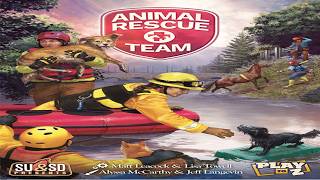






Animal Rescue Team Deep Dive
What the Community Thinks About Animal Rescue Team
Animal Rescue Team has become a notable cooperative entry in Matt Leacock's design portfolio, drawing strong appreciation for its thematic integration and polished presentation. The game finds broad support among cooperative enthusiasts who value meaningful interaction and logistics-heavy gameplay. However, reviewers acknowledge genuine design trade-offs: the game delivers complexity and challenge, but at a cost that not every group will accept. Where some celebrate the demanding puzzle and emergency-response atmosphere, others find the difficulty curve steep even on the lowest settings, with insufficient mechanical knobs to adjust without reducing the core experience.
Core Mechanics That Define Animal Rescue Team
Cooperative Resource and Vehicle Management
At its heart, Animal Rescue Team asks players to orchestrate a fleet of thematically distinct vehicles (cars, SUVs, motorcycles, boats, and trailers) each with unique movement ranges and carrying capacity. The core tension springs from the logistics puzzle: which animals fit in which vehicles, how far each vehicle can travel in a single action, and how to position rescue specialists and equipment across the map so that future turns compound into solvable chains. Players must communicate constantly about current positions and future needs, turning the game into a continuous negotiation of priorities. The mechanic works because vehicles aren't abstractions; a motorcycle moves faster than a truck towing a trailer, and a boat cannot cross dry land without a tow. This layer forces genuine cooperative planning rather than individual optimization.
Mission-Based Objectives and Time Pressure
Rather than racing against a timer, players work through three escalating missions that must be completed before the game's time track advances too far. Completing a mission requires assembling specific tokens and spending them at shelters under the right circumstances. The elegance lies in how this creates a shifting strategic landscape: early in a scenario, players focus on rescuing animals to generate the tokens they need; later, the pressure flips to prioritization: some animals must be left behind because resources are limited and time is running short. Reviewers emphasize that this structure feels authentically tied to the real-world challenge of managing disasters: you cannot save everyone, and failure comes from over-commitment as much as under-preparation.
The Animal Rescue Team Experience
Constant Dialogue and Coordination
The game generates a distinctive feel of coordinated urgency. Players spend turns talking through the landscape: "If you go there and pick up the horse, I can drive it to the shelter next turn." This constant back-and-forth creates the sensation of a team actually working together, not simply taking turns at a puzzle. The openness of the board state (nothing is hidden, all information is public) means players cannot blame randomness for a failed plan; every loss traces back to human error or an underestimated obstacle. That clarity makes victories feel earned and defeats feel like lessons learned.
Tension Between Compassion and Triage
The flavor text of each rescue card describes animals in genuine distress: dogs trapped in wells, animals fleeing fires. This creates a thematic tension rarely present in cooperative games. Players must actively choose which animals to rescue and which to abandon, a decision that carries emotional weight precisely because the theme grounds it in recognizable stakes. The game does not let players forget what they are abandoning; each animal left behind is a visible failure, which elevates the pressure far beyond what a purely abstract puzzle would generate.
What Makes Animal Rescue Team Stand Out
Integration of Theme into Core Mechanics
Reviewers consistently note that the game's systems emerge organically from its setting rather than being bolted on top of an existing engine. Horses cannot fit in small vehicles. The boat moves through water but must be towed across land. Specialists like the veterinarian and rope rescuer provide advantages tied directly to their expertise. This is thematic design in the truest sense: the rules communicate the setting without requiring explanation, and when players learn the rules, they learn the rescue scenario simultaneously. The map itself, with its randomized layouts and distinct terrain types, changes from game to game, forcing fresh approaches rather than letting players memorize a solution.
Accessibility of Difficulty Through Scenarios
The game includes multiple scenario sets that scale in difficulty not by tweaking numbers but by changing which three missions are in play. This means a family playing for the first time can select an easy scenario and experience a more forgiving game, while a seasoned group can take on harder challenges using the same ruleset. This scenario-based scaling honors both the casual player and the hardcore enthusiast without requiring a house-ruled variant or multiple rulebooks.
Potential Drawbacks
High Difficulty with Limited Mechanical Scaling
Even on the easiest difficulty, Animal Rescue Team punishes inefficiency severely. Players who miscalculate movement, misallocate tokens, or misjudge the cascade of events can find themselves in unrecoverable positions. Some reviewers found this refreshing, since the stakes feel real because failure is possible, but others felt the gap between "just right" and "unwinnable" is narrow, with little room for learning or experimentation. The challenge comes almost entirely from the mission cards themselves, not from adjustable knobs or toggles, which means players in search of a gentler learning curve may need to apply house rules or accept frustration through trial and error.
Complexity of Vehicle Logistics and Edge Cases
The depth of the logistics system is also its curse. Players must track which vehicles can move where, which animals fit in which vehicles, whether equipment occupies space, how trailers reduce movement, and whether animals left in vehicles overnight remain in those vehicles. A misstep in understanding the fine print can derail turns or create surprising soft-locks where shelters fill up and vehicles have no capacity, creating a bottleneck that feels arbitrary rather than strategic. This is not poor design, but it does mean the rulebook requires careful reading and some scenarios may benefit from clarification before play.
If You Enjoy Animal Rescue Team
Players who appreciate the logistics and real communication of Animal Rescue Team will find kindred spirits in several existing titles. Pandemic, also by Matt Leacock, shares the cooperative spirit and escalating crisis structure, though it operates at a higher level of abstraction. Thunderbirds, which Animal Rescue Team reimplements and expands, uses a similar vehicle-and-specialist framework for a rescue narrative. For those who love the theme of animal welfare alongside cooperative play, Endangered offers a pick-up-and-deliver system grounded in wildlife protection. Fate of the Fellowship, another Leacock design, captures the sense of urgent resource management and meaningful decisions under time pressure in a different genre entirely. And for groups who want a lighter approach to cooperation with less punishment for early mistakes, Forbidden Island and the broader Forbidden series provide accessible cooperative entry points that maintain thematic coherence.
What Reviewers Are Saying
"The logistical planning of this is the best part of the game in my opinion. And planning for those future rescues and missions is also the best part of the game because you're you're constantly being like you're prioritizing. You're you're prioritizing and you're rep prioritizing even sometimes during in in the middle of the same turn."
— TheGameBoyGeek
"I like cooperative games that have real cooperation, that have real dialogue to them. And I feel like Animal Rescue Team does do that. You know, there are you're constantly going to be talking about how to manage your resources and manage the vehicles and get them to where you want them to be."
— Grant with Grant's Game Rax
"It's one of those games where it's like yes, it feels familiar. There's nothing absolutely new here, but the components, the theme, the way theme is integrated into the game, and just all the open communication of cooperative nature is why this one got on the list and it just looks amazing on the table."
— TheGameBoyGeek