














Confusing Lands Deep Dive
What the Community Thinks About Confusing Lands
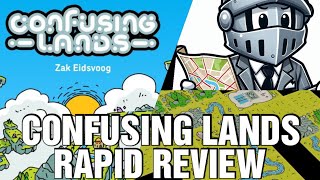
Reviewers agree on the basic shape of Confusing Lands: an 18-card micro game for one or two players that plays in about ten minutes and packs into almost nothing. Tabletop Tolson called it "fantastic" and pitched it directly to fans of Button Shy's pocket-sized card games, while Envy Born Games' own channel described it as a great game for one to two players that is quick to pull out and play. The Board Game Garden went further, saying the design felt like exactly what they had wanted Sprawlopolis to be, and came away preferring it to that better-known title. Chairman of the Board placed it among the strongest examples of its genre, saying it would rather play it than comparable overlap-and-score games.
Where the community splits is on how forgiving the scoring actually is. Foster the Meeple, covering the game as part of a sponsored segment with publisher Envy Born Games, warned that the scoring conditions are "where things get a little bit confusing and a little bit wonky and kind of hard to achieve," even while calling the base loop simple and straightforward. Ryan and Bethany Board Game Reviews, who received their copy from the publisher for review, leaned the opposite way, framing the same scoring choice as the game's best decision point rather than a liability. Before You Play landed somewhere between the two, praising the presentation and portability while noting the game will not appeal to anyone who only wants heavier fare. The Board Game Garden, playing an early prototype copy sent by the publisher, echoed that the scoring logic takes a moment to click before it clicks well.
Core Mechanics That Define Confusing Lands
A drafting hand that punishes and rewards passing
Each round, players are dealt two cards, choose one to play into their own landscape, and hand the other directly to their opponent, who must then place it somewhere in theirs. Tabletop Tolson described the tension this creates: players look at the card they are giving away and ask whether it will help their opponent, whether it might hurt their score, or whether it is simply the safer of two options to release. Ryan and Bethany Board Game Reviews called this the same drafting pool "hate drafting," noting that a player can hand over a card knowing it either tempts an opponent onto the costly scoring side or gives them nothing useful at all. Because every card played face up onto the shared table stays visible, the two channels agreed that players can track what has already been placed even without knowing exactly what is left in an opponent's hand.
Double-sided cards and a ten-point toll on every goal
Every card in the deck has two faces: a plain landscape side and a scoring-condition side. Envy Born Games explained that choosing the scoring side adds one more objective to a player's personal landscape, but each objective added costs ten points at the end of the game, so a player has to make those points back through play. Ryan and Bethany Board Game Reviews and Chairman of the Board both confirmed the same ten-point toll, with Chairman of the Board adding that overreaching on goals "has bitten me pretty hard in the past" because it is difficult to squeeze full value out of more than a couple of scoring cards at once. Cards must also overlap at least one space of whatever is already on the table, and a scoring condition can never be covered once it is placed, a rule several reviewers pointed to as the reason placement choices carry real weight.
The Confusing Lands Experience
A fast spatial puzzle built on overlap and rotation
Reviewers described the physical act of play as a small tile-overlap puzzle: cards can be rotated a full ninety degrees in any direction and must always overlap the existing landscape rather than slide beneath it, a rule Tabletop Tolson contrasted directly with the tuck-under placement of Sprawlopolis. Envy Born Games walked through a solo version of the same puzzle, where a player draws two cards, keeps one, discards the other, then flips the top card of the deck to stand in for what an opponent would have passed back, so the placement puzzle stays intact even without a second player.
A short, competitive back-and-forth between two players
For the two-player game, Chairman of the Board emphasized the added autonomy of only facing one opponent: a player can glance across the table, see what that opponent is building, and decide how much a passed card will actually help them before handing it over. Ryan and Bethany Board Game Reviews framed the same short session as ideal for a quick sit-down, saying the game "understands and delivers on being a micro game" and does not overstay its welcome even with a short expansion of extra cards added in.
What Makes Confusing Lands Stand Out
A genuinely pocket-sized, travel-ready package
Multiple channels singled out portability as a defining strength. Tabletop Tolson said an eighteen-card box "is going on my trip with me this summer," and Envy Born Games agreed it could fit on an airplane tray, calling it great for travel whether played solo or with a second player. The Board Game Garden planned to bring it on a nearly six-hour flight alongside another title from the same publisher, and Before You Play noted the box follows the same compact, wallet-style format as Button Shy's card games, meaning it can travel in something even smaller than its own box.
Replayability through variable, sometimes double-symbol scoring cards
Because every one of the eighteen scoring conditions is unique, reviewers found that the cards drafted and the sides chosen changed the feel of the game from one session to the next even with a small, repeating card pool. Ryan and Bethany Board Game Reviews said "every subsequent play has not disappointed" despite seeing the same cards recur. Tabletop Tolson highlighted the optional promo pack of six additional cards, which introduces scoring conditions built around two overlapping symbols on a single space rather than one, extending play from eight rounds to ten without adding much time.
Potential Drawbacks
Scoring conditions that read as confusing before they click
The game's own selling point is also its most common criticism. Foster the Meeple said the scoring conditions are where the design gets "a little bit confusing and a little bit wonky and kind of hard to achieve," despite calling the underlying rules simple. Ryan and Bethany Board Game Reviews admitted their own maps "just do not work" and joked that building two overlapping personal landscapes at the same time made the shared table genuinely hard to read. The Board Game Garden likewise flagged that the scoring logic takes some early plays to fully understand.
A real risk of losing points chasing too many goals
Because every scoring condition costs ten points to place, several reviewers described watching that cost get away from them. Chairman of the Board explained that going into a session planning to put down as many goals as possible is not often a good thing, since it is difficult to get maximum value out of more than a couple of scoring categories at once. Envy Born Games made the same point from the publisher's side, describing the ten-point cost per objective as a mechanic players need to respect from their very first game.
If You Enjoy Confusing Lands
Chairman of the Board placed Confusing Lands alongside other overlap-and-score card games, saying they would rather play it than Agropolis or Sprawlopolis and grouping all three with games like Circle the Wagons. Tabletop Tolson made a similar comparison, pointing to Chomp as another small-box game built around choosing a scoring condition or a terrain card to fill out a personal player area. The Board Game Garden went furthest with the Sprawlopolis comparison, saying Confusing Lands was exactly what they had wanted Sprawlopolis to be and that they ultimately enjoyed it more than that game, even while noting the two play in a similar overlapping-card style.
What Reviewers Are Saying
"I must admit that has bitten me pretty hard in the past, because you go into this game thinking I'll just put as many goals down as I can, but that is not often a good thing, because it's quite difficult to get maximum potency of each of those scoring categories. Really nice flow to this one, some good puzzly aspects to it."
— Chairman of the Board
"I love the tension of choosing the cards and choosing whether they're going to be a scoring or not scoring. I think that's a fantastic decision point because it's very tempting."
— Ryan and Bethany Board Game Reviews
"There is a market, an audience for people who really enjoy those really quick, specifically 18 card game style sets, I guess, and this could easily go not even in that box. You can easily travel with it in something much smaller, and it's just so much game in a tiny little package."
— Before You Play