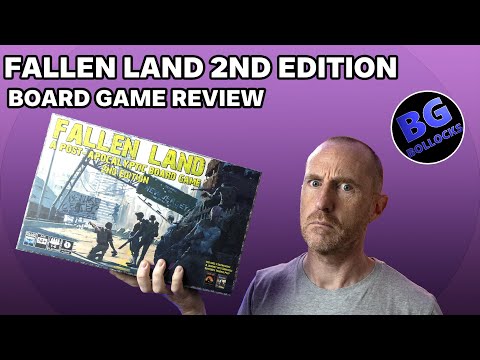





Fallen Land: A Post-Apocalyptic Board Game Deep Dive
What the Community Thinks About Fallen Land
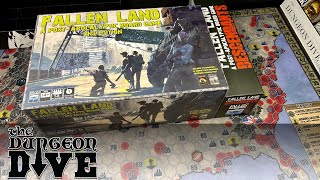
Fallen Land has earned consistent praise from Dungeon Dive Daniel, a prominent board game reviewer who has returned to this game multiple times since its 2017 release. The community response centers on a single conviction: this is one of the finest adventure games ever made. Daniel describes it as belonging to the conversation with classics like Talisman, Runebound, and Sleeping Gods, yet standing apart for its specific thematic grounding in post-apocalyptic survival.
Core Mechanics That Define Fallen Land
Deck Building and Resource Management
At its heart, Fallen Land combines two interlocking systems. Players acquire cards from an enormous shared deck of more than 800 unique cards split across encounter types and loot, cycling through them as the game progresses. What makes this distinctive is the thematic integration: every card reveal advances the story rather than merely checking a box. Surviving a radiation zone doesn't just award points; it tells the tale of how your party navigated that specific wasteland encounter. Fallen Dominion Studios, the publisher, designed resource management as a constant negotiation between survival needs and opportunity costs. Do you spend your salvage coins upgrading your town or equipping your party for an immediate mission? These choices shape every turn.
Party Building and Synergy
Fallen Land invites obsessive character optimization. Each character card lists stats, special abilities, and flavor text that create distinct personalities. Beyond raw numbers, characters link together: a husband-and-wife team gains bonuses when fielded together. Equipment layers on top, a ranged weapon here and armor there, and bonuses compound across the entire party. Finding an experimental laser rifle that synergizes with a character's skill multiplies its value tenfold. This depth keeps loot draws exciting across dozens of plays, as reviewers consistently note the joy of discovering a legendary item that finally completes a party's potential.
The Fallen Land Experience
Thematic Immersion Through Flavor Text
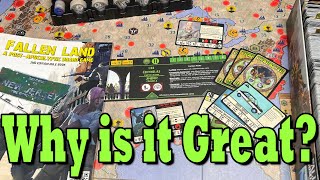
Reviewers repeatedly return to the game's prose as a defining feature. The encounter cards don't merely present mechanics; they narrate vivid scenes. A plains encounter might describe desperately gathering supplies while avoiding cattle rustlers. A city card presents an entire Dawn of the Dead scenario compressed onto cardboard: you're trapped in a mall, constructing a makeshift ballista, firing a grapple line to escape as rad zombies claw below. This storytelling density creates atmosphere without requiring a separate rulebook or app. Players feel transported into the post-apocalyptic wasteland rather than manipulating abstract symbols.
Sandbox Freedom with Structure
Despite its 240-minute playtime, Fallen Land never feels like a slog because agency is constant. Each turn presents genuine choices: venture out on a three-week mission for major rewards, or spend two weeks healing and gathering resources? Pursue prestige through combat, or build town health through infrastructure? Explore the radiated coasts (dangerous, better loot) or stick to plains (safer, faster)? Reviewers praise this balance: the game provides enough structure to guide play (victory conditions, turn phases) but enough sandbox freedom that players author their own adventure arc across a single session.
What Makes Fallen Land Stand Out
Uncompromising Documentation
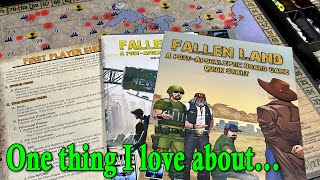
Fallen Land has become a reference point for how board games should teach themselves. The rulebook is 41 pages of meticulous prose, abundant examples, and design philosophy. A quick-start guide distills the essentials. Most crucially, the first-player sheet walks through each game phase in sequence, ensuring the table always knows what comes next. Reviewers note this isn't merely functional; it reflects the designers' respect for players' time and mental overhead. After learning once, players can return months later and reacquaint themselves via the quick guide. This attention signals a labor of love, with the game spending many years in development, and that refinement appears in every detail.
Multiple Play Modes That Actually Work
Many games pay lip service to solo, co-op, and competitive variants; Fallen Land executes all three with equal polish. Solo mode strips out direct conflict cards but preserves all thematic encounters and progression. Cooperative mode keeps the tension but adds collaborative problem-solving. Competitive mode unleashes mercenary groups and sabotage cards that force tactical depth. Reviewers emphasize that unlike games that feel half-baked in alternate modes, Fallen Land's three paths feel intentional and complete. Combined with a full scenario book offering linked campaigns and one-off challenges, the replayability is extraordinary.
Potential Drawbacks
Bookkeeping Overhead
Characters accumulate bonuses from equipment, abilities, and synergies. Towns track health, prestige, resources, and technology upgrades. Each turn involves recalculating stat totals as gear changes hands. Reviewers acknowledge this friction: forgetting a plus-one modifier costs you a success on a skill check, and the game enforces strict no-takebacks memory rules. Most dedicated players solve this by printing a character tracking sheet and maintaining careful records. For players who avoid complex spreadsheet-like upkeep, this overhead may overshadow the thematic rewards.
Extended Play Time and Potential Analysis Paralysis
A 240-minute baseline assumes efficient play; reviewers note that with full player counts (the game supports 2 to 5), adding multiple turns per round, plus reading flavor text aloud, sessions can stretch well past four hours. Solo play is far more manageable, but groups may find themselves making hurried decisions by hour three simply to finish. The sandbox nature, with unlimited possible actions each turn, also invites overthinking. Some players will thrive in this open-ended space; others may long for tighter turn structure or a clock.
If You Enjoy Fallen Land
Fallen Land appeals directly to players who love Talisman (hex crawl adventure, character progression, random encounters), Runebound (modular board, stat tests, loot climbing), Sleeping Gods (nautical exploration with narrative cohesion), Touch of Evil (overland modular map, asymmetric scenarios), and Fortune and Glory (pulp adventure, globe-trotting, risk and reward). Players new to that family but drawn to post-apocalyptic themes will appreciate how Fallout: The Board Game approaches the setting with lighter rules, though reviewers suggest Fallen Land captures the wasteland aesthetic more comprehensively. For those seeking dense, text-rich encounters in a strategic framework, Fallen Land stands alone.
What Reviewers Are Saying
"Fallen Land is the gold standard for board game documentation. If they were to teach a class at Board Game University all about designing documentation for your board game, Fallen Land would be the premier example of how to do it right."
— Dungeon Dive Daniel
"Fallen Land is one of the finest adventure games that I've ever played. It's like top tier, S-tier board game design right here. If you like games like Talisman and Runebound or Sleeping Gods, and you also happen to like the post-apocalyptic theme and setting, there just isn't a better game than Fallen Land."
— Dungeon Dive
"Fallen Land gives me that post-apocalyptic adventure feel better than just about any other game I can imagine. You're building up your home base, recruiting people into your town, building parties of survivors, sending them out into the wasteland to scavenge, looking for vehicles, all while avoiding mutants, bandits, and radiation."
— Dungeon Dive