








The Great Library Deep Dive
What the Community Thinks About The Great Library
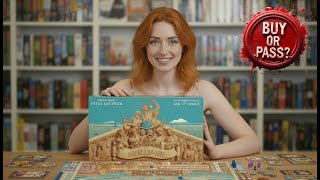
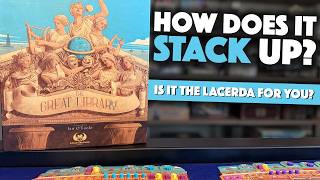
The Great Library is the latest heavy euro from designer Vital Lacerda, illustrated by Ian O'Toole and published by Eagle-Gryphon Games for one to four players. Most coverage so far is anticipation rather than verdicts. Mike DiLisio of The Dice Tower ranks it among the most anticipated games of 2026, largely because Speakeasy, the same team's previous game, was the channel host's number one game of 2025. Jenna of The Board Game Garden calls its theme the most intriguing of any Lacerda game, and one of the Board Gaming Ramblings hosts came away from a look at the game at Spiel with one message: everything is really thematic as always. Among those who have played it, the Brothers Murph found it fun and very combo heavy and called it another Lacerda that is still good. Ryan, who played a prototype for a late-pledge preview, calls it thinky but more forgiving than several of Lacerda's other designs. The sharpest critique comes from Board Game Critique, whose review is based on watching available footage rather than playing. That review praises the time system and the library puzzle but questions the playtime, the Great Works track and how the game scales to four players. All of this coverage predates retail release: Eagle-Gryphon Games sponsored the Heavy Cardboard stream and provided its prototype, the late-pledge preview used a prototype, and the Brothers Murph played it for their own channel during the crowdfunding campaign.
Core Mechanics That Define The Great Library
Time as the Main Currency
Every action in The Great Library costs time. Ryan explains that when a player runs out of time, that player is done for the generation, and the Brothers Murph describe time as the main resource being paid, since each round represents a generation of the library's history. Board Game Critique describes a personal time track that tops out at 20 units and a passing rule it calls clever. Players who pass choose turn order and a bonus for the next generation, but anyone still acting pays two time per action to each player who has already passed. That creates a game of chicken over when to stop. The action chips also drive the game clock. Ryan notes that each action taken moves its chip to the end of a long timeline, and that is how players reach the two events, the burning of the library and its final destruction, that end the game.
Many Routes to the Same Action
Ryan describes seven primary actions, among them the harbor for building ships, the port for sending the fleet out, the school for training scribes and a location for translating documents. Players start with two workers and pre-plan by placing them on two of those actions each round. The game then offers many other ways in: bonus action tokens, buying an action outright, invited scholars who move around the board, and location tiles unlocked from the player board. Ryan compares it to Inventions because a player can back into an action, and the Heavy Cardboard hosts point to the same Inventions inspiration during their stream. The Brothers Murph put it simply: the fun is finding every possible way to take as many actions as possible before having to pass.
The Great Library Experience
Theme Built Into the Systems
Players work as clerics of the Library of Alexandria. They bring scribes into a school, train them, and have them translate documents in subjects such as law, arts and medicine, according to the Brothers Murph. Meanwhile a fleet of ships sails out to collect relics from other civilizations. Ryan points out that the invited scholars who become extra workers are real historical figures whose names are printed on the tiles. At the center sits the library itself. Each generation a new head librarian tile sets the filing rules, such as greens wanting to be next to blues, and Ryan notes that it does not matter whose tiles are already there, so everyone hunts for the best spots in a shared puzzle.
Chaining Actions Into Combos
The game feels like assembling a sequence rather than taking single turns. The Brothers Murph describe it as the kind of recent Lacerda design where players do not get many turns but try to chain as much as possible. Ryan describes realizing mid-turn that a different action is needed first and working out how to reach it. In the Heavy Cardboard stream one host sums up the feeling: there are so many things to do, and the question is how to get to them. Board Game Critique singles out the payoff, a single library placement that meets two head librarian requirements at once and cascades into bonuses.
What Makes The Great Library Stand Out
A Library Puzzle That Changes Every Generation
Board Game Critique calls library placement the heart of the game. Tiles can only go in by fulfilling the king's requests, and the head librarian changes every generation, so a plan that scored last round may not score this round. That review also notes spatial competition, since aggressive players can block valuable positions. It adds that players who focused on navigation and players who stayed in Alexandria translating manuscripts both remained competitive.
A Solo Mode and a Polished Prototype
Board Game Critique describes the solo opponent as a card-flip automa that is streamlined yet applies real pressure through manuscript competition, harbor blocking and library placement, and calls it one of the stronger solo implementations it has seen. On presentation, the Brothers Murph praise the art, and the Heavy Cardboard hosts say the prototype they played was so good it was embarrassing to call it a prototype.
Potential Drawbacks
Length and Downtime
This is a long game. In the late-pledge preview, the first play took four hours, much of it spent looking up rules and icons, and a two-player game is estimated at two or three hours. Board Game Critique calls the campaign's 45 minutes per player wildly optimistic. It reports a four-player session running over four hours, a teach of 40 minutes or more, and experienced players taking five to eight minutes per turn. That review also warns that the game suits experienced euro players and will overwhelm newcomers. Jenna of The Board Game Garden expects it to be very heavy.
Great Works and Four-Player Scaling
Board Game Critique's biggest complaint is the Great Works system. Collecting translation stones by ship and then paying them in at the academy costs a great deal of time, and in most games it watched the library filled within three generations, too soon for that investment to pay off. It also found four players compresses the game so much that the librarian adjacencies become bonuses players fall into rather than plan for, while two or three players leave more room. The Heavy Cardboard hosts found the two-player game much snappier and were caught out by how quickly the end can arrive.
If You Enjoy The Great Library
Ryan says The Great Library feels closer to The Gallerist, one of Lacerda's lighter games, than to On Mars or Anachrony, so fans of The Gallerist are a natural fit. Both Ryan and the Heavy Cardboard hosts compare its way of backing into actions to Inventions. The Dice Tower and the Brothers Murph both frame it as the follow-up to Speakeasy from the same design, art and publishing team. Board Game Critique suggests Kanban EV for similar time-crunched action efficiency in a more streamlined form and Lisboa for comparable spatial optimization.
What Reviewers Are Saying
"First off, that time management system creates such good tension. Every turn, you're making these agonizing trade-offs about whether to spend time now or save it for later."
— Board Game Critique
"So, really what the game does is it gives you like seven of these primary actions you can take but then all these different ways to take them. So, it feels a little bit like Inventions in that you can back your way into an action."
— Watch Review
"Yes, it feels the there are so many things that you feel like you want and need to do and it's just a matter of how do I go about doing it, right?"
— Heavy Cardboard