






Children of the Colossi Deep Dive
What the Community Thinks About Children of the Colossi
Children of the Colossi arrives with a genuinely compelling pitch: tribes competing to harvest eggs from and tame giant titans moving dynamically across the board. The visual identity is striking, and the core mechanical idea of movable action platforms is novel. Reviewers across multiple channels acknowledge what Cosmodrome Games attempted here. What they consistently report, however, is disappointment. Not because the game is fundamentally broken, but because significant execution issues prevent the elegant idea from reaching the table cleanly. The consensus sits somewhere between "decent foundation" and "missed opportunity," with universal recognition that barrier-to-entry problems overshadow what could have been a standout area-control title.
Core Mechanics That Define Children of the Colossi
Dual-Layer Worker Placement and Area Control
Children of the Colossi establishes an interesting tension between two spaces: your workers can either contest area control on the central board or climb aboard individual Colossi to access exclusive action boards. This split creates genuine strategic choices, as committing units to one pursuit means reducing presence in the other. Reviewers describe this as the game's strongest mechanical foundation. The interplay between managing units on the ground versus on the moving giants gives players something tactically meaty to consider. Each of the five available Colossi brings its own action board with unique options, and players select three for any given game, building asymmetry into setup. This variety means different games can feel distinctly different, which multiple reviewers flagged as valuable.
Battle Resolution Through Card Play
Rather than pure numerical strength determining area outcomes, combats are mediated through battle cards that players play to shift advantages. Luke Hector of The Broken Meeple specifically praised this layer as introducing "sneaky tactics and ambush-like strategies," noting that even losing battles reward participation with some resources. The battle card system avoids the harshness of winner-takes-all area control, allowing second-place finishers to still accumulate eggs. Reviewers saw this as preventing runaway leaders and distributing tension across the table, though the mechanic remains somewhat shadowed by the presentation problems that plague the game as a whole.
The Children of the Colossi Experience
Thematic Disconnect
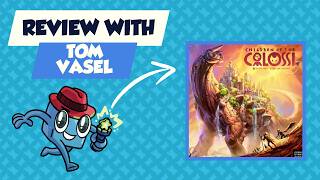
Reviewers consistently note a gap between the game's rich post-apocalyptic premise and the abstract mechanics players actually execute. Tom Vasel, reviewing for the Dice Tower, captured this most pointedly: the theme conjures images of tribes clinging to the backs of massive moving creatures, workers scrambling across living landscapes, a sense of danger and dynamism. The actual play, however, feels distant from that fantasy. Workers climb on and off Colossi through action resolution rather than emerging narrative. The egg-collection puzzle dominates; the grand dinosaurs fade into mechanical necessity. Reviewers wanted the gameplay to feel like the cover art promised, and it does not.
Cognitive and Logistical Friction
Iconography issues compound the disconnect. Symbols across the Colossi boards do not read intuitively. Reference cards exist but are often positioned far from affected players, requiring consultation of a rulebook or passed materials. The cognitive load of remembering what each icon does, what each action space triggers, and how the moving Colossi affect positioning builds friction into every teach and every early play. Multiple reviewers reported needing to reference the rulebook repeatedly even after initial instruction, suggesting the design failed to reduce unnecessary friction around core operations.
What Makes Children of the Colossi Stand Out
Modular, Moving Action Platforms
The concept of Colossi as physical boards that move around the central map is genuinely innovative for area-control games. Rather than fixed action spaces on a static board, here the players must account for Colossi shifting positions turn by turn. Luke Hector called this "something a little bit different" that the industry "doesn't see a lot" in area-control design. This creates a planning problem: if the Colossus you want to use for its unique actions is positioned on the opposite side of the map, you face a choice between waiting for it to drift back or using alternate actions. It is the kind of asymmetrical board state that rewards long-term thinking, and reviewers recognized its originality even as other complaints mounted.
High Replayability Through Colossus Selection
Drafting three of five Colossi for each game creates substantial setup variance. Each board brings different action efficiency, movement types, and special rules tied to its available eggs. Removing one Colossus fundamentally shifts available strategies. Luke Hector noted that "the combination of three that you use does have a fairly dramatic effect on the game," and emphasized that this variety "does have an essence of originality." For players willing to push through the friction, different Colossus combinations reward repeated plays with genuinely different tactical landscapes.
Potential Drawbacks
Oversized Board and Table Space Demands
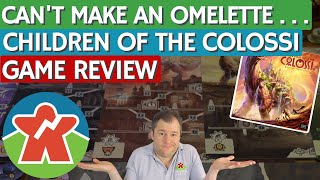
The most consistent and emphatic criticism across all reviewers concerns physical footprint. Luke Hector expressed disbelief at the central board size, noting it "warrants more table space than something like a Lerner game, Galactic Cruise." Tom Vasel conducted an on-camera measurement and observed that even on a full-size gaming table with a generous footprint, components "barely fit" with all five Colossi boards laid out. The main board itself comprises only eight location spaces for egg placement, yet commands enormous real estate. Reviewers questioned why so much table acreage was necessary when the actual play area could have been condensed. This is not mere convenience complaint; it directly limits access. Casual game groups without dedicated gaming tables simply cannot play this game. Several reviewers flagged this as a hard blocker for their households.
Iconography and Rulebook Clarity
The symbols are not intuitive, and the rulebook compounds rather than resolves ambiguities. Luke Hector spent significant time describing the mismatch between visual clarity and mental parsing: even after multiple plays, some symbols remain difficult to recall without consulting reference materials. The rule book contains walls of text and pictorial examples without always resolving edge cases. Tom Vasel and others reported FAQ moments arising during play, suggesting incomplete testing or insufficient documentation. Alex Rackle from Board GameCo highlighted this as a primary factor dragging down the experience, noting that iconography problems "get in the way of feeling like a smooth, streamlined experience." This is especially costly for a game with a 60-minute stated playtime but often requires 90 minutes to two-plus hours due to rule clarifications and reference lookups.
If You Enjoy Children of the Colossi
Players drawn to Children of the Colossi's core concept will likely find similar satisfaction in Blood Rage and Dune, both of which offer asymmetrical area control with distinctive faction abilities and interactive resolution mechanics. Blood Rage similarly rewards long-term positioning and clever battle card selection; Dune delivers the high-stakes negotiation and shifting board control that appeals to those who enjoy the dual-layer positioning puzzle Children of the Colossi attempts. If the Colossus concept specifically appeals to you (modular, moving elements on a contested map), Cosmic Encounter-family games that shift board state turn by turn may also resonate.
What Reviewers Are Saying
"This thing is huge. I mean, this is a game that warrants more table space than something like a Lerner game, Galactic Cruise, and any of those other ones this year. Look how big this board is. I can't even fit it in the entire camera frame. There is no reason for the board to be this huge."
— Luke Hector, The Broken Meeple
"The gameplay itself doesn't ever really feel like that. This was a huge disappointment for me. One, because it was so big and grand and it didn't even need to be this big. The theme doesn't particularly come through. I don't feel like the game itself is that much fun. It's just okay at best."
— Tom Vasel, The Dice Tower
"I wanted to like this one and I don't think it's bad, but I think there are too many things that get in the way of the enjoyment. The rule book is not great. The iconography is not great. The table space, it is a bit of a table hog."
— Alex Rackle, Board Game Co.