












Borealis: Arctic Expeditions Deep Dive
What the Community Thinks About Borealis: Arctic Expeditions
Borealis: Arctic Expeditions has earned consistent praise from reviewers as a gateway game that balances accessibility with surprising strategic depth. Channels like Allies or Enemies and BoardGameCo highlight its charming Arctic theme, adorable scientist pawns in colorful parkas, and beautifully illustrated animal cards as immediate draws. Yet beneath the cute presentation lies a genuinely crunchy optimization puzzle that rewards careful planning. The consensus is clear: this is a lightweight game from Lucky Duck Games that plays fast and teaches quickly, but offers substantial decision space for players willing to engage with its layered scoring systems.
Core Mechanics That Define Borealis: Arctic Expeditions
Card Play and Scientist Movement
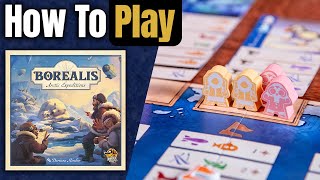
The core turn action revolves around playing animal cards to your personal board's locations, each with requirements tied to which scientists occupy that space. When you play a card showing scientists, those scientists move in the directions indicated by the card's arrows. Scientists can move to base camps at the edges of your board, but once in a camp, they remain frozen and cannot be moved again by future card plays. This tension between needing scientists present to play cards and having them scatter across your locations creates the game's primary puzzle. As reviewers noted, it's easy to plan several turns ahead only to realize your scientists ended up in the base camps, cutting off your best plays.
Multi-Path Scoring System
Victory requires balancing several distinct scoring vectors simultaneously. First, you score for how far your tokens progress along expedition tracks, with bonus multipliers based on vehicle icons on the cards you play. Second, you collect sets of animals within each location, earning exponentially more points for larger sets of the same species. Third, rotating scoring cards add unique conditions each game; one might reward having multiple cards of your most common vehicle type, another rewards clustering scientists together, fundamentally shifting your strategy. Finally, objective cards offer racing opportunities where only the first player to fulfill a condition claims the points before that objective expires. This layering means a successful strategy in one game might be entirely wrong in the next, keeping the experience fresh despite the straightforward base rules.
The Borealis: Arctic Expeditions Experience
Quick to Teach, Surprising Depth
Borealis exemplifies the modern gateway game design philosophy. A new player can understand the core loop in a few minutes: play a card, move scientists, advance your token if the vehicle icon matches, draw a card. Yet reviewers consistently reported that actual playtime felt brisk, often shorter than the box estimate at two players. This brevity makes Borealis an ideal palate cleanser in a game night without sacrificing meaningful decisions. The artwork, featuring adorable Arctic animals and scientists in charming parkas, immediately invites players in, especially those drawn to games like Azul or Splendor for their aesthetic appeal combined with accessible rules.
Satisfying Optimization With Multiple Winning Paths
Reviewers noted that Borealis rewards different playstyles within a single game. One player might prioritize completing objectives and advancing tracks, accumulating steady points, while another ignores the race entirely to focus on building massive animal set collections in specific locations. Both strategies have proven viable, with reviewers reporting wins achieved through entirely different approaches. This flexibility stems from the scoring card variability; with many scoring card options and objectives to draw from each game, the optimal priority shifts. A player can accept that not every goal will be achieved and still emerge victorious by executing their chosen strategy cleanly. This permission to specialize rather than optimize everything simultaneously keeps the game feeling fresh rather than oppressive.
What Makes Borealis: Arctic Expeditions Stand Out
Thematic Elegance and Component Quality
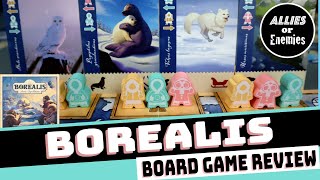
The Arctic expedition theme permeates both art and mechanics in ways that feel natural rather than bolted-on. Scientists moving progressively deeper into uncharted territory, stopping at camps to study and photograph animals, directly maps to the mechanical flow. Reviewers were unanimous in praising the quality and character of the chunky scientist pawns, each colored differently and with unique details. The double-sided player boards offer players agency in setup. The card artwork is rich and evocative; players genuinely want to collect certain animals not just for points but because the cards are beautiful. This aesthetic investment transforms a light puzzle game into something memorable.
Variable Goals Create Branching Strategies
The rotating objective and scoring card system distinguishes Borealis from similar lightweight games. Each game uses a different combination of objectives and scoring cards, generating dozens of possible setups. Reviewers noted this variability prevents the game from becoming stale. The objective race mechanic, where completing a card's requirement can lock out other players unless they finish in the same round, adds a tension absent from pure multiplayer solitaire. Unlike games where everyone plays in isolation, Borealis forces some awareness of what opponents are accomplishing. The scoring card variations are particularly impactful: whether you are rewarded for vehicle diversity, animal clustering, or scientist concentration fundamentally shifts which cards matter and which locations deserve focus.
Potential Drawbacks
Risk of Analysis Paralysis and Limited Direct Interaction
Reviewers identified analysis paralysis as a real concern, particularly for new players or those prone to overthinking. With multiple card draws available each turn, potential scientist placements to consider, and future-turn sequencing to optimize, some players can spend long turns calculating the perfect play. Worse, this problem is table-wide; if one player bogs down, everyone slows. Additionally, direct player interaction is minimal. You cannot disrupt opponents' plans beyond taking cards from the shared display before they do and racing for objectives. There are no blocking mechanics or catch-up tools. Some players drawn to confrontational games will find this lack of player-versus-player tension unsatisfying, though reviewers who prefer competitive but non-destructive gameplay appreciated this restraint.
End-Game Rushing and Limited Board Asymmetry
A motivated player can race to fill a location quickly, triggering game end before others fully develop their strategies. If that player has claimed a few objectives along the way, this rushing strategy can be mathematically sound, despite feeling antithetical to the careful optimization the rest of the game rewards. Reviewers noted this is technically viable but aesthetically unsatisfying. Additionally, while the board offers two sides with slightly different scientist requirements, the difference feels minimal and does not meaningfully alter play. One reviewer wished for greater asymmetry to ensure long-term replayability beyond the goal cards alone.
If You Enjoy Borealis: Arctic Expeditions
Borealis shares DNA with several acclaimed gateways. Fans of Azul will recognize the tight, elegant ruleset and the focus on set collection with clean flow. Those who loved Splendor's engine-building through card acquisition and tableau management will find similar satisfaction in balancing card play, scientist positioning, and scoring paths. Cascadia offers another apt comparison: a lightweight, art-forward game that hides surprising depth in spatial puzzle-solving and multi-layered scoring. If you enjoyed any of these and want something that plays fast and offers more variability in win conditions through goal cards, Borealis is a natural next step.
What Reviewers Are Saying
"This is a quick light jaunt in the snow, but you still have some choices to make on this expedition. The heart of the puzzle is planning, and the trickiest part is where those scientists are, since you need them present to place a card, but you also need to move them when you place that card."
— Allies or Enemies
"This game is surprisingly crunchy as far as weighing up the opportunity cost of everything you do, because everything is fun. This is the kind of game you can get people up and running in five minutes, which gives you a satisfying game with a short teach and lets you enjoy a lot of the fun of the card art and playing them into your tableau."
— BoardGameCo
"Borealis Arctic Expeditions is very much a gateway game. It can be explained in a couple of minutes. The theme isn't really integral to the gameplay, but it is super adorable, and the art and presentation are really inviting."
— Allies or Enemies