






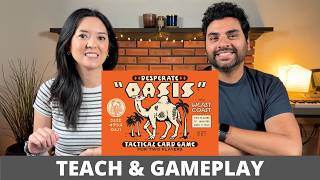


Desperate Oasis Deep Dive
What the Community Thinks About Desperate Oasis
Desperate Oasis occupies a fascinating place in the board gaming landscape: a small box game that punches above its weight with mechanical depth and aesthetic distinction. The community recognizes it as a gem from an indie publisher, a two-player lane battler that combines strategic card play with a visual identity unlike anything else in its category. Reviewers consistently praise the game for delivering serious tactical gameplay in a package small enough to carry anywhere, challenging the notion that complexity requires bulk.
The consensus centers on tension and engagement. Players note that while Desperate Oasis sits alongside other lane-battling classics in concept, it distinguishes itself through its commitment to both visual storytelling and clever card mechanics. The game attracts a particular type of enthusiast: those who appreciate tight two-player head-to-head games where every card placement carries weight, and who value the quality of production and theme as much as the mechanics themselves.
Core Mechanics That Define Desperate Oasis
Lane-Based Card Play with Asymmetric Powers
At its heart, Desperate Oasis functions as a lane battle game where players compete for control of oases by playing cards with strength values and animal types. Each animal, camels, scorpions, and others, carries unique special abilities that activate only when enough cards of that type accumulate in a single lane. This creates a layered decision space: players must consider not only card strength but how their placements attract corresponding animals from adjacent lanes, potentially triggering cascading effects that neither player anticipated.
The face-down card mechanic adds deception and bluffing to the mix. Players can play cards face-down in limited quantities per round, knowing that their opponent cannot predict the strength or ability that will emerge at the revelation phase. This creates moments of genuine tension where a seemingly winning lane flips on its head when a hidden animal power activates, making the game as much about reading opponents as it is about optimal card placement.
Limited Hand Size and Forward Planning
With a small deck and limited hand size, Desperate Oasis forces careful resource management. Players cannot afford to waste cards on lanes they cannot win, yet must commit enough presence to control the oases that matter. The scoring system, where only the leading cards in each lane matter at round's end, means that sometimes strategic retreat outweighs aggressive commitment. This interplay between tempo, board position, and future setup is what grants Desperate Oasis its reputation as one of the most strategically satisfying pocket games available.
The Desperate Oasis Experience
Desert Tension and High Stakes
Playing Desperate Oasis invokes a sense of pushing one's luck in a harsh environment. The theme of competing for scarce oases grounds the abstract card play in narrative weight: both players are struggling to maintain lifelines in an unforgiving landscape. Each card played represents a calculated bet that the oasis being fought for is worth the resources spent. When an opponent reveals a face-down card that shifts the entire lane, it stings in a way that feels thematic; survival is uncertain, and assumptions lead to ruin.
Visual Seduction and Portability
Beyond mechanics, Desperate Oasis impresses through its aesthetic presence. The art direction evokes a 1950s New Yorker sensibility applied to desert imagery, creating a timeless visual language that feels both playful and sophisticated. The color palette, dominated by warm, distinctive hues, creates immediate visual interest on the table. This combination of strategic engagement and gorgeous presentation means Desperate Oasis works equally well in a casual game cafe or pulled from a backpack during a lunch break.
What Makes Desperate Oasis Stand Out
Strategic Depth Delivered at Pocket Size
Many games claim to pack complexity into small boxes; Desperate Oasis actually delivers on this promise. The animal power system creates asymmetric gameplay effects that must be learned and respected. A player's strategy shifts when facing a lane where camel abilities activate, versus one where scorpion migrations reshape card groupings. This variability, combined with the unknown deck composition, ensures that no two games play identically, yet the rules remain teachable in minutes.
Deviousness Through Asymmetric Placement
What sets Desperate Oasis apart from straightforward lane battles is the option to play cards on an opponent's side of certain oases. This mechanic embodies the game's thematic core: players can sabotage as well as support. Playing an animal card that attracts more of the same type to the opponent's lane can backfire spectacularly, creating moments of beautiful reversals where a player's own trap springs shut on themselves. It is this mixture of agency and risk that transforms Desperate Oasis from a solid game into one worth hunting down.
Potential Drawbacks
Limited Player Count and Niche Appeal
As a strictly two-player game, Desperate Oasis immediately eliminates tables seeking broader social experiences. For some players, the abstraction of theme, while beautifully rendered, still feels light compared to games with deeper narrative integration. The lane-battle genre itself appeals to a specific audience; those who find area-control games unengaging may not find Desperate Oasis compelling despite its mechanical refinements.
Randomness in Card Draw and Setup Variability
While the game rewards tactical play, luck in card draw can occasionally overshadow skillful planning. A player dealt a poor hand may struggle to mount a meaningful challenge, especially in early rounds where card economy is tight. Additionally, since players remove cards before play, the specific mix of abilities in each game changes the strategic landscape. Some players prefer games where the ruleset remains absolutely consistent from play to play.
If You Enjoy Desperate Oasis
Players drawn to Desperate Oasis typically cherish other lane-battling games like Battle Line, which shares a similar architectural focus on control and bluffing. Those who love the aesthetic sophistication may also appreciate games with equally evocative art paired with lighter mechanics. Those seeking more portability might explore Love Letter or Scout, though neither matches Desperate Oasis's strategic weight.
What Reviewers Are Saying
"Desperate Oasis manages to set itself apart by just having such a fantastic aesthetic that feels foreign in the world of board games and not just in the small box format, but the trikonee color and kind of the 50s New Yorker cartoon aesthetic really go to service just giving this a sort of timeless feel while at the same time just being a really good one of those games in a particularly small box accompanied by a couple really nice wooden tokens."
— Cardboard Harold
"Desperate Oasis has layers to its strategy here. It is a lane battle game. You are fighting over various lanes. You are fighting against your opponent for control over various different lanes. And you are doing it by playing cards both face down and face up. And those cards have strength values and other things on them. If you get three camels into this lane, then this cool special ability activates here. You can really be sort of planning ahead where you're like, I'm going to put two camels here and a camel here and then later I'm going to put one right here, bring them both together, then I get the special ability."
— Grant's Game Rex
"Desperate Oasis. I thought that was good. It's a small quirky lane battling game from a little indie publisher that also looks so striking. I'm so happy I hunted down a copy of my own. It's so striking and lovely to look at. It's a little small box and it's meant to be really engaging and fun two-player lane battler and meant to be a bit devious, you know, because you can play the card on your opponent's side, which really got me super excited to play it."
— Shut Up & Sit Down