






Mimir's Challenge Deep Dive
What the Community Thinks About Mimir's Challenge
Mimir's Challenge strikes reviewers as a refreshingly different area control game that executes a simple premise with sharp mechanical design. The Dice Tower's Tom Vasel awarded the game a solid 7 out of 10, praising it as a clever "very simple game where you're just trying to outthink everybody else," while noting that it "feels a little bit different than other things that are out there right now." The game has generated genuine enthusiasm from those who have actually played it, particularly for how its hidden-information layer and bluffing mechanics elevate the experience beyond typical area majority games. The consensus centers on three strengths: fast play, accessible rules, and memorable moments of interaction. Where reviewers diverge slightly is on production choices (the hexagonal box splits opinion), but the underlying game design itself appears sound and engaging across multiple player counts.
Core Mechanics That Define Mimir's Challenge
Area Control
At its heart, Mimir's Challenge is an area control game where players compete for majority in nine Norse-themed realms across a modular hexagonal board. Rather than direct combat between players, victory flows to whoever commands the most Viking tokens in each region at the end of a placement and revelation phase. The game distills the area control formula into three quick rounds: players place tokens across realms face-down to hide their deployments, then reveal everything simultaneously to resolve majorities and claim treasure artifacts. Mistzone Games designed this system to be teachable within minutes yet tactically meaningful, creating natural kingmaking moments through the game's elegant tie-breaking rule where tied players receive nothing while a third player benefits. This streamlined approach keeps play snappy (45 minutes for four players) while maintaining enough strategic tension that player count affects game feel markedly, with four players creating more chaos and unpredictability than smaller counts.
Hidden Deployment
The game's signature mechanic is deploying your army tokens face-down before revelation, creating a powerful layer of bluffing and deduction. Players cannot see where opponents have committed their forces, leading to genuine uncertainty about strength distribution across the board. When tokens flip face-up simultaneously, surprise and deduction become central to the experience. This hidden deployment system works because it interacts directly with the three special ability tokens (Raven, Valkyrie, and Worm) that each player controls. Reviewers highlighted how this mechanic forces constant calculation: you must guess where opponents positioned their elite tokens and exploit that uncertainty through clever action sequencing. The Dice Tower's coverage emphasized that "knowing" where the double-axe token is hidden creates a tense game of psychological warfare, where one player might bluff strength in a region just to draw out a powerful ability from an opponent, sacrificing that region to gain an advantage elsewhere.
The Mimir's Challenge Experience
Gleeful Meanness
Mimir's Challenge captures a particular flavor of player interaction: the pleasurable cruelty of thwarting opponents with perfectly-timed special abilities. The Valkyrie can poach your own troops from nearby realms into a contested zone at the last moment, the Raven swoops in to steal a treasure token from under your nose, and the Worm actively frightens away enemy soldiers. Tom Vasel crystallized the feeling as "a lot of meanness to this," delivered with a tone of genuine appreciation rather than complaint. Reviewers note that these abilities feel fair because using them removes your elite token from the board entirely, converting it from a scoring asset into a one-time trick. This creates a satisfying push-pull: do you execute your nasty ability now to deny an opponent something, or do you save it for a more critical moment? The game thrives on this tension, where every ability activation is a small drama of disruption and counterplay, generating memorable table moments even in a 40-minute game.
Rapid-Fire Decision-Making Under Uncertainty
Because tokens are hidden and the simultaneous-reveal system resolves each region instantly, Mimir's Challenge puts players in a constant state of incomplete information. You must decide placement strategy without knowing what your opponents have committed, then react in real-time when the board flips. This creates palpable tension during the reveal phase and the subsequent ability-activation window. Reviewers highlighted the game's elegant handling of this: ties are resolved by a rule that cancels both tied players' claims while benefiting the third player, injecting genuine chaos into the final round where victory points lock. The result is a game that feels alive and unpredictable, where careful plans evaporate and unexpected third-place players seize opportunities. Playtime never bogs down despite this complexity because the ruleset is so clean; players grasp the fundamentals immediately and spend their cognitive energy on tactics rather than parsing rules.
What Makes Mimir's Challenge Stand Out
A Hexagonal Board That Actually Matters
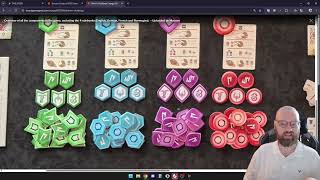
Mimir's Challenge distinguishes itself through exceptional board design. The game features a modular hexagonal grid assembled from individual leaf-shaped tiles representing nine Norse realms. These tiles are not purely functional; reviewers repeatedly marveled at the production quality. The Unknown Channel playthrough showcased how the tiles feature gorgeous artwork with relief details, atmospheric imagery of icebergs, lava, sword monuments, tree houses, and ice castles. The game even includes a color-blind-friendly version printed on the reverse side. This investment in board aesthetics elevates the experience from abstract puzzle into thematic immersion. More importantly, the modular system ensures variability across games, making each setup feel fresh. The Board Gaymes James review called them "really cool, especially cut out cardboard leafs" that made the whole game visually distinct. While the hexagonal box itself generated criticism from Tom Vasel, the board inside overcomes packaging concerns through sheer quality.
Elegant Mechanical Integration of Special Abilities
Rather than bolting unique powers onto players as a separate system, Mimir's Challenge bakes special abilities into the core area control loop. Three special token types (Raven, Valkyrie, Worm) are placed alongside regular troops during the hidden deployment phase, but they function radically differently: using a special ability immediately removes that token from the board, leaving you with fewer soldiers for scoring. This design creates a critical decision point: you gain a powerful option but lose combat strength in the process. Tom Vasel explicitly praised this integration, noting that "when you utilize them, they come off and you do not have you have one less soldier on the board." The system avoids the complexity of traditional asymmetric player powers while delivering meaningful differentiation. Every player has access to the same three abilities (though each is unique per player), putting everyone on equal footing mechanically while leaving room for clever sequencing and reading opponents.
Potential Drawbacks
Impractical Box Design
The hexagonal box is a production choice that has not aged well in community perception. Tom Vasel delivered the bluntest assessment: "Yes, the box is a hexagon and yes, that's stupid." The critique centered on practical shelf storage (hard to arrange on shelves next to other games) and opening difficulty. The Unknown Channel review and Board Gaymes James both preemptively addressed the concern by confirming the box does fit on a standard Kallax bookshelf, suggesting the design team anticipated this complaint. However, the fact that multiple reviewers felt compelled to confirm basic shelf compatibility underscores that the hexagonal form factor creates friction at the retail and home-collection levels. The box design sacrifices pragmatism for brand differentiation, a choice some players will embrace and others will resent.
Missing Player Reference Materials
Tom Vasel identified a gap in the rules presentation: the three special abilities (Raven, Valkyrie, Worm) are explained in the rulebook, but the game lacks a quick-reference card for each player showing ability descriptions at a glance. Tom Vasel observed that "you will get them mixed up" during play, particularly early games. While the abilities are simple (flying to a zone, calling troops from adjacent realms, scaring away enemies), players in the heat of gameplay benefit from having the text visible without consulting the rulebook. This is a minor but meaningful miss in player experience design. The game includes player shields (screens that hide artifact cards and troop placement), and these could easily incorporate ability reminders on the front. The fix is straightforward, but its absence in the base package represents a small usability friction that affects new players most acutely.
If You Enjoy Mimir's Challenge
Players drawn to Mimir's Challenge's blend of hidden information and rapid area control will find similar satisfaction in Emerald City, which was mentioned naturally in community discussions as a spiritual cousin. Both games deliver tight area majority gameplay with a bluffing layer that rewards reading opponents and managing incomplete information. For those captivated by the special abilities system, Mimir's Challenge's reliance on asymmetric token effects pairs well with other games emphasizing player powers as core mechanics rather than add-ons. The game's accessibility and quick playtime also recommend it to those who love lightweight Euros (like games by Reiner Knizia or Stefan Feld) where simple rules mask tactical depth. Reviewers who appreciated the chaotic tie-breaking mechanic and the "meanness" of the special abilities will gravitate toward games with strong player interaction and table talk, steering away from pure optimization puzzles toward games where reading your opponents is as important as calculating probabilities.
What Reviewers Are Saying
"It's a very simple game where you're just trying to outthink everybody else. I also like, and this is the age-old nonsense of to a tie making the tied people lose and someone else wins, super fun. And because of it, I think the game is best at four because there's more of these ties and more things a little bit of that chaotic energy going on."
— The Dice Tower
"I think it's cool. The cover's a little misleading cuz it shows this guy jumping at this giant tree and stuff. That's not going to happen. But it's a very simple game where you're just trying to outthink everybody else."
— The Dice Tower
"It's this really cool, especially cut out cardboard leafs that you're going on for your board. And there are multiple different versions of the board as well, there is a color-blind friendly board on the back."
— Board Gaymes James