






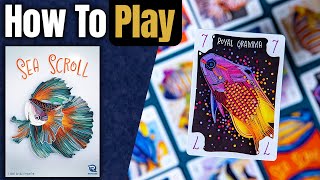


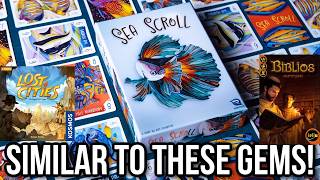


Sea Scroll Deep Dive
What the Community Thinks About Sea Scroll
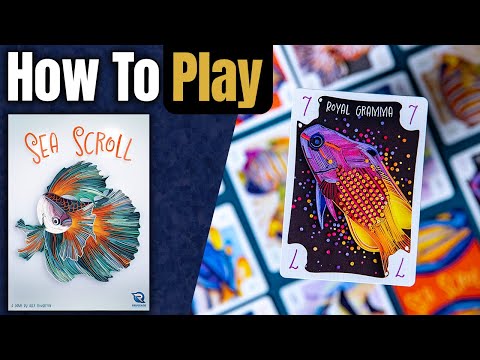
Sea Scroll has captured the affection of board game reviewers with a deceptively simple card game that delivers surprising depth. Published by Renegade Game Studios, it emerges as a clever drafting experience that rewards careful hand management and strategic bluffing. Game Boy Geek compared its tension to beloved classics, and Creary fell in love with it over repeated plays through the month. What starts as a light, quick game about collecting schools of fish becomes an unexpectedly tense exercise in predicting opponent behavior and managing incomplete information.
Core Mechanics That Define Sea Scroll
Drawing, Holding, and Selective Collecting
Each turn follows a straightforward sequence: draw two cards from the ocean deck, optionally claim one school of fish from the reef, then discard one card face-up into the reef. This loop creates constant tension because players face a core dilemma every single turn. You must discard something, but whatever you discard becomes public information and available for other players to claim as part of a school. Reviewers emphasize that the decision of what to discard is agonizing. The reef serves as both temporary storage and a strategic signal. A player can discard a card they believe others will not claim, or intentionally feed the reef to mislead opponents about their hand.
Majority Scoring with Teeth
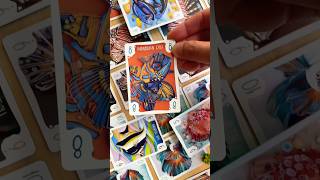
The scoring system transforms majority control into a high-stakes gamble. Each fish type exists in quantities matching its point value, so a seven-value fish has seven copies, and the player with the most of that type at game end gains those points. But here is where Sea Scroll becomes swingy: any player who holds at least one card of that type without controlling the majority loses points equal to the fish's value. Collecting requires confidence. If you pursue a fish and fall short, the penalty stings as much as the reward you missed. Because cards are removed from the deck before play, you never know with certainty whether the majority is still achievable, and a single card can swing the entire game.
The Sea Scroll Experience
Tension Through Hidden Information and Bluffing
Sea Scroll excels at creating table atmosphere despite minimal rules overhead. Players must pay constant attention to what opponents discard, which schools they take, and what that behavior reveals about their hands. The game becomes a series of mind games. You might discard a card to suggest you hold more of that type, or bait an opponent into collecting a school from the reef knowing you already control the majority elsewhere. The imperfect information means you constantly theorize about opponents' hands based on what they discard or collect, transforming the game into a psychological puzzle where reading the table matters as much as the cards you draw.
Quick Gameplay That Rewards Strategic Delays
Despite a brief playtime, Sea Scroll offers meaningful decisions about timing. You can collect a school early to signal commitment and discourage others, or wait and collect later when opponents appear less interested. Delaying sometimes proves wise, letting you watch which fish types opponents accumulate before committing. On the final turn, after the ocean deck empties, players take one last action where they can still discard but cannot draw, adding a final moment of tension. The game ends quickly, which reviewers appreciate, but the speed does not undermine the strategic weight, and Creary describe returning to it again and again because each game presents fresh puzzles.
What Makes Sea Scroll Stand Out
Elegant Design That Echoes Earlier Classics
Game Boy Geek identify Sea Scroll as spiritually close to two beloved games: Lost Cities, with its tension about not wanting to discard, and Biblios, with its fight for type majorities. Sea Scroll synthesizes these into something faster and more scalable than either predecessor, adding the swingy penalty system that heightens stakes. The reef as a communal discard area creates a marketplace of information that players constantly read. Creary connect it to Arboretum, another acclaimed card-management game, praising how the two-card draw and one-card discard create an ever-growing hand that players must carefully manage while deciding which schools to activate.
Variant Cards That Transform Strategy
Sea Scroll includes a generous set of variant cards that players can optionally mix in, each changing a rule meaningfully. One variant requires discarding an additional card when claiming a school, preventing hand growth and opening new options for others. Another lets players ask opponents whether they hold a specific fish. Game Boy Geek emphasize the variants' power: they completely change how the game plays while remaining optional, letting groups choose their preferred complexity. So much built-in variety ensures replayability without requiring new purchases, a design choice reviewers celebrate as player-friendly.
Potential Drawbacks
Swingy Scoring That Cuts Both Ways
Game Boy Geek identify the swingy scoring as the genuine weakness. Collecting several cards of a type might seem to secure majority, but if an opponent quietly collected more, you lose those points instead of gaining them. One card can separate victory from defeat. Players seeking games where skill dominates randomness may find this frustrating. Reviewers note, however, that the short playtime mitigates the concern: an unlucky game can be reshuffled and replayed immediately with a different variant, which keeps the swinginess from souring the experience.
Incomplete Information Demands Constant Vigilance
The removal of cards from the deck before play creates uncertainty that some players may find anxiety-inducing rather than engaging. Because those cards are never seen, you cannot know whether the majority you are pursuing is mathematically possible. You might hold four of a nine-card type with no idea whether the fifth sits in someone's hand or was removed unseen. This creates decision tension that, at higher player counts where hand information is harder to track, can edge toward paralysis. Reviewers embrace this as intentional, but players who prefer predictable game states should prepare for the uncertainty.
If You Enjoy Sea Scroll
Reviewers consistently recommend Sea Scroll to fans of Lost Cities, citing the shared tension of managing what you discard and committing to a path. Players who love Biblios will recognize the fight for type majorities and the satisfaction of denying opponents points. Creary's comparison to Arboretum suggests that anyone drawn to elegant card management with hidden hands and majority-based scoring should experience Sea Scroll. Its scalability and quick playtime make it accessible to both couples wanting a fast duel and larger groups wanting tight, interactive card play.
What Reviewers Are Saying
"It feels like a little bit of a multiplayer Lost Cities, if you will, which feels great. It also feels like a popular game called Biblios, where you're building up certain numbers of types and you're fighting with other players. Now, this game is more swingy than Biblios, because in Biblios you either win it or you don't. In this, if you don't, you get minus the amount of points."
— Game Boy Geek
"You're really trying to strategically collect your sets of fish. If there's a value seven fish, there are seven copies of that card, and you want to have more than anybody else to score them as positive points. And in fact, if you have some but not the majority, you're actually going to lose that many points."
— Nick
"We've played this game so many times this month and I have fallen in love. It is so clever because you're also taking cards out in the beginning, so you never quite know if you have the majority. You could have four of the nine cards, but does someone have five?"
— Creary