




Little Soldiers Deep Dive
What the Community Thinks About Little Soldiers
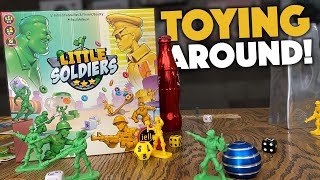
Little Soldiers has sparked genuine enthusiasm among board game reviewers, particularly for families and casual gamers. The game's premise captures something rarely seen in modern design: permission to engage with toy soldiers using household objects as terrain while following clear, strategic rules. Reviewers appreciated its ambitious concept of transforming ordinary household items into tactically meaningful obstacles, combined with its accessibility for players new to tactical games. Across the review community, the consensus emphasizes the game's core appeal to families seeking an entry point into war games without the overhead of specialized components or lengthy rulebooks.
Core Mechanics That Define Little Soldiers
Line of Sight
Little Soldiers employs a straightforward line of sight system where units can only target or perceive opponents when an unobstructed visual path exists between them. The game distinguishes between tall and short obstacles: taller objects block line of sight entirely, while shorter items do not. This simple rule creates meaningful positional play without requiring complex terrain tracking. Reviewers appreciated how the rule stayed intuitive, allowing players to grasp cover mechanics by observation rather than rulebook reference. The flexibility of using whatever is available at the table means each battlefield presents different tactical possibilities based on the household items you choose to arrange.
Action Points
Each turn, players spend a fixed budget of action tokens to activate their soldiers and execute actions. IELLO designed the system to scale with game progression: round one gives minimal tokens, with additional tokens added each subsequent round. This creates a natural escalation where early turns feel cautious and resource-constrained, then open up into more dynamic late-game play. Reviewers noted that the constrained early-game token economy sometimes felt limiting, but the modular expansions address this by allowing players to increase unit counts and tactical complexity. The action point system keeps turns snappy while rewarding players who plan efficiently.
The Little Soldiers Experience
Nostalgic Childlike Wonder
The most emotionally resonant aspect of Little Soldiers is how it evokes the experience of being a child and actually playing with toy soldiers. Players described an almost mystical moment of reconnection with childhood imagination, as if adults had finally figured out rules to legitimize the unselfconscious play that kids naturally invent. This wasn't sentimental nostalgia for a game system but rather the authentic feeling of recreating childhood imagination with adult-approved structure. Reviewers emphasized that the game captures something rarely seen in modern design: permission to engage in play that embraces the toy nature of the pieces without embarrassment.
Playful Improvisation with Household Items
The concept of building your battlefield from whatever surrounds you transforms setup into collaborative world-building. Players noted that grabbing a coffee mug, a plate, a box, or a book from the table and arranging them feels intuitive and creative. Instead of consulting a tileset or terrain guide, players improvise obstacles that are spatially obvious: taller objects block vision, smaller ones do not. This design choice makes Little Soldiers feel like a game adults finally designed to legitimize the imaginative play that kids naturally invented with no rules at all. The resulting battlefields look chaotic and organic rather than precisely balanced, which perfectly matches the game's playful tone.
What Makes Little Soldiers Stand Out
Accessible Gateway to War Games
Reviewers consistently highlighted Little Soldiers as an exceptional introduction to tactical play for families. The rules remain light enough that a six-year-old can engage meaningfully with strategic decisions, yet the game includes modular expansions that add layers of complexity for players ready to explore deeper systems. The game does not require a dedicated play space, specialized tokens, or hours of rulebook study. It transforms an ordinary dining table into a playable battleground within minutes, making it practical for families who want war game tactics without the hobby game overhead.
Thematic Consistency and Humor
Little Soldiers commits fully to its playful aesthetic at every level. The artwork features soldiers getting glued back together after battles, campaign cards depict cats disrupting the battlefield, and every visual element reinforces that you are playing with toys, not commanding armies. This thematic honesty runs deeper than most children's games, which often downplay their toyetic nature. Reviewers appreciated the visual direction and the humorous touches throughout the components. The game does not ask players to suspend disbelief; it invites them to embrace absurdity and have fun with the premise. This consistency gives Little Soldiers a distinctive voice in a genre often preoccupied with realism or gritty atmosphere.
Potential Drawbacks
Limited Depth for Experienced Gamers
While reviewers consistently praised Little Soldiers for families, several noted it offers little incentive for experienced war gamers to return repeatedly. The base rules felt straightforward, and even when playing with modules that expand unit count and complexity, the core loop did not deliver enough strategic richness. The fundamental tension felt limited: move soldiers, roll dice, deal damage. For players accustomed to intricate card-driven mechanics or probabilistic decision trees, Little Soldiers may feel like watching the same scenario repeat with minimal variation.
Balancing Accessibility with Richness
The game faces a structural challenge: its strength lies in simplicity and approachability, yet that same simplicity can feel thin when extended beyond the target audience. The flexible string measurements for distance, while tactile and fun, can become a source of informal rule-bending if players do not take the game seriously. The variable activation token system creates asymmetry round-to-round, but does not generate the kind of emergent complexity that keeps dedicated gamers engaged. Expanding the system via modules adds rules overhead that undermines the "pick it up and play" magic that makes Little Soldiers special. The design occupies a tricky middle ground: approachable enough for casual family play but not deep enough for hobby gamers, and the modules risk making it too complicated without delivering commensurate strategic reward.
If You Enjoy Little Soldiers
Players drawn to Little Soldiers' playful skirmish gameplay and family-friendly tactical fun should explore related titles that capture similar sensibilities. King of Tokyo shares Little Soldiers' vibrant energy and straightforward dice-rolling combat, though it trades miniatures and terrain for monster card play. Toy Battle arrived around the same time as Little Soldiers and offers a competing take on accessible tactical gameplay; reviewers who appreciated Little Soldiers' aesthetic sometimes gravitated toward Toy Battle for slightly more mechanical sophistication. For those wanting to explore the hobby war game lineage that Little Soldiers introduces, Descent and Gloomhaven offer deeper dungeon-crawling experiences with similar modular complexity. If you are seeking pure nostalgic satisfaction with household-items-as-terrain play, no modern game quite replicates the specific magic of Little Soldiers, which makes it remarkably unique.
What Reviewers Are Saying
"This is a tactical skirmish game for families and for children, and you can use any household objects that you have lying around to kind of create the terrain."
— Dice Tower
"I like the look of it. I like the aesthetic of it. I like that humorous touch. I wish that it shown through in the gameplay a little bit more."
— Dice Tower
"When I saw this, I was really hooked with that idea of use obstacles, pull the keys out of your pocket and make some stuff, right? Uh the soldiers can look past anything that is shorter than them, but taller obstacles like the game box and stuff like that. That's going to block their line of sight."
— Dice Tower