







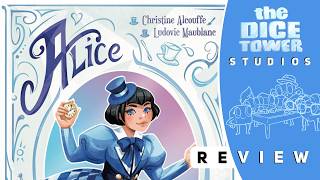

Alice Deep Dive
What the Community Thinks About Alice
Reviewers across multiple channels respond to Alice with genuine enthusiasm and a sense of pleasant surprise. The overwhelming consensus is that this flip-and-write stands out from a crowded field, offering both refreshing mechanics and rewarding strategic play. Most reviewers strongly prefer the competitive every-player-for-themselves mode, where the mirroring system shines; the team variant, while well-intentioned and offering distinct gameplay, draws some criticism for rules clarity and token-passing balance issues. None of these concerns dampen the overall positive reception. Across the board, Alice is described as charming, engaging, and distinctive within its genre.
Core Mechanics That Define Alice
Flip and Write
Alice operates as a flip-and-write where a shared input, revealed each round, becomes the public shape all players must incorporate into their personal grids. Players mark off symbols and icons on their sheets: eat me and drink me tokens that let them modify shape sizes, flamingos, roses, hedgehogs, teacups, and terraces. This core loop is familiar to the genre, but Alice layers its signature twist on top.
The Mirror-Flip System and Strategic Timing
The game board consists of two sides of a single sheet. Reviewers emphasize that crossing a mirror or looking glass is not a passive event; it is the heart of Alice's strategic decision-making. When a player crosses a mirror, they flip their sheet and resume building from the mirror square on the opposite side. They may flip multiple times throughout the game, but each crossing locks them into pursuing a different set of scoring conditions. Players must decide when to commit to the other side, knowing that access to either side is temporarily restricted once they flip. This forces meaningful trade-offs: should you pursue the flamingo path on the front, or take the risk and cross the mirror to chase teacups on the back. Reviewers praise this as the true hook of the game, where planning ahead and reading the available shapes creates genuinely tense moments.
The Alice Experience
Charming and Whimsical
Multiple reviewers describe being "charmed" by Alice; one notes that the theme is present but not overbearing, and the production itself conveys a sense of whimsy. The chunky wooden Alice token, the holographic effect on the box, and the care taken in aligning the front and back sheets all contribute to a sense that the designers prioritized both craft and player delight. The Wonderland theming serves the mechanics rather than overwhelming them, creating an atmosphere that feels playful and engaging without becoming fussy.
Engaging and Strategically Tense
Reviewers report that the seemingly simple act of drawing shapes and crossing off symbols becomes absorbing. The spatial puzzle of fitting polyominoes into the grid, combined with the decision of when to flip, keeps players engaged throughout. Unlike many flip-and-write titles where the back of the sheet sits unused or identical to the front, Alice makes both sides feel essential and distinct. Players experience tension in their choices, thinking ahead about which scoring path they will pursue while remaining flexible enough to adapt to the shapes revealed each turn.
What Makes Alice Stand Out
Production Quality and Component Satisfaction
Reviewers consistently call attention to how Alice feels in the hand and on the table. The chunky wooden Alice token, screen-printed in full color, is described as something that did not need to be wooden or premium, but the choice to do so elevates the entire experience. The box features a die-cut design with a holographic effect, creating a moment of delight when first opened. These details suggest that the publisher understood the appeal of a tactile, beautifully produced flip-and-write and invested accordingly. For a game with minimal components, the intentionality shines through.
The Perfectly Integrated Flip Mechanic
In most flip-and-write games, the back of the sheet is either blank or mirrors the front, adding little to the experience. Alice made a deliberate choice to make the flip central to gameplay and to ensure the production quality supports it: the front and back line up perfectly when folded at game end for scoring. Reviewers note this could easily have been a "real miss" if the printing was misaligned, but the execution is flawless. More importantly, the flip is not cosmetic. Crossing the looking glass forces strategic decisions, creates distinct scoring conditions, and makes the sheet feel like a puzzle with multiple paths. This is what sets Alice apart from other entries in the genre.
Potential Drawbacks
Team Mode Rules Clarity and Timing Ambiguities
The team variant introduces an A player and a B player per team, each with their own sheet, plus key cards, soldier tokens, flower tokens, and guard tokens that add interaction and team-based strategy. However, one reviewer notes that the rules surrounding when tokens can be passed and certain timing sequences are not as clear as they could be. For example, if a team member earns a token on their turn but their teammate also has the ability to give it away immediately, it is unclear whether the newly earned token is subject to that power in the same turn or only on subsequent turns. These are the kinds of edge cases that require group judgment calls, detracting slightly from an otherwise smooth experience.
Alice Token Passing Balance in Team Mode
In team mode, the Alice token passes between teams based on the B player collecting bows. In one reviewer's experience, the token switched hands only once across the entire game, giving one team an enormous advantage in card selection and pacing. This feels less balanced than the competitive mode, where the pass token rotates reliably every turn. Some reviewers who learned team mode first reported enjoying it, suggesting that this experience is highly group-dependent; nonetheless, most who played both modes gravitated toward the competitive version for its tension and fairness.
If You Enjoy Alice
The Hobbit: There and Back Again and Fellowship of the Ring Trick Taking represent related experiences. Like Alice, these games are compact and invite repeated play. If you enjoyed the polyomino puzzle and strategic sheet-flipping of Alice, you may appreciate the tight, thematic decision-making of these two-player trick-taking games, particularly the campaign structure and character selection that rewards foresight and table talk.
What Reviewers Are Saying
"This could have been a real miss if these were printed a little off and didn't quite line up. But no, it works really, really well, and I'm glad for that. I think it also leads to some really strategic moments where you have to know when you want to go through that looking glass. I'm so glad that you're not just plotting out one path forward, but you're starting in the center and you're kind of working on multiple directions at the same point. I mean, which leads to you really saying, 'All right, now I'm ready to go through the looking glass.'"
— Dice Tower
"But Alice was a fresh breath of air. A fresh breath of air, fresh air. Because you could flip the sheet. You can do that with every single game. But most of the time it's not going to be anything on the back. But here is like a game mechanism that you flip around and you write on the other side and you have to pop out the other side. And you can play it in teams mode also. That gives you another way to play the game and different kind of things you want to achieve. So I thought that was super fun."
— Board Gaming Ramblings
"I was charmed by it for sure. I did prefer the player versus player or every man for himself version as opposed to the team-based one. That's what brought it down a little bit. But, wow, was really really charmed by Alice Through the Looking Glass."
— Dice Tower