











Rebuilding Chicago Deep Dive
What the Community Thinks About Rebuilding Chicago
Rebuilding Chicago emerges as a solid entry in the Rebuilding series from WizKids Games, earning respect for its mechanical elegance but dividing players over its tension-heavy design. Reviewers from Rolling Dice and Taking Names found the core experience engaging yet acknowledged it's not for everyone, particularly noting that lighter gaming groups may find the constant pressure of managing unhappiness overwhelming. Rahdo's solo playthrough emphasized the game's accessible rule set paired with surprising strategic depth, while a three-player tutorial from an unknown channel highlighted how the asymmetric neighborhood boards create meaningful variety across plays. The consensus centers on one thing: this is a game that demands careful planning and invites the kind of tension some players seek and others actively avoid.
Core Mechanics That Define Rebuilding Chicago
Expandable Neighborhood Board
Unlike most tile placement games that confine you to a 4x4 or 5x5 grid, Rebuilding Chicago grants players remarkable freedom. You begin with a small starting board representing your neighborhood's core, but through the expansion event, you can pull suburb tiles from a bag and attach them anywhere you choose, growing your district organically in any direction. Every expansion tile adds rubble, wasteland left by the great fire, which you'll need to cover by placing buildings over time. This mechanic from WizKids transforms the familiar puzzle of tile placement into something less about cramming into a box and more about thoughtful neighborhood growth, where timing decisions about when to expand shape your entire strategy.
Multi-Use Building Cards
Each building card pulled from the market offers a genuine fork in the road. One side lets you place a building on your board immediately, gaining resources and amenity improvements. The other side keeps the card in play permanently, providing passive income during the profit phase or scoring bonuses at game end. This duality forces you to weigh immediate board development against long-term value, and critically, the amenity gained from a card doesn't always match the quality track it improves. A blue amenity building might push purple quality, forcing you to balance asymmetrically. The tension between these choices makes every card acquisition consequential.
The Rebuilding Chicago Experience
Constant Resource Pressure
Money stays perpetually tight. After your first purchases, you'll rarely have enough cash for the cards you actually want, forcing you to trigger events just to generate income. This creates an oscillating rhythm: build buildings when you can afford them, activate events when you can't, hope those event triggers actually benefit your board state. Rolling Dice and Taking Names described playing with resources so constrained that pivoting your strategy felt like panic rather than planning. It's the kind of pressure that sharpens decision-making for some players and exhausts others.
The Rubble Reckoning
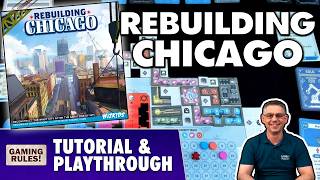
Every round, uncovered rubble on your board threatens you with the "on the world stage" event. This event forces all players to calculate statues minus rubble, with severe penalties if you're behind. Early rounds dock points modestly; by round three, the swing is 15 points either way. As reviewers described it, this creates the sensation of "feeding your family," a constant, looming obligation. You know it's coming. Every round you're forced to chase it, cover rubble, build defensively. Some find this tension exhilarating and strategic; others find it relentless and exhausting. The rule book acknowledges the divide by offering easy, standard, and expert difficulty levels that adjust the unhappiness escalation each round.
What Makes Rebuilding Chicago Stand Out
Asymmetric Neighborhood Design
Each player selects a different Chicago neighborhood at the start, and these aren't cosmetic differences. River North comes pre-loaded with shopping; Fulton emphasizes entertainment; Hyde Park starts sparse. Beyond layout, every neighborhood has three unique laws, neighborhood-specific bonuses you can activate once per round. This systemic asymmetry means no two games play the same way, and switching neighborhoods changes your strategic calculus entirely. WizKids designed the neighborhoods so thoroughly that choosing which one to rebuild becomes your first major decision.
Event-Driven Pacing
Seven events structure the game's turn economy, each triggering different scoring conditions. Night on the Town scores entertainment, Shopping scores commerce, Fine Dining scores restaurants, and so on. The brilliance lies in timing: whoever activates an event gets priority claim on the rewards, but triggering it also ends the round once all seven events fire. This creates a negotiation between urgency and patience. Do you trigger shopping before your opponent to lock in your quality advantage, or wait and hope they don't? This push-pull of event timing, knowing it's coming, unsure when, elevates Rebuilding Chicago beyond a straightforward card-and-tile affair into a game of reading the table and making calculated risks.
Potential Drawbacks
A Harsh Skill Floor on the Rubble Event
The "on the world stage" event hits differently for different players. Some find the constant pressure to clear rubble creates elegant strategic tension. Others feel hammered by a mechanic that penalizes board expansion (since every suburb added includes rubble) and rewards caution at exactly the moments you want to grow. By turn three, players with well-cleared boards enjoy a 15-point swing advantage over those who expanded aggressively. Rolling Dice and Taking Names noted that while money stays tight throughout, this particular event felt like it could randomly crater a player's position. It's not an unfair mechanic, it's just a severe one.
Opacity in Player Standing
Unlike games where you track points openly throughout, Rebuilding Chicago keeps much hidden. End-of-game bonuses from special landmarks and cards mean a player can feel solidly in the lead, only to have another player score points they never saw coming. Rolling Dice and Taking Names noted this mystery, that you never felt like you were in the lead, as a point of friction. Some players thrive on the suspense; others find it frustrating to optimize toward a finish line they can't quite see.
If You Enjoy Rebuilding Chicago
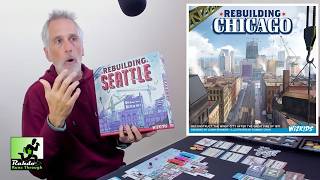
The natural companion is Rebuilding Seattle, the series predecessor that shares much of the mechanical DNA but has been refined in Chicago's expansion and event systems. If you've played Seattle, you'll recognize the neighborhood growth engine and amenity balancing, but Chicago layers on more strategic nuance. Beyond the series, fans of city-building games that reward careful planning over luck will find kinship here. This isn't a game about negotiation or direct player conflict, it's about reading the table, timing your moves precisely, and building a neighborhood that can weather both the literal rubble of 1871 Chicago and the metaphorical pressures of competing for scarce resources.
What Reviewers Are Saying
"You're constantly chasing making sure rubble spots are cleared up on your board. You're constantly knowing cuz every round that's going to trigger just like in games where you have to feed the family. You know at the end it's coming. It's like, here's my population. Do I have enough food to feed them? It's a constant tension during the round that you have to focus on."
— Rolling Dice and Taking Names
"Rebuilding Chicago is a standalone successor to Rebuilding Seattle. You're responsible for managing the zoning and expansion of a major neighborhood following the great Chicago fire of 1871. Each round, your population grows, and you can either build a new building, expand into a new suburb, activate an event, or build a landmark, after which you earn profit based on the neighborhood's commerce."
— Where There's a Will There's a Play
"The gameplay here is fantastic as well, and everything I said about the original Seattle is true here. I really appreciate the puzzly nature of the polyomino tile-laying, but more importantly, it's really about the economy management. You've got to meet the needs of these people."
— Rahdo Runs Through