





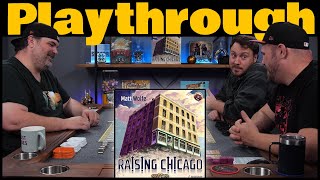

Raising Chicago Deep Dive
What the Community Thinks About Raising Chicago
Raising Chicago from Capstone Games and Spielworks provokes an interesting reaction among strategists and Euro game enthusiasts: genuine admiration tempered by reservations about the play experience. Reviewers across Board Gaming Ramblings, Heavy Cardboard, and Getting Games recognize the game's mechanical sophistication and thematic boldness, yet some note it demands patience that not all groups are willing to invest. The game has earned respect as a clever, unique economic simulation, even from those who acknowledge they may never return to it.
Core Mechanics That Define Raising Chicago
Blind Bidding and Contract Securing
At the heart of Raising Chicago lies a tense bidding system where players simultaneously place bidding markers on resource cards paired with project tiles. The player with the most markers wins the right to build a project and claims the resources attached to that card. Ties are broken by piece height and position, meaning spatial awareness on the bid board itself becomes strategically important. Once a player secures a contract, they must pay the required resources to complete the building, placing it on the board to influence city development and unlock track bonuses.
Poverty Track as Consequence
The poverty track functions as the game's primary punishment for ambition without resources. When a player cannot afford the full cost of resources required to build a project they have won, they move down the poverty track one space per missing resource type. This mechanic transforms every bid into a calculation not just of value, but of financial viability. The system creates a constant tension between wanting to secure valuable contracts and having the means to actually complete them. By game end, your position on the poverty track directly reduces your final score, making resource management as critical as initial bidding strategy.
The Raising Chicago Experience
Economic Weight and Tension
Raising Chicago delivers a heavy economic experience where every decision carries calculated risk. The interplay between bidding aggression and resource availability creates genuine tension throughout all eight rounds. Players must anticipate market dynamics, manage multiple resource tracks simultaneously, and decide whether to overextend or play conservatively. This tension compounds as the game progresses; early generosity with resources can cripple late-game flexibility, yet hoarding resources while competitors race ahead creates its own anxieties.
Satisfying Engine Emergence
As players progress through the rounds, building production engines becomes increasingly rewarding. Early buildings generate permanent resources on their respective tracks, and by mid-game, players discover synergies between neighborhood bonuses, prestige building placement, and accumulated income. The moment when your accumulated buildings begin working in concert delivers that distinctive Euro game satisfaction of watching an engine perform exactly as designed. Prestige buildings that score based on adjacent structures add another layer of spatial puzzle-solving to this satisfaction.
What Makes Raising Chicago Stand Out
Historical Theme Authentically Integrated
Raising Chicago's theme about lifting an entire city above ground to accommodate a sewer system during 1880s Chicago is not merely decorative window dressing. The game designer took a genuinely fascinating historical fact and built mechanics that reinforce it meaningfully. Players are not abstract point-gatherers but construction companies solving a real city planning challenge. This historical grounding gives economic decisions narrative weight; you are not just managing resources, you are literally raising a city to meet public health demands.
Tight Bidding Mechanism with Spatial Consideration
The bidding system itself stands out by adding a spatial dimension typically absent from traditional bid-for-contracts designs. The physical arrangement of your pieces on the bid board matters; it affects tiebreakers and forces players to think about positioning as part of strategy. This prevents the game from collapsing into pure number-crunching and introduces a tactile, spatial puzzle element alongside the economic decision-making.
Potential Drawbacks
Length and Pacing Relative to Strategic Depth
At 90 minutes with a complexity rating of 4.0 out of 5, Raising Chicago occasionally feels longer than its strategic payoff demands for casual groups. While the game delivers meaningful decisions, reviewers note it can stretch if your table prefers shorter, snappier experiences. The eight-round structure with multiple mini-phases per round means players spend time managing tracks, running companies, and resolving bonuses that, while mechanically interesting, can feel procedural to those less engaged with economic optimization.
Dry Presentation for Engagement-Focused Groups
The game's dry, spreadsheet-like economic focus excludes players who prefer narrative emergence, social interaction, or high-luck mechanics. Raising Chicago demands sustained attention to resource math and forward planning. There is no randomness to soften decisions, no comedic moments to lighten the mood, no trading or negotiation to create table interaction. For groups that value these elements over pure strategic puzzle-solving, Raising Chicago can feel austere and demanding.
If You Enjoy Raising Chicago
Raising Chicago appeals most to strategists who love heavy Euro games with economic engines. Fans of bidding systems, resource management puzzles, and thematic integration will find rich ground here. If you value games where careful planning and track optimization matter more than luck or social play, and you appreciate learning a game with genuine historical weight, Raising Chicago rewards that investment. The game shines in groups comfortable with 90 minutes of focused economic play and who enjoy the satisfaction of building interlocking systems that gradually become more powerful.
What Reviewers Are Saying
"It's a very clever game. It's very good. It's just a little bit dry and a little bit long for what it was."
— Board Gaming Ramblings
"This is such a fascinating historical thing to have happened, and especially it's a really cool thing to design a whole game around. I feel like this could be a really fascinating experience."
— Getting Games
"Raising Chicago is one of those games I would love to keep. Yeah, because I think it's awesome. But I agree, we will never play it. So this, if we would have kept this, it's just my collector gene that kicks in."
— Board Gaming Ramblings