







Pilgrims: Curious Adventures Deep Dive
What the Community Thinks About Pilgrims: Curious Adventures
Pilgrims: Curious Adventures has earned a notably mixed but warm reception from board game reviewers. The Dice Tower's hosts offered solid-but-reserved ratings, reflecting a game that charms on first encounter but reveals itself as slightly uneven on deeper inspection. One host expressed fascination with how the indie video game translated to the board format, while another found the strategic puzzle nature diverged more from the original than expected. Despite these concerns, both reviewers acknowledged the game's genuine appeal, with one noting that repeated plays have actually strengthened his appreciation for the title.
Core Mechanics That Define Pilgrims: Curious Adventures
Movement Puzzles and Card Collection
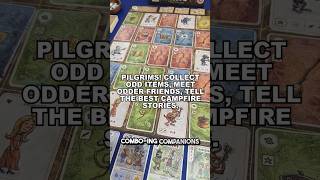
At its heart, Pilgrims is built around a deceptively elegant movement system. Players choose from four different modes of transportation (the wheel moving orthogonally one or two spaces, the horse moving like a rook in chess, the boat moving diagonally, or walking a single space in any direction) to navigate a grid of cards and claim treasures. Each movement type can only be used once per round across three turns, creating a careful puzzle of planning where you need to go and when. As you land on spaces, you collect companions, which join your party tableau, or items, which go into your hand. This is the core loop of the game, and it drives much of the decision-making. Publisher Pink Troubadour has distilled the exploration and collection spirit of the original Pilgrims video game into this focused movement-based puzzle.
Adventure Cards and Engine Building
The secondary system that gives the game depth is its adventure card mechanic, which serves as the primary source of victory points and ongoing benefits. You complete adventure cards by gathering the required companions in your party and discarding the specified item cards. Completing these contracts is more than just scoring; it creates an engine that strengthens your future actions. As you fulfill contracts over the four rounds of play, you accumulate abilities and bonuses that make your subsequent moves more powerful. This engine-building element is what Maple University's reviewers described as truly satisfying: you interlock characters, items, and contracts together as efficiently as possible, and when the pieces align, it feels clever and rewarding.
The Pilgrims: Curious Adventures Experience
A Tactical Puzzle That Invites Optimization
Playing Pilgrims is fundamentally about solving a puzzle on your turn. You assess the board state, consider which companions and items are available, and calculate which movement sequence will set you up best for completing contracts. The board state is constantly changing as other players make moves, so you work with tactical information available at the start of your turn. The Dice Tower found this puzzle-solving nature satisfying, especially when you successfully trigger a chain of abilities: moving to collect the right card, playing a companion ability to move again, and landing exactly where you need to be. These moments of elegant solution feel genuinely clever. The game shines at two players, where back-and-forth play keeps the board in constant flux and forces you to adapt.
Charm and Cute Theming
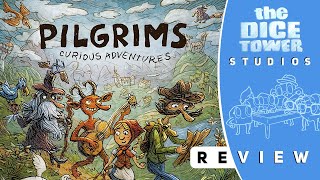
Beyond mechanics, Pilgrims carries the whimsy of its video game source material beautifully. The artwork is notably cute and carries over many recognizable elements from the original game: characters, items, and scenes that create visual coherence between media. Maple University highlighted how this visual lift from the video game adds considerable charm to what is otherwise a relatively simple game mechanically. The world itself has a silliness and humor baked into the adventure cards and companions you encounter. This thematic cohesion means that even in moments of mechanical repetition, the game's personality keeps it engaging. You are not just moving and collecting symbols; you are going on a whimsical journey with charming characters.
What Makes Pilgrims: Curious Adventures Stand Out
Accessibility and Simplicity Without Sacrifice
One of Pilgrims' strongest points is how it manages to feel simple while containing genuine strategic depth. The Dice Tower praised the designers for keeping the game uncomplicated without sacrificing the puzzly nature that makes it interesting. This is not a heavy euro or a rules-dense experience: the core loop is straightforward, icons handle language independence, and setup is quick. Yet within that simplicity lies real decision space, including which movement to use, which companions to recruit, and which contracts to pursue. The game respects player intelligence without demanding they memorize complex systems. This makes it accessible to newer players while offering enough puzzle to satisfy experienced gamers.
A Solid Solo Mode and Flexible Player Counts
Pilgrims surprised reviewers with the quality of its solo variant. The Dice Tower specifically mentioned being pleasantly surprised by the solo mode after trying it on repeat plays, finding it a genuinely solid solitaire experience. The game also scales across 1 to 4 players, though reviewers noted it shines brightest at two players. At higher player counts, the board becomes more crowded and downtime increases, but the core puzzle remains intact. The ability to experience the game in multiple contexts, whether solo, two-player, or higher counts, gives it flexibility that extends its longevity.
Potential Drawbacks
Analysis Paralysis and Decision Fatigue
The complexity of the movement puzzle, while its strength, can also become a liability. The Dice Tower identified analysis paralysis as a real risk: players can spend considerable time mapping out which movements to use, where to go, and how to optimize their card collection. Because there are multiple good options and the board state constantly shifts, some players will want to calculate extensively. Additionally, reviewers noted an odd cadence to the game's pacing. The four rounds with three actions each mean the game is technically the right length, but it often feels both rushed and repetitive. As one host noted, the puzzle-solving feels clever when you nail it, but the same loop repeating can eventually wear thin. The game hits a strange sweet spot where it does not feel long enough to accomplish everything you want, yet pushing for more length would amplify the repetitive nature.
Disconnect from the Video Game and Cooling with Replays
For players familiar with the original Pilgrims video game, the board game adaptation may disappoint in its strategic abstraction. The video game emphasizes figuring out what characters actually want and the problem-solving around personal context. The board game strips this away: companions simply need symbols, and any item matching that symbol works equally well. There is no narrative puzzle or context to solve, just symbol matching. One host specifically felt this disconnect and found it made the game less engaging than the source material. Furthermore, while one reviewer's appreciation grew with plays, another noted the opposite trajectory, cooling on the game with repeated plays as the repetitive nature became more apparent. Despite the charm and humor, the core puzzle can start to feel like you are doing the same thing over and over, which limits long-term appeal for some players.
If You Enjoy Pilgrims: Curious Adventures
You might also enjoy Ark Nova, which was mentioned alongside Pilgrims by reviewers. Both games feature careful card optimization, engine building through strategic play, and the satisfaction of lining up just the right combination of resources to execute your plans, though Ark Nova is far heavier. If you appreciate puzzle games where movement and positioning matter, consider Cascadia for its accessible spatial scoring. Maple University also mentioned Sweet Lands as sharing that engine-building DNA where you assemble the right pieces for future turns. For fans of the whimsical, storybook aesthetic combined with thoughtful gameplay, Everdell blends beautiful art with satisfying card-and-worker mechanics.
What Reviewers Are Saying
"I was very charmed by it, but then also the simplicity of the gameplay and the translation of what you're doing in the video game to the board game. I think it's certainly not a one-to-one, but it works really well."
— The Dice Tower
"When you nail that, it feels clever. You feel clever. The puzzle feels clever, but that gets repetitive."
— The Dice Tower
"You'll have a lot of fun optimizing it because you're trying to work out the right place to move. You're trying to get characters that either have good actions or which match with the contracts, and you're trying to pick up items which match with the characters to activate their cool powers."
— Maple University