











Super Boss Monster Deep Dive
What the Community Thinks About Super Boss Monster
Super Boss Monster arrives as a reimagining of a beloved franchise, and reviewers greet it with cautious respect rather than excitement. The consensus is straightforward: this is the best version of Boss Monster ever released, but it remains constrained by its own legacy. Those who loved the original will find here a polished, modernized experience. Those who bounced off Boss Monster's randomness and light strategy will likely find the same frustrations persist, despite the new framework. Reviewers consistently note that Brotherwise Games achieved what it set out to do—deliver a more stable, gamified platform while maintaining full backwards compatibility with decades of expansions—but many wish the designer had been bold enough to break free entirely and reinvent the series for today's play styles.
Core Mechanics That Define Super Boss Monster
Card Drafting with Worker Placement
At its heart, Super Boss Monster is a drafting game where players take turns selecting room cards and spell cards from a shared market. But the redesign adds a worker placement layer that separates it from its predecessors: each turn, players place a minion token on one of several locations in the town board, each offering a distinct bonus. You might claim an extra treasure symbol, draw a card, or draft a hero directly from the town rather than competing for one based on your dungeon's loot. This dual-action sequence—draft a card, place a minion—creates a tension between building your hand for long-term synergy and securing immediate tactical advantages. The minion placement feels fresh enough to engage players who tired of the original, and reviewers note it adds a layer of spatial puzzle-solving to what was once purely card-based.
Simultaneous Reveal and Dungeon Construction
Once everyone has drafted and placed minions, players simultaneously reveal the room they've chosen to build. This mechanic prevents the table read of "oh, I'll just build what beats your dungeon" and forces players to commit blind. Rooms slot into your dungeon as a vertical stack, either extending the path or overlaying previous rooms with enhanced effects. Reviewers describe the subsequent hero adventure phase as satisfying: heroes enter your dungeon and take damage as they pass through each room, and if they survive, they wound you instead. The spatial stacking creates a rudimentary Rube Goldbergian puzzle—arrange your rooms so their damage combines effectively, and consider which treasures you're advertising to lure which heroes. The play flow is brisk, typically thirty minutes even with new players, and the simultaneous-reveal mechanic keeps everyone engaged every turn.
The Super Boss Monster Experience
Whimsical Evil
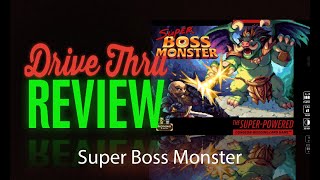
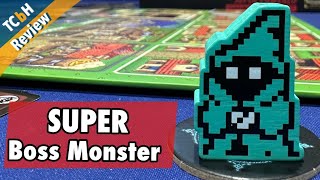
Super Boss Monster drips with theme. The 32-bit Super Nintendo aesthetic, the cheeky boss character art, the absurd creature names and descriptions—all of it radiates retro video game nostalgia with a wink. Reviewers who grew up with 16-bit gaming repeatedly mention the joy of the presentation; one reviewer noted it "looks like little villages in Zelda" and captures that era's spirit perfectly. The tone is playful antagonism: you are unapologetically evil, competing to build the most lethal dungeon and harvest the most souls. There's no pretense of heroism or cooperation. Take-that spell cards that sabotage opponents feel thematic because you're all cartoonish supervillains, and that lightness makes the occasional sting of a well-timed "Chill" spell land as fun rather than vindictive.
Puzzle Over Power
Despite its light theme, Super Boss Monster rewards puzzle-solving. Multiple reviewers highlighted the "what is this puzzle?" moment when you draw your hand of cards: how do you arrange these rooms and spells to maximize damage output? How do you balance catching the heroes you can afford against speculating on big payoffs? The solo mode particularly shines here, where the puzzle becomes "catch all the heroes before the tavern fills up," requiring you to generalize rather than specialize. One reviewer called it their favorite player count because "you can just kind of go, oh rip, got those, those are dead, those are dead and then you know do the next round" without table downtime. The combo-building aspect—layering rooms so their abilities chain together—offers enough mechanical satisfaction to reward attention without demanding heavy rules overhead.
What Makes Super Boss Monster Stand Out
Native Solo Mode Done Right
The solo mode is the standout addition and arguably the game's best argument for a purchase. Reviewers who have played extensively in solo mode consistently ranked it as their favorite way to experience the game. It removes take-that cards and player-targeting effects, reshuffles the goal from "beat other players" to "catch all 24 heroes without taking five wounds or letting one reach the tavern." The result is a surprising amount of granularity in scoring: if you fail catastrophically, you still get a score and can retry. If you catch most heroes, you rank up through a series of escalating titles culminating in "Grand Ultimate Master of the Dungeons" at a perfect 36 points. One reviewer reported achieving "Total Boss" (30 points) multiple times and lower scores when heroes overwhelmed them—and found the whole experience engaging both ways. The solo mode's puzzle nature, where you need to balance catching every type of hero against building a coherent engine, transforms the game from a party experience into a thoughtful solitaire puzzle.
Accessibility and Entry Point
Super Boss Monster serves as the definitive gateway to the Boss Monster series. The rules overhead is minimal—turns follow a predictable rhythm, iconography is readable, and teach-as-you-play works smoothly. But more importantly, Brotherwise designed it to be the best version of an already-proven concept: full backwards compatibility means players can mix in decades of Boss Monster cards and expansions, yet the new worker placement layer and refined hero mechanics modernize the experience for players who found the original too random or too light. Multiple reviewers noted it delivers on the promise of being "the best version of Boss Monster you could buy," even if they wished for something more revolutionary.
Potential Drawbacks
Randomness Remains the Ceiling
For all its polish, Super Boss Monster inherits the original's heavy reliance on luck. The heroes you attract depend partly on your treasure symbols but also partly on what the random deck serves up each round. Competitive games can feel decided by who draws into the high-value epic heroes versus who is stuck with weaker options. Reviewers noted this makes cutthroat play vulnerable to felt-bad moments: one player can send a powerful hero at an unprepared opponent, or a well-timed "Chill" spell can turn a winning position into a loss. This works fine at the table of players embracing the chaotic evil theme, but players seeking chess-like optimization or predictable strategy find themselves frustrated. One reviewer compared it to Munchkin—thematically fun but mechanically unpredictable in ways that can feel arbitrary rather than emergent.
Limited Mechanical Depth Beneath the Presentation
Reviewers who approached Super Boss Monster hoping for sophisticated dungeon-building mechanics—something akin to tower defense games like Orcs Must Die or deckbuilders like Slay the Spire—found the rooms underwhelming. Most room effects fall into narrow categories: deal damage, gain a bonus, or trigger a conditional effect. One reviewer noted the rooms "tend to be very dry, do some damage or if you do some damage, you might get an extra point." The game lacks the cascading interactions and dynamic hero behaviors that would make a Rube Goldbergian dungeon feel genuinely clever. Heroes don't deviate paths, adjust tactics, or respond to your room arrangements in meaningful ways—they take damage, keep moving, or die. For players seeking mechanical richness, this gap between the theme's promise (an evil dungeon that actively kills adventurers) and the mechanics' delivery (rooms apply additive damage modifiers) leaves the game feeling like a framework with polish rather than a system with depth.
If You Enjoy Super Boss Monster
If Super Boss Monster resonates with you, explore Boss Monster and Boss Monster 2: The Next Level to deepen the experience—they share DNA with Super Boss Monster and offer hundreds of compatible cards. For the sophisticated dungeon-building itch, try Slay the Spire, which builds on roguelike deckbuilding with far more mechanical interlocking and hard strategic choices. If you crave the tower-defense aesthetic without cards, Super Pixel Tactics (another recent retro-styled reboot from a different publisher) offers tactical grid-based play. And for players who love the chaotic, take-that energy without the dungeon theme, Munchkin delivers similar vibes of competitive sabotage wrapped in fantasy absurdity.
What Reviewers Are Saying
"In truth, it's just a little bit better boss monster. If you really didn't like boss monster in the past, I don't think this is going to do it for you. But if you really wanted to like boss monster and just needed it to be a little bit better, then this is a great way to do it."
— The Cardboard Herald
"The solo mode is first of all, it's moderately or mildly difficult. You score up basically. You have the three endgame conditions. In any of those cases, you're going to score. So you could have a very very low score if you don't get off your butt at the beginning of the game and the heroes kind of overwhelm everything. Whereas if you can make it through to the end of the deck, you're going to have a much higher score. And so there's a lot of granularity in the score chart."
— Drive-Through Review
"You have a dungeon that heroes need to be attracted to and then you're going to subject them to sequenced torture in some like Rube Goldbergian dungeon construction. Sounds so cool, but it just doesn't have enough dynamics to really satisfy that itch."
— The Cardboard Herald