












Philosophy Deep Dive
What the Community Thinks About Philosophy
Philosophy has earned near-universal praise from the board game community as a rare abstract strategy game that manages to be both elegant and intellectually satisfying. Watch It Played describes every turn as its own puzzle to solve, a design quality that keeps the game engaging turn after turn. The game's central promise, that simple tile placement rules can generate complex, interwoven decisions, holds up consistently across multiple playthroughs. The channel Cobra singles out the cascading tile reactions as exactly the kind of moment they look for in a game, while Gaming with Edo & Jessica describe playing it "again and again" with their family. The main consensus centers on the idea that Philosophy achieves what abstract games aspire to: mechanical clarity paired with endless tactical nuance.
Core Mechanics That Define Philosophy
Tile Placement and Activation
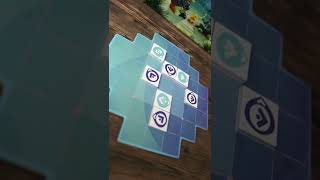
At Philosophy's heart lies tile placement on a nine-square center board. Cobra walks through the two-step turn structure in detail: a player places one tile from their hand onto an empty space, then immediately checks whether it activates. What makes Philosophy distinctive is that placing a tile immediately triggers activation: if a tile's targeting arrow points at an opponent's tile, that opponent's piece moves according to the symbol printed in the tile's center. Most tiles push, pull, toss, persuade, or rephrase a single adjacent or distant opponent piece, and Cobra notes that the rephrase tile is the only one that can target a player's own piece. The designer, published through Quality Beast, crafted each of the twelve unique tiles to feel purposeful. Players quickly learn which tiles are safe early moves and which should be reserved as powerful tactical weapons. The clarity of the iconography means that once you grasp the symbols, the game becomes language-independent: the arrows and effect symbols speak for themselves, requiring no translation.
Engine Building Through Chain Reactions
Philosophy elevates itself through chain reactions, the cascading activation of tiles that follow a single placement. Cobra explains that when a tile moves an opponent's piece, any of the active player's own tiles that suddenly acquire a valid target will activate automatically in turn, though each tile activates only once per move, which keeps the reaction from spiraling forever. Skilled players construct board states where a single placement triggers a sequence of movements that accomplish multiple objectives. Cobra describes these moments, where one move spirals into several linked actions, as the core satisfaction of the game and the reason the cascading tiles feel like "magic" once a player has learned the rules. The mechanic feels like solving a puzzle: players must visualize how one tile will move a piece into the targeting zone of another, which will then push their own piece closer to a winning position. Mastering when and how to create these cascades separates experienced players from novices, making Philosophy a game that improves with practice.
The Philosophy Experience
Contemplative Puzzle Solving
Philosophy evokes a meditative state during play. Watch It Played notes that turns often involve extended thinking as players mentally walk through possible tile placements, imagining how pieces will move and what chain reactions might unfold. Cobra describes becoming personally frozen while evaluating every single piece on the board and its potential impact, walking through what each tile would do in every open space, a sign not of a broken game, but of satisfying depth. The game rewards this contemplation: rushing leads to missed combinations or overlooked threats. This deliberate pace, coupled with the game's conversational theme, creates an atmosphere of thoughtful discussion rather than frantic competition. Even a quick game can feel meditative because each move requires genuine consideration.
Tense Back-and-Forth Competition
Despite its contemplative nature, Philosophy generates real competitive tension. Because players can only place tiles in the center nine squares and the board fills predictably, players must balance offense (setting up their own three-in-a-row) with defense (disrupting opponent threats). Cobra compares it directly to chess in pacing and tactical depth: a skilled player facing a newcomer can win decisively in minutes, yet repeated plays between matched opponents yield close, nail-biting finishes. Watch It Played echoes this, noting games can end in seconds if one player creates an unstoppable winning sequence, or stretch to twenty-five minutes if both players methodically maneuver for advantage. The respect token, which Watch It Played calls one of the best tokens seen in any game, a physical object passed between players to acknowledge an exceptionally clever move, reinforces that tension is born of mutual respect, not hostility. Players want their opponent to make their best move, because beating them under those conditions makes victory more satisfying.
What Makes Philosophy Stand Out
Chain Reactions That Feel Like Magic
Cobra highlights chain reactions as the defining moment of delight in Philosophy. Unlike abstract games where every move simply places a piece, here a placement causes other pieces to move, which can cause a player's own pieces to move, which can cause further cascades. Cobra describes setting up board states where a single tile, placed confidently, unfurls into a sequence of movements that reshapes the entire position, calling those chain-reaction moments exactly what they yearn for in a game. The tiles themselves, designed with beveled undersides similar to Azul, allow players to flick them up and push them into place easily, and Cobra notes this tactile feedback makes the eventual production version of the chain reactions even more satisfying.
The Respect Token: Elegance and Sportsmanship
Philosophy's respect token stands out as one of the smartest social mechanisms in modern board games. Unlike victory points or mechanical powers, the token serves purely symbolic value: it signals acknowledgement that an opponent's move was excellent. Cobra explains that the token reinforces the game's conversational theme, giving players a way to mark the moment an opponent's argument, or move, truly lands. Gaming with Edo & Jessica describe handing the token back and forth during family play whenever someone pulls off a move the other did not see coming, with no direct effect on the game beyond the acknowledgement itself. This thematic elegance reinforces Philosophy's core conceit: this is a conversation between two people, and even in competition, players can recognize good ideas when they see them enacted.
Potential Drawbacks
Turns Can Demand Extended Contemplation
Watch It Played notes that Philosophy can create real analysis-paralysis moments: turns can take quite a while as a player works through "okay, how do I do this," and a single game can stretch anywhere from two seconds to twenty-five minutes depending on how much a player wants to calculate. Because every tile placement cascades into potential chain reactions, and because only tiles already on the board can move, each decision carries weight. Cobra echoes this, describing becoming personally frozen while walking through what every piece on the board would do if moved to each open space. This is not necessarily a flaw, both reviewers frame it as thematic, reflecting the idea that careful communication requires pausing to choose words carefully, but it is worth knowing for players who prefer faster turn flow. A player skilled at visualization and spatial reasoning will move briskly; a player who needs to mentally compute movements may take longer.
Box Design Is Awkward
One reviewer noted that the game box is almost but not quite square, making it frustrating to close properly on the first try. This is a minor physical complaint about the packaging rather than the game itself, but worth flagging for players who are particular about storage or shelf space.
If You Enjoy Philosophy
Players who gravitate toward Philosophy typically love other abstract strategy games. Those who appreciated The Duke, another game with movement icons printed directly on pieces, will recognize Philosophy's kinship with that design philosophy. Players who enjoyed Terracotta Army will recognize the respect token's spiritual ancestor in how players can acknowledge clever opponent moves. For those seeking pure abstract challenge without theme, Philosophy also shares DNA with traditional chess-like games, though with a more compact playtime and easier entry point than classical games. A few reviewers mentioned that Philosophy functions well as a gateway into abstract strategy: it teaches the fundamentals of placement, movement, and tactical foresight without overwhelming players with asymmetric roles or hidden information. Players who enjoy games where the board itself becomes the primary variable, where the same twelve tiles play completely differently depending on configuration, will find Philosophy rewarding across dozens of plays.
What Reviewers Are Saying
"Every turn feels like a puzzle to solve which is really satisfying and fun. The game ethos and the way that the game rewards you for thinking hard, and knowing that you want your opponent to do the best move possible because when you win it makes it so much more satisfying."
— Watch It Played
"You move a piece and it moves another one and it moves another one and it creates the main potential you win because of that. Those moments are moments I yearn for in games and this game has that so it makes me very excited."
— Cobra
"This is a great abstract strategy game. The play was great, played it with my boy and we just played again and again and again and lots of different plays. You can win quick like oh I didn't see that but you pick it up you play it again and have some fun."
— Gaming with Edo & Jessica