










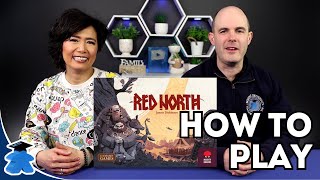
Red North Deep Dive
What the Community Thinks About Red North
Red North, a two to four player card game designed by James Dickinson and published by Mighty Boards, has drawn warm and consistent praise as a small-box strategy game with more bite than its size suggests. Grant's GameRex ranked it second among the top small-box games of the year, calling it a very thinky strategic game in a 30-minute package. Board Gaming Ramblings gave it a double keep and a strong recommendation, and one of the hosts named it the favorite of that batch. Their history with the game adds useful context: Red North is a new version of Såd, an earlier game from a very small company, and Board Gaming Ramblings describes it as the same game that now simply looks better, with the god powers adjusted a little. Much of the early coverage came with publisher support. Ella and Tyler's overview was sponsored in part by Mighty Boards, Board Gaming Ramblings played a review copy, and Watch It Played featured the game in a paid sponsor segment, so the enthusiasm is best read as early impressions. The one note of hesitation is that the best strategy is not obvious on a first play.
Core Mechanics That Define Red North
Area Control
Every point in Red North comes from winning outposts, a fact Ella and Tyler underline: how you claim them and what you do with them is up to you, but claiming outposts is the only route to victory. The game runs over three rounds, which Meeple University's teach names spring, summer and Ragnarok, with each outpost worth one, two and then three points. At the end of a round, whoever has the highest total strength in an outpost's color takes it. Outposts also grant abilities for the following round. Red passes the first player token, green breaks ties, blue unlocks a promote action that boosts a jarl, yellow lets you pull a raider from the discard pile into your party, and purple draws two cards. Players who contest a color without winning it receive compensation glory. Grant's GameRex points out that outposts give both points and special abilities, so defending an outpost matters as much as taking a new one, and Ella and Tyler describe trading outposts as a strategy in its own right.
Betting and Bluffing
Each round begins with every player simultaneously placing three cards face down to form a raiding party. Actions then go around the table one at a time. Reinforce flips one face-down card up and adds a card from your hand to either end of the row, which, as Meeple University puts it, makes your party stronger at the cost of giving opponents vital information. Withdraw returns a face-down card to your hand, inspire spends glory to add strength to a face-up card, and in the final round players can invoke a god card. Board Gaming Ramblings sums up the bluff: flipping a blue card might signal your plan, or you might really be stacking green to take the green outpost. Hidden jarls add to the uncertainty. Ella and Tyler describe revealing one at the end to add strength to the cards on both sides and win an outpost by a single point.
The Red North Experience
Good Anxiety Over Face-Down Cards
The defining feeling is suspicion. Grant's GameRex describes the internal monologue of every round: having four strength in blue, spotting an opponent's two in blue, and wondering whether their face-down cards hide more blue or whether it is a bluff. That tension is getting Grant anxious just thinking about it, but in a good anxious way. In a short clip, the channel adds that players are always slightly stressed about the face-down cards they cannot see, and that the game is full of intrigue.
Timing When to Leave the Round
The subtler decision is when to stop. Passing is the only way to bring new cards into your hand, and you do it by taking one of the muster groups laid out in the center. Grant's GameRex calls the question of whether to pass early and give up actions in order to grab a muster group for a later round really cool. Ella and Tyler highlight the opposite move. Withdrawing cards makes your party smaller, but it can leave you with more turns after others pass, when there is more information on the table and you can claim outposts other players are not going for. They describe it as testing the waters while you see what everybody else does.
What Makes Red North Stand Out
Strategy in a Filler Slot
Reviewers keep returning to how much decision-making fits into a short game. Ella and Tyler place it in an almost filler zone of about 30 minutes that is still strategic enough to produce exciting decisions. Grant's GameRex notes the box lists 25 to 45 minutes but feels it should never take more than 30, and puts the weight on the edge of light and medium. Board Gaming Ramblings calls it a very quick game and a small filler that is really, really good. Grant's GameRex had played it three or four times in a single week.
Interactive, Intertwined Decisions
Ella and Tyler stress how much the players' choices feed into each other. The cards you collect when you pass, the god powers in play and the outposts each player holds all intertwine, and everything opponents do is worth watching. They also found multiple paths to victory, from fortifying outposts you already hold to switching targets, with adaptability shaped by which cards come out in the muster groups. The small box helps it travel. Grant's GameRex calls it an easy game to bring anywhere, and Board Gaming Ramblings found it much easier to keep on the shelf than bigger games.
Potential Drawbacks
Strategy Is Not Obvious at First
Ella and Tyler admit that at the beginning the strategy is not very apparent. Early on, nobody has any bonus abilities, so players have to guess which outposts are most valuable while remembering that those abilities carry into later rounds. Patterns emerge with repeated plays, but a first game may feel like feeling out the system rather than executing a plan.
Less Social Than Some Hidden-Information Games
Groups looking for loud table talk may find Red North quieter than expected. Grant's GameRex compares it with another Mighty Boards release, Pinched, which is built for trash talking and big reactions. Red North shares the guessing about where opponents are going, but Grant describes it as a more strategic, more thoughtful game and less of a social one, focused on working out your own raiding party.
If You Enjoy Red North
Grant's GameRex points to Pinched, also from Mighty Boards, for a lighter and more social take on predicting where other players are going, with plenty of bluffing and trash talk. Players curious about the game's roots can look for Såd, the original version; Board Gaming Ramblings calls Red North the same game with a better look and adjusted god powers, and planned to keep Red North in its place. Ella and Tyler add that Red North feels a lot like a lane battler, especially at two players, so fans of that style should feel at home.
What Reviewers Are Saying
"I love games where not only am I thinking about what I'm doing, I'm also thinking about what you're doing, what you're going for on your turn, and how do I outsmart you? How do I be make clever decisions in the game? And Red North is full of that."
— Grant's GameRex
"All in all, it is a very interactive game between you and other players. Everything that everyone else will be doing is something that you'll be paying attention to. The cards you collect, the cards you collect from the middle when you pass, the god powers that you have, everything intertwines."
— Ella and Tyler
"Very quick game. Highly recommend this one. A small filler game that is really really good."
— Board Gaming Ramblings