









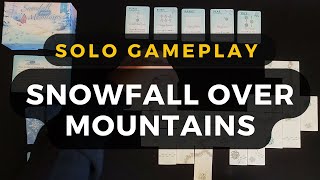


Snowfall Over Mountains Deep Dive
What the Community Thinks About Snowfall Over Mountains
Snowfall Over Mountains has captured the hearts of solo board game enthusiasts across multiple review channels. Ryan and Bethany Board Game Reviews describe it as a game meant exclusively for relaxing, a perfect coffee break experience that fits neatly into both space and playtime constraints. Let's Table It, in their cozy games coverage, calls it an under-the-radar gem that deserves more attention than it currently receives. The game's consistent praise centers on its ability to deliver a meditative, peaceful gaming experience that feels thematically cohesive with its winter setting.
Core Mechanics That Define Snowfall Over Mountains
Tile Placement with Dynamic Constraints
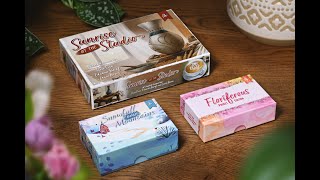
At its heart, Snowfall Over Mountains is a tile-laying puzzle where you place tiles orthogonally adjacent to existing tiles to build out a landscape. The game comes with a set of tiles, though four are randomly removed before play to ensure variability. Each tile features different elements (walking trails, rabbit paths, bear prints, bushes, trees, and ponds) that form the foundation of the puzzle. Published by Pencil First Games, the game's elegance lies in its simplicity: choose one of two tiles in hand, place it adjacent to existing tiles, draw a new tile, and repeat until all tiles are placed. You cannot overlap tiles or place them diagonally, which creates meaningful spatial decisions despite the game's compact footprint.
Multi-Layered Scoring with Tool Cards
What elevates Snowfall Over Mountains beyond basic tile placement is its compound scoring system. You randomly select goal cards from five different feature types (ponds, bushes, rabbits, bears, and trees), each with its own scoring condition: ponds score when surrounded on all sides, bushes score for the largest rectangle, rabbits score for long connected paths, bears score for trees adjacent to the longest bear path, and trees score for isolation in a column. Additionally, you choose two of three drawn tool cards that provide special abilities like moving or rotating previously placed tiles. Unused tool cards grant bonus points at game's end, creating tension between whether to use them for strategic benefit or preserve them for endgame scoring.
The Snowfall Over Mountains Experience
A Meditative Solo Journey
Multiple reviewers emphasize the meditative quality of playing Snowfall Over Mountains. Ryan and Bethany note that it is a very relaxing game, and when playing solo, the game fosters a calm, peaceful atmosphere that feels thematically aligned with its winter landscape aesthetic. Let's Table It comments that the game creates a serene experience perfect for a snow day with a cup of hot cocoa, capturing the cozy fantasy the game's art and theme inspire. The solo-focused design means there are no aggressive interactions or competing agendas, only the player's own puzzle to solve. The game plays in roughly 15 to 20 minutes, making it ideal for those moments when you want engaging gameplay without a heavy time commitment.
Accessible Yet Thoughtful Puzzle Solving
Despite its relaxing nature, Snowfall Over Mountains demands meaningful decisions. Let's Table It notes the puzzle aspect: you must anticipate how drawing tiles will affect your ability to satisfy scoring conditions. One reviewer describes the tension of recognizing that a placement great for one goal card takes away scoring on another. The game mechanics force you to think ahead, balancing immediate tile placement against future scoring opportunities. The low setup barrier, compared to heavier solo games, means the game invites repeated play without friction, allowing you to iterate on strategies and discover better tile combinations on subsequent attempts.
What Makes Snowfall Over Mountains Stand Out
High Replayability Through Randomized Goals
The random removal of four tiles and the selection of different goal cards from a larger pool means each game presents a unique puzzle. Let's Table It emphasizes this variability, noting that each game brings different scoring conditions, which shapes how you approach tile placement fundamentally. Because you are never playing with the complete set of tiles, and the tool cards are randomized too, no two games feel identical. A mini expansion included with some copies amplifies this by adding extra tool cards and additional scoring parameters for each feature type, extending the game's strategic depth.
Compact Production and Beautiful Presentation
Reviewers consistently praise Snowfall Over Mountains' aesthetic and component quality. The game fits in a compact box, making it genuinely portable in a way that larger solo games simply are not. Let's Table It notes the artwork is gorgeous, and another reviewer describes the winter-themed visual design as beautiful and wintry, with everything looking very pleasant. The small box size and quick playtime make this an ideal game to carry to work or bring on travels. It truly is what Ryan and Bethany call a coffee break game that does not demand table space or extended setup while still delivering meaningful gameplay.
Potential Drawbacks
Limited Depth for Heavy Game Enthusiasts
While the puzzle elements provide satisfying decisions, Snowfall Over Mountains is fundamentally a light game. Let's Table It compares it to A Gentle Rain and 9-Minute Kingdom, other tile-placement puzzles in the solitaire space. Players seeking complex rule interactions, asymmetrical powers, or branching decision trees may find the core experience too straightforward. The game excels precisely because it does not try to be heavy, but for those craving deeper strategic or tactical challenges, it will feel limited. Ryan and Bethany acknowledge this positioning by noting it suits players who want to dabble in solo play and go past pure solitaire, but do not want something huge or heavy yet, framing it explicitly as an entry point rather than an advanced puzzle.
Tile Randomness and Regret
Because you cannot see upcoming tiles before placing the current one, you sometimes discover placements that in hindsight seem suboptimal. The solo playthrough shows this dynamic in action, with the reviewer occasionally noting better spatial arrangements that become apparent only after additional tiles are drawn. While tool cards offer limited correction through moving or rotating previously placed tiles, the tile-draw luck remains a factor. Players who find randomness frustrating or who prefer deterministic puzzle solving may experience moments of tile regret, seeing the perfect configuration only after committing pieces to the board. This is less a flaw than a design choice that keeps the game moving and prevents analysis paralysis, but it can sting for players seeking complete control over outcomes.
If You Enjoy Snowfall Over Mountains
Reviewers recommend several games that share similar appeals. A Gentle Rain comes up as a natural comparison, another tile-placement solo game with a cozy, peaceful aesthetic that Let's Table It mentions directly as a touchstone. 9-Minute Kingdom appears as another tile-laying comparison, appealing to those who like the spatial puzzle and connection mechanics. For players drawn to the cozy, nature-themed aesthetic, Parks and Cascadia offer different mechanisms but similar atmospheric experiences and gentle scoring. Players new to the solo space should consider Snowfall Over Mountains itself as an ideal gateway title that respects both their time and their table.
What Reviewers Are Saying
"It's a very relaxing game. If you've played games like A Gentle Rain, this game would likely be perfect for you."
— Watch Review
"It's a solo game, and this is a great gateway solo game. I don't play a lot of solo games because it's just setup and things like that, but this has such a low setup barrier that it actually kind of draws me into that solo world."
— Ryan and Bethany Board Game Reviews
"I don't think this gets enough attention for what it is. I think of other games, even small games, that get more attention at solo, and this one, I think, just really deserves it."
— Let's Table It