












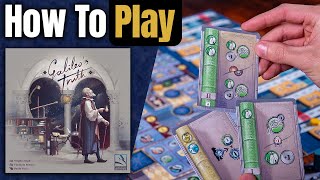


Galileo's Truth Deep Dive
What the Community Thinks About Galileo's Truth
Reviewers consistently praise Galileo's Truth as a thematic standout that translates its historical premise into compelling gameplay. The game has earned recognition as a spiritual successor to Darwin's Journey, with critics noting its shared artistic vision and approach to historical narratives. Multiple reviewers highlight the seamless integration of theme and mechanics, where the threat of the Inquisition does not feel like window dressing but rather drives every decision players make. For a game still in prototype phase heading into crowdfunding, Galileo's Truth has already captured the enthusiasm of dedicated board game communities, with reviewers eager to see the finished product.
Core Mechanics That Define Galileo's Truth
Deck Building and Resource Generation
At its heart, Galileo's Truth is a deck-building game that establishes player economies through card play and accumulation. Players begin with a small starter deck and gradually acquire new treatise cards throughout the game, cycling through them over several rounds. The beauty of this system lies in how it interacts with your expanding toolkit: each card you play generates resources based on the symbols on its spine, giving you coins, research, astronomy progress, and philosophy card draws. As one reviewer noted, drawing more cards is a good thing when optimizing your deck, since philosophy books increase your hand size. The key decision is not just what cards to acquire, but when to hold them, since cards played from your hand activate immediately and then cycle back into your discard pile. Income flows simultaneously across all players from both their bookshelf tracks and any inventions they have created, creating a smooth rhythm that accelerates as the game progresses.
Worker Placement, Observation, and Inventions
Galileo's Truth layers a worker placement system on top of its deck foundation through the natural philosopher, your single persistent worker who can be assigned to action spaces on the main board. Unlike pure worker placement games where you reclaim your worker after a turn, here your philosopher remains locked in place and can even be jailed or executed by the Inquisition, a thematic twist that punishes overextension. Observing the night sky stands as one of the most thematic actions: you spend astronomy resources to reveal and claim observation tiles. If you follow the Copernican model, you draw more tiles and keep one, gaining flexibility; if you have switched to the Ptolemaic model, you take fewer tiles and gain less competitive footing. Creating inventions mirrors this theme-first design: you spend coins and books to acquire invention cards that provide ongoing income, once-per-cycle abilities, or endgame scoring conditions. Writing treatises, your primary action for knowledge advancement, requires meeting minimum levels in subject tracks, then spending books and research to claim cards from a pyramid display. These pillars work in concert, with inventions enhancing your ability to observe and write treatises, all while the threat of suspicion forces difficult pacing decisions. Thundergryph Games wraps the whole system in clean iconography that supports the flow.
The Galileo's Truth Experience
The Tension of Hidden Progress
What makes Galileo's Truth tick is the constant pressure-cooker dynamic around the Inquisition suspicion track. You cannot simply rush toward victory points, because every advance on the scoring track triggers suspicion, so the faster you move, the more attention you draw from church authorities. Reviewers emphasize that this creates a uniquely tense pacing puzzle: you must progress knowledge and build your scholar's reputation, but at a measured pace or risk jail time and potentially burning at the stake. The game represents this beautifully through penance cards, which are mandatory dead cards in your deck that clog your engine and cost you points if you do not pay to remove them. One reviewer crystallized this design philosophy by describing a philosopher who is trying to progress knowledge in time but does not want to do it too fast, because too rapid a movement of knowledge can burn you at the stake. This creates a game where optimal play feels thematically coherent, where your economic engine must be carefully pruned to manage risk rather than simply optimized for speed.
Smooth Turns and Hidden Information Cooperation
Despite the depth, turns move briskly, especially in early cycles. Players choose one main action from several options (passing, abjuring their faith, playing treatises, playing penance cards, using an invention, upgrading their academic level, or assigning their natural philosopher), then resolve any secondary actions. The pass mechanic creates a dynamic pacing system: once anyone passes, subsequent non-passing players gain suspicion for each remaining round, incentivizing everyone to finish turns quickly or commit to passing early and locking in turn order for the next cycle. Reviewers note that this push-your-luck element around passing, combined with how cards cycle from hand to play area to discard and back, keeps the game moving even as complexity builds. The production supports this flow with iconography that scales from simple income symbols to more complex secondary-action choices that feel optional rather than punitive.
What Makes Galileo's Truth Stand Out
Theme-First Mechanical Integration
Galileo's Truth succeeds where many thematic games falter: its mechanics do not merely decorate its historical setting, they enforce and deepen it. The binary choice between the Copernican and Ptolemaic models is not cosmetic flavor; it is wired into every major action. Observing the sky, claiming inventions, and even endgame scoring all branch based on which model your scholar follows. Switching models costs suspicion and reshapes your available paths, creating a genuine strategic fork. The natural philosopher's fate (free, jailed, or burned at the stake) directly tracks your recklessness, and reviewers call this the heart of the game, since losing your worker cripples your ability to access powerful board actions. One reviewer praised how every currency, including suspicion, books, coins, and research, ties back to the core narrative of forbidden knowledge. The game teaches you through play that knowledge advancement and survival are not separate goals but competing pressures, which is exactly what the historical setting demands.
Rich Endgame Scoring and Replayability
Final scoring in Galileo's Truth is deliberately layered, rewarding different paths to victory and ensuring that early setbacks do not guarantee defeat. Your natural philosopher's status gives you varying point values depending on the model you committed to, creating swing potential in the endgame. You also gain points relative to how other players' philosophers fared, and completed mentor cards grant bonuses. Inventions with endgame conditions can swing close games, and each penance card remaining costs you points. This multi-path scoring, combined with how different academic level requirements and prohibition challenges change each game, ensures that strategies vary widely across plays. Observing aggressively, writing treatises, or upgrading your academic rank all feel viable rather than dominated by a single optimal strategy. Reviewers emphasize that learning the game teaches you different approaches: early plays may prioritize stabilizing suspicion, while later plays might commit to high-risk routes once you have built a resilient deck.
Potential Drawbacks
Prototype Status and Rules Complexity
Reviewers acknowledge that Galileo's Truth was still in active development when previewed, with rules changes possible before its crowdfunding launch. Early plays require careful rulebook consultation, particularly around the interactions between your chosen model, the action groups separated by mandatory and optional icons, and the various ways to modify suspicion. The deck-building system is smooth once learned, but the number of secondary actions available from treatise cards, inventions, and natural philosopher spaces means new players can experience analysis paralysis even though individual turns are fast once a decision is made. Some players may also find the constant suspicion management tense rather than engaging, viewing the limiting factor as artificial pressure rather than thematic flavor.
Deck Cycling and Limited Hand Space
The constraints of resource storage, since you may never bank more than a set number of coins and research tokens on your desk, create friction that some may find frustrating rather than strategic. You are constantly deciding whether to save resources or immediately convert them into card acquisitions and actions, and the discard-pile shuffle required when your deck empties can occasionally strand you without key cards during critical turns. Treatise card acquisition requires either adding the card to your hand, forcing you to discard another treatise, or placing it directly on top of your deck, creating a multitude of sequencing decisions that must be recalculated as your deck composition evolves. While reviewers frame this as elegant constraint design, players seeking fast, simple card gameplay may find the constant management of deck, hand, discard, and play area more bookkeeping than fun.
If You Enjoy Galileo's Truth
Reviewers who love Galileo's Truth frequently recommend Darwin's Journey as a spiritual sibling, sharing Thundergryph's distinctive artistic style and historical narrative approach. The systems differ, since Darwin's Journey emphasizes worker placement and voyage planning while Galileo's Truth centers on deck building and suspicion management, but the thematic elegance and willingness to let theme drive mechanics are shared DNA. For fans of the deck-building core, Dominion remains the genre touchstone, while players who enjoy the Renaissance-science setting and tense euro decision-making should explore Newton, which casts players as scholars traveling, studying, and publishing across early-modern Europe. Those drawn to high-tension knowledge races will also appreciate Lorenzo il Magnifico for its layered card play under constant pressure.
What Reviewers Are Saying
"The year is 1610 and the world as we know it is on the precipice of change, with a fragile balance between ancient dogma and the dawning of reason."
— Getting Games
"All while the shadow of the Inquisition looms large. One misstep, one too bold announcement, could lead to your arrest and perhaps a fiery end."
— Watch Review
"You are a philosopher who's trying to progress knowledge in time, but you don't want to do it too fast, because we all know that too fast of movement and knowledge can burn you at the stake."
— Cray