






The Old Ones of El Dorado Deep Dive
What the Community Thinks About The Old Ones of El Dorado
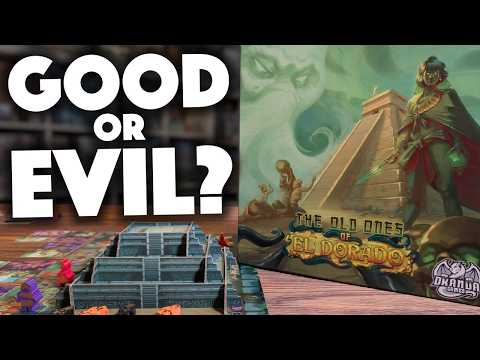
The Old Ones of El Dorado has garnered significant interest from the board game community with its distinctive card mechanism and thematic blend of euro gameplay. Reviewers appreciate the innovative closed-economy card system and the player interaction it creates, though opinions differ on game length and depth. The design from Dranda Games presents a fresh take on card play that prioritizes tactical decision-making over random draw mechanics.
Core Mechanics That Define The Old Ones of El Dorado
The Closed-Economy Card System
At the heart of The Old Ones of El Dorado lies a genuinely innovative card mechanism. Rather than drawing from a deck, players work with a fixed set of cards, three per player, that circulate between hand and board throughout the game. On your turn, you either play a card to one of the action rows (triggering bottom-row effects) or take cards from a row (triggering top-row effects). This closed economy means you never run out of cards to interact with, and card availability becomes a critical strategic consideration. As reviewers noted, once a row fills to its limit, taking those cards becomes tempting but consequential: you trigger bonuses for players with keepers in that row, and you and anyone else taking cards gain madness tokens as a penalty.
Multi-Layered Worker Placement with Consequence
The Old Ones of El Dorado from Dranda Games combines worker placement, through the placement of keepers on card rows, with a madness mechanic that adds genuine tension to blocking plays. When you place a keeper on a row, future players who interact with that row either gain a bonus action or incur madness, depending on whether they are playing or taking cards. This creates a push-your-luck dynamic where you are constantly balancing board control against resource accumulation. The madness system uses your limited resource storage space, forcing difficult decisions about what to keep and what to sacrifice to clear your mind.
The Old Ones of El Dorado Experience
Rapid Turn Structure with Deep Comboing
Individual turns can resolve quickly if you are simply grabbing resources, but the true depth emerges through combo chains. Playing a card that triggers one action can cascade into secondary and tertiary effects: a worship action might allow you to place followers, which then enables sacrifice actions, which unlock new movement options on the village track. Reviewers highlighted that turns can vary dramatically in length depending on how many cascading bonuses you unlock. The game flows smoothly during teaching phases, with reviewers praising the iconography and straightforward action resolution once you understand the basic flow.
Racing to the Point Threshold with Multiple Paths to Victory
The game ends the moment any player reaches the victory point threshold, followed by one final round for other players to catch up. This creates genuine tension in the endgame, as reviewers noted, with multiple viable paths to those points: building the shared temple (with area majority rewards), completing your personal tablets, placing mask pairs in your sanctum, and advancing sacrifice tracks. One reviewer mentioned that in their particular game, final scoring was extremely close, suggesting the victory point economy is well-balanced and tightly contested.
What Makes The Old Ones of El Dorado Stand Out
A Card Mechanism Unlike Traditional Deck Builders
The absence of a shuffled deck fundamentally changes how you plan. You know exactly which cards are in play and which remain in players' hands or on the board. This transparency allows for genuine tactical play rather than hoping for lucky draws. Reviewers emphasized that this card economy is the best part of the game, offering clever opportunities to strand opponents without resorting to direct player-versus-player conflict. The closed system also means that certain card actions may be rarer or more common depending on which cards players happened to draw at setup, creating natural variability in game feel across plays.
Tight Thematic Integration of Worker Placement and Sacrifice
The Old Ones of El Dorado weaves its Cthulhu and El Dorado mythology through every mechanism. Followers and villagers are not abstract resources; they are people you worship with, put to work in your sanctum, and ultimately sacrifice to move up sacrifice tracks. Building the temple is a shared communal effort where area majority determines who benefits most. Sculpting your personal tablets requires resources but grants immediate points, rewarding player agency. Reviewers appreciated that the game's theming is not window dressing, since the mechanics reinforce the narrative of competing cults vying for favor from the old ones.
Potential Drawbacks
Game Length May Leave Players Wanting More
One prominent reviewer expressed surprise at his own criticism: the game did not feel long enough. He noted that despite reaching the point threshold, he felt he had not accomplished enough, wanting to pursue multiple strategic paths (building the temple while also crafting masks, for instance) but running out of turns before getting the chance. At roughly thirty minutes per player, the game can feel brisk, particularly at higher player counts. This raises questions about whether players who enjoy engine-building and extended development will find sufficient depth, though some reviewers hypothesized a house rule of two additional turns might address this concern.
Early Setup Variability and Learning Curve Roughness
The random card distribution, three cards per player with several dealt to the initial board rows, means significant early-game variability. Some actions appear frequently in a given game; others may be rare or absent entirely. While this creates replayability, it also means your first play might not showcase all the game's options. Additionally, reviewers noted that during teaching, the game requires explaining several interconnected systems at once: the action rows, keeper placement, madness penalties, worship versus sacrifice decisions, and track advancement. Once the mechanics click, turns flow smoothly, but the initial cognitive load is substantial. Reviewers also stressed that the previewed version was a prototype, so components and balance may change before release.
If You Enjoy The Old Ones of El Dorado
Fans of The Old Ones of El Dorado should explore games that share its emphasis on clever card interplay and closed economies. Isle of Trains uses a similar card-as-multiple-resources mechanic in a locomotive-themed setting that rewards tight planning. Explorers of the North Sea and Galactic Cruise offer comparable euro-style depth with worker placement and area majority elements. If you appreciate the exploration and majority-control racing aspect, The Quest for El Dorado offers a deck-building race through the jungle. Those drawn to the Cthulhu mythos paired with economic systems should also consider Cthulhu: Death May Die for a more combat-driven take on the same horror flavor.
What Reviewers Are Saying
"The card play mechanism is the unique selling point for this game, and it's a really interesting one. There's a limited number of cards in a row. Once there are three cards in a row, you think, okay, well, nobody else can play a card there. That bit is really clever."
— Paul Groen
"All in a race for points. As soon as someone reaches the threshold, it's going to trigger the end of the game. This is on Kickstarter right now from Dranda Games. This is a prototype. It'll give you a good idea of what the game will look like and play like. Things are going to be tweaked."
— Watch Review
"There's quite a lot of comboing and progression as the game goes on. Turns can be fairly quick, but they can also be quite combo-heavy, so it depends on how many resources you have available."
— Watch Review