





One Card Dungeon Deep Dive
What the Community Thinks About One Card Dungeon
One Card Dungeon has captured the hearts of solo gaming enthusiasts with its remarkable ability to deliver a full dungeon-crawling experience from a single playing surface. Reviewers praise it as a brilliant execution of minimalist game design, offering tactical depth and compulsive replayability despite its brutal difficulty. The game has earned particular admiration for how much adventure it accomplishes with so little, a testament to Dryad Games' elegant system design that proves complexity and size are not prerequisites for memorable gameplay.
Core Mechanics That Define One Card Dungeon
The Energy Die Puzzle and Resource Management
The heart of One Card Dungeon lies in its energy phase, where players roll three dice and must assign each die result to one of four stats: movement, attack, defense, and range. This creates a compelling puzzle every turn, since players must decide whether to prioritize mobility to evade enemies, damage to dispatch threats, or protection to mitigate incoming hits. The game's damage calculation uses division (enemy damage divided by your defense, rounded down), which adds another layer of tactical consideration but does require either mental math or a reference table. Dryad Games has designed this resource allocation to be the primary decision point, making every roll feel consequential.
Movement, Line of Sight, and Enemy Behavior
Movement in One Card Dungeon operates on a grid system where two movement points purchase orthogonal movement and three points buy diagonal moves. Enemies follow predictable pathing rules: they move toward the player while maintaining maximum safe distance, and they only attack when in line of sight. This rules structure creates emergent tactical scenarios where players must carefully consider how their positioning affects enemy pathfinding, and whether they can use walls or treasure objects to break line of sight. Range increases throughout play, starting limited to melee and upgradeable through stat increases, allowing players to attack enemies at greater distance.
The One Card Dungeon Experience
Brutal But Addictive Difficulty
One Card Dungeon is unabashedly difficult. It establishes a twelve-floor dungeon gauntlet where each floor introduces a stronger enemy, and players who reach certain floors face additional boss encounters without recovery. Reviewers emphasize that the difficulty works in the game's favor, since it remains deeply engaging despite consistent defeat. The accessibility of setup and reset, mere minutes between attempts, combined with the addictive puzzle of pushing one floor deeper, creates a just-one-more-run quality that makes time disappear. Even experienced players struggle to reach the final floors, yet the experience remains rewarding through near-victories and moments of tactical brilliance.
Tight Tactical Puzzles with High Variance
Each turn presents a tight puzzle: with whatever the energy dice provide, players must decide the optimal distribution to survive, deal damage, and position for the next round. The luck-dependent nature means that poor rolls can spell doom, but skilled play extends survival even on modest rolls. Expansion content, including tiles that boost enemy stats, treasure dice that provide temporary stat pools, and a perdition stone that damages all enemies but also the hero, layers additional tactical choices onto this foundation. Players report that the puzzle-solving element keeps them engaged even when rolling poorly, since creative positioning and resource optimization can overcome unlucky dice.
What Makes One Card Dungeon Stand Out
The Entire Dungeon on a Single Card
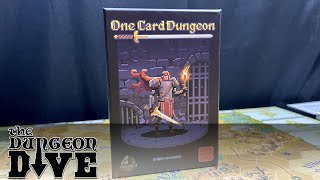
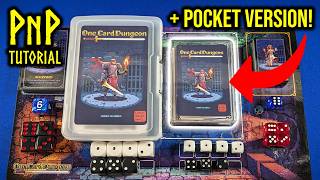
What makes One Card Dungeon remarkable is its literal name: the base game delivers a complete dungeon crawl on a double-sided card, with each face representing six floors. Reviewers repeatedly emphasize the compactness. You can print it at multiple sizes, keep a poker-card version in a backpack, or create a full-sized playmat version. The design achieves what most would consider impossible: a dungeon crawler with atmosphere, progression, and meaningful decision-making that fits in a pocket. Dryad Games' decision to offer the game as print-and-play files amplifies this advantage, allowing players to customize components and scale the game to their preferences.
High Modularity and Endless Customization Potential
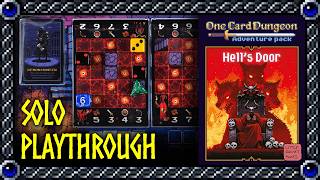
The system's underlying elegance makes it exceptionally open to modification. Reviewers noted discovering Star Wars, Metal Gear Solid, and Diablo themed reskins created by the community. The base framework of four classes, a consistent stat and defense resolution system, and modular dungeon floors invites custom content creation. Even without house-ruling, expansion packs introduce new dungeon floors with different enemy distributions, special spaces that alter stats, and new mechanics like the treasure die and perdition stone. This modularity means the game never becomes stale, since new challenges emerge from expansions or custom content, keeping solo adventurers engaged indefinitely.
Potential Drawbacks
Class Balance Issues and Limited Item Loop
Reviewers identified a weakness in class design. The Wizard emerges as the dominant class thanks to its once-per-floor ability to reroll all energy dice, a powerful resource that other classes lack. The Barbarian, by contrast, requires the hero to drop to one health before gaining a single reroll per turn, a situational ability that pales in comparison. Similarly, the teleporting Corsair overshadows the wall-climbing Sherpa in utility. This variance in class power means that choosing the Wizard maximizes win potential, creating an imbalance that tempts players to redesign weaker classes. Additionally, players draw a few items at the start and never gain additional items as rewards for defeating bosses or completing floors, a missed opportunity that could ease the difficulty curve and provide reward satisfaction.
Occasional Tedium and Heavy Luck Dependence
Extended dungeon runs can devolve into repetitive action loops, particularly when positioning forces a player to circle an enemy repeatedly while waiting for favorable rolls before attacking. Some positions allow cheesing the game, such as bunking in a corner behind a wall or treasure die to limit incoming damage to a single enemy, though victory still requires dice to break the stalemate. More fundamentally, the game is heavily luck-dependent: catastrophic rolls early in a run can doom an otherwise skilled player within the first few floors. This variance is intentional and adds tension, but players who dislike luck-heavy games will struggle to enjoy the experience despite the tactical layer beneath.
If You Enjoy One Card Dungeon
Fans of tight, puzzle-like solo experiences should explore Mage Knight for deeper tactical complexity, or The 7th Continent for a sprawling exploration narrative. Gloomhaven: Jaws of the Lion offers more character progression than One Card Dungeon but requires significantly more table space. For minimalist design excellence, Sprawlopolis and Palm Island deliver quick, card-based puzzles in even smaller footprints. And if you crave more Dryad Games content, the published expansions to One Card Dungeon extend the base game with fresh dungeon layouts and mechanics that amplify both difficulty and strategic options.
What Reviewers Are Saying
"The time just goes by so fast when I play this, where I'm just puzzling with the energy dice and figuring out when to use my class ability and what's the best time to use the items. It is just so much fun trying to outmaneuver the enemies and all of that."
— Watch Review
"It really does feel like a dungeon crawler. It's crazy despite how simple it is and minimalistic when it comes to the components. It really does accomplish so much with so little."
— Watch Review
"This game just got me hooked. And I liked it so much that I made a travel-sized version of it. It is going to be a staple and have a permanent spot in my backpack moving forward. It is so compact footprint-wise and easy to relearn and pick up again."
— Watch Review