




Reactor Rescue Deep Dive
What the Community Thinks About Reactor Rescue
Reactor Rescue has captured the attention of reviewers who appreciate both the educational value and the pure joy of hands-on circuit building. The game resonates most strongly with those who grew up tinkering with electronics kits; reviewers frequently compare it to the old RadioShack 101 circuit kits, but recognize that Reactor Rescue adds a compelling game layer around the core experience. The consensus is clear: this is genuinely fun to play, not just educational. Tabletop Tolson, an educator who reviewed the game, notes that the scaffolding (the progression from tutorial to specialist modes) is "at its best," allowing players to learn through doing rather than instruction. Bower's Game Corner emphasizes the surprising accessibility; viewers report that even players with zero electrical background find themselves understanding circuit logic after repeated play. The Dice Tower team identifies strong parallels to Forbidden Sky, another game that rewards puzzle-solving and tangible success when circuits light up. What emerges is respect for a game that successfully marries learning and entertainment without feeling preachy or dry.
Core Mechanics That Define Reactor Rescue
Action Timer
Every circuit-building attempt is constrained by a 2-minute timer, a mechanic that transforms what could feel like a leisurely puzzle into a race against the clock. Players must quickly evaluate the circuit card, gather their wired components, and physically connect them correctly before time expires. Tabletop Tolson highlights how the timer encourages quick thinking and prevents other players from sitting idle waiting for someone to complete a circuit. The timer also allows for difficulty scaling; players can remove it entirely for teaching moments, shorten it for advanced play, or use a 15-minute solo timer for the game's dedicated single-player variant. This design choice keeps the game's pace tight while remaining flexible enough to support learners at different skill levels.
Positive Player Interaction
Rather than punishing players with take-that mechanics, Reactor Rescue rewards system mastery through engine building. When a player completes all five tokens of a specific type (say, all radial interfaces), they gain a permanent bonus card that provides that component for free in future turns. This engine-building approach, familiar from games like Ticket to Ride, means that more efficient players create cascading advantages for themselves. Tabletop Tolson expresses concern about the game's optional event cards that introduce negative effects, noting that in an educational setting, failure and natural consequence (losing a turn to retry a circuit) feels more appropriate than artificial punishment. Tabletop Tolson recommends house-ruling away the malfunction cards when teaching, allowing the core system to reward discovery and success without the sting of arbitrary setback. This core philosophy, removing the friction of randomness, keeps the focus on learning and improvement.
The Reactor Rescue Experience
Satisfying Physical Feedback
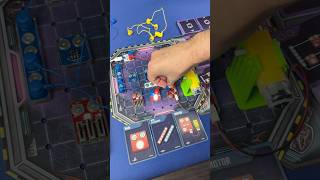
What separates Reactor Rescue from typical board games is the moment when the circuit works. Players wire up components using magnetically-attached connectors, power the board, and watch or hear the payoff: lights brighten, motors spin, sensors respond to hand movement. This immediate feedback is cited repeatedly by reviewers. The Game Boy Geek describes the feeling of building a functioning circuit as a return to childhood wonder. Bower's Game Corner captures a moment of pure satisfaction, noting that "that is so freaking cool" and describing the pleasure of seeing a distance sensor respond as fingers move closer to it. Tabletop Tolson, despite their educational framing, admits outright that this hands-on experience was genuinely fun. The physicality of the components, the magnetized wires that snap into place, and the working circuits create a sense of real engineering rather than abstract puzzle-solving.
Progressive Learning Through Scaffolding
The game's training-wheels approach means novices are never overwhelmed. Circuit cards come in three difficulty levels (marked by lightning bolts), and crucially, all cards offer two sides: a learning mode that shows exactly how to wire the circuit, and a specialist mode with no diagram. Players start with learning-mode cards only, building confidence and understanding. As they succeed, trainers gradually introduce specialist-mode cards where they must remember or reason through the connections. Bower's Game Corner captures this perfectly, noting that after just a few plays, the electrical logic starts to click. The scaffolding feels natural and player-controlled. The game respects that learning is individual; solo variants and cooperative play mean nobody feels rushed or judged. This design philosophy, removing the pressure-cooker element while maintaining genuine challenge, is what separates Reactor Rescue from educational games that feel like work.
What Makes Reactor Rescue Stand Out
Real Electronics Embedded in Board Game Play
Labbox Education, the partner publisher, designed electronics that teach actual circuit principles while remaining accessible. The components are not toys: they are functional circuits. RGB lights respond to color wiring, potentiometers control brightness and motor speed, distance sensors detect proximity and adjust LED output. Reviewers consistently note that the components feel high-quality and user-friendly; the magnetic connectors prevent frustration from loose wires or broken connections. The Game Boy Geek walks through level three circuits and expresses genuine delight at the variety: switches, bulbs, motors, RGB lights, sensors. This is not pretend electronics; players are learning real concepts while solving real puzzles. The wow factor of seeing a circuit actually work is a powerful teaching tool that typical card or dice games cannot replicate.
Flexible Difficulty and Solo Variant
Reactor Rescue ships with multiple ways to play, all fully integrated into the core game. Families with mixed ages can play together; children use learning-mode cards, adults use specialist mode, and both have fun. The solo variant, which provides a 15-minute challenge to assemble seven repair tokens without exceeding two of any type, offers a completely different experience: frantic, forgiving, and rewarding. The Dice Tower team emphasizes that this scalability is rare and well-executed. There is no separate rulebook or awkward house-rules feel; the game naturally supports teaching-mode (no timer), standard play (2-minute timer, learning or specialist cards), and solo sprints (15 minutes, choose your difficulty). This flexibility means a single copy of Reactor Rescue can serve a classroom, a family game night, or a solo challenge. Reviewers appreciate that the core game works in all configurations without compromise.
Potential Drawbacks
Event Card Imbalance
Some successful circuit completions trigger event cards that reward the player or all players with bonuses. However, other events introduce malfunction cards, which are red cards that impose penalties: force a player to retry a circuit in half time, remove tokens they have already placed, or discard and redraw resources. Tabletop Tolson, an educator, raises a thoughtful concern: in an educational setting where learning and confidence-building matter, these punitive cards feel at odds with the game's philosophy. A player who fails naturally loses a turn (they must retry the circuit), which is already a consequence. Stacking additional malfunction cards on top of failure can create a snowball effect where struggling players fall further behind, potentially discouraging them from trying. Tabletop Tolson recommends house-ruling away the negative event cards when teaching, keeping only positive events and natural consequences. This is not a flaw in the game's core system, but rather an acknowledgment that the event deck was designed for competitive play, not purely educational contexts.
Card Draw Randomness and Luck Variance
Resource cards (components) are drawn from a deck, and the hand management mechanic (discard two, draw one) can feel punishing when luck is poor. Tabletop Tolson recounts discarding two cards repeatedly and drawing the exact same card back four times in a row, losing four turns of progress. Additionally, the cosmic override card acts as a wild component, and some players receive multiple copies while others never see one. This luck variance means that two players building identical circuits may have vastly different difficulty levels based on draw luck. Reviewers do not see this as a critical flaw; rather, they note it as a trade-off. The open-market house rule (allowing players to take cards from a face-up display rather than always drawing from the deck) is suggested as a potential fix. For casual and educational play, this variance is accepted; for competitive tournament play, it may warrant attention.
If You Enjoy Reactor Rescue
The Dice Tower team identifies Forbidden Sky as the closest comparison, and for good reason. Both games center on tangible circuit-building where success is marked by a visible, audible payoff. If you loved that moment in Forbidden Sky when the circuit lit up, Reactor Rescue delivers the same satisfaction with a deeper engineering puzzle. Ticket to Ride is also mentioned by Tabletop Tolson as a mechanical parallel; both games feature hand management, card drafting or drawing from a deck, and the flexibility to pursue different paths to victory. Players who enjoy euro-style engine building, where completing sets unlocks permanent bonuses, will appreciate Reactor Rescue's token-completion rewards. For those seeking cooperative experiences, the game scales seamlessly to cooperative play. For families balancing education with entertainment, few games match Reactor Rescue's ability to teach real concepts while remaining genuinely fun.
What Reviewers Are Saying
"I really love the hands-on experience of moving things around and switching dials and running motors and turning lights on. It was really fun."
— Tabletop Tolson
"It makes me feel like I went to RadioShack years ago and bought an old circuit kit, but there's a board game here, too. You are learning without even realizing it."
— Watch Review
"I can feel myself getting better. And it is the kind of thing where if I kept doing it repeatedly, um, I think you would just be like, okay, it would start to make logical sense, right? It why? Like you saw it last time where it was like, oh, this has to go here and this has to go there. And it's like it's starting to make logical sense despite the fact I have no history of being electrical at all."
— Bower's Game Corner