





Enthrone Deep Dive
What the Community Thinks About Enthrone
Reviewers who actually sat down with Enthrone come away impressed by its focus. One spotlight review called it one of the best games from that week and praised the action system for adding "this whole new layer of strategy." Grant Lyon reacted with similar enthusiasm across two separate videos, describing the production as "insanely good" and noting a convention play that left them wanting to "play it again" immediately.
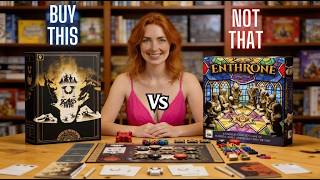
The most detailed take comes from Board Game Critique, whose dedicated head-to-head comparison against Scales of Fate is also the only source that raises real doubts. The two hosts of that video disagree with each other throughout: one defends Enthrone's tight, chess-like design as its strength, while the other argues the same design becomes "a deterministic puzzle" with repeated play. Both agree the production is gorgeous and the core action system is clever at first, but they split on whether that cleverness survives a dozen or more plays. No other channel raises the longevity concern, so it reads as a minority but specific worry rather than a broad consensus.
Core Mechanics That Define Enthrone
The Action Track Priority Queue
Every character on the board also occupies a slot on a shared action track, and only pieces near the top of that track can do anything on a given turn. That same spotlight review summarized it simply: pieces in the top half of the track can move, and the top two can "knock another player out." Board Game Critique's breakdown goes further into the specific thresholds on their copy, describing eight track positions where only the top five pawns can move, the top three can enter the throne space, and the top two can attack, while the bottom three sit completely locked. Whichever piece acts slides to the back of the line, so a player who wants to use a particular character again has to wait several turns for it to climb back up.
Secret Identities and Multiple Win Conditions
At the start of the game each player is secretly assigned one character with a set of other characters it is hunting. That spotlight review laid out the paths to victory: moving the chosen character to the center throne tile, eliminating all of its named targets, or eliminating the opponent's chosen character. Board Game Critique's rundown of the same rules adds a fourth condition on top of those three, in which a player automatically wins if the opponent eliminates four characters without having already won. Because identities are hidden, every move a player makes toward the throne or toward an elimination doubles as a signal the opponent has to interpret.
The Enthrone Experience
A Game of Reading Intentions
Grant Lyon's hands-on description captures what it feels like to sit across the board from an opponent: "when an opponent moves a character, you're constantly thinking, is that their character? Do they want me to think that's their character? Do they want me to capture that character because they care about capturing that?" That constant second-guessing is the appeal both enthusiastic reviewers point to, since every move can be a genuine attempt or a deliberate fake.
Fast, Repeatable Sessions
Both Grant Lyon and Board Game Critique frame Enthrone around short run times. Grant Lyon clocked a typical game at about 15 minutes and said they wanted to "play it over and over again" right after finishing one. Board Game Critique's hosts echoed that their fastest games wrapped in under 15 minutes, which let them "play it three or four times in an evening, rapidly iterating on strategies" even while they debated whether that speed came at the cost of depth.
What Makes Enthrone Stand Out
Sculpted Production Value
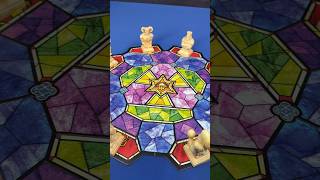
Every reviewer who handled the game singled out its physical presentation. Grant Lyon called it "insanely good production value" with "such a cool look," and in a separate roundup segment described "a bunch of big old miniatures" that make the game "look really cool" on the table. Board Game Critique's hosts detailed the components more specifically: eight finely sculpted three-inch fantasy busts and a four-piece illustrated stained-glass board that they agreed "looks absolutely stunning on the table."
An Elegant, Chess-Like Focus
Several reviewers reached for chess as a reference point. That same spotlight review described Enthrone as feeling "chess adjacent," partly because of the large pawn-like pieces, and Grant Lyon told viewers who are "a fan of games like chess" to check it out. One Board Game Critique host defended that comparison directly, arguing the appeal is that "the rules are simple, but strategic depth comes from the interactions between simple elements," the same way chess works.
Potential Drawbacks
A Puzzle That Can Become Predictable
The same action track that reviewers praise for creating tension was the target of Board Game Critique's sharpest criticism. One host argued the priority queue becomes something players solve rather than play: "you're just calculating which pawns will be available three turns from now instead of making actual strategic choices," adding that the constraint "stops feeling like tension and starts feeling like the game is playing you." No other channel raised this specific concern, so it stands as one reviewer's take rather than a shared complaint.
Replayability Concerns Without Variable Setup
That same video questioned whether Enthrone holds up over many plays. The hosts noted there are "no variable player powers, no events, nothing that changes up the game," calling it "the exact same structure every single time," with an identical board setup from game to game. They said they began to "worry about the game feeling stale around 10 plays" even though they still found the first several sessions satisfying. This is a forward-looking worry rather than a complaint about the games they had already played, and it did not come up in any of the shorter spotlight reviews.
If You Enjoy Enthrone
- Scales of Fate: Board Game Critique built an entire episode comparing the two games directly, both released around the same time at the same price point with similar two-player hidden-identity premises, though the hosts ultimately disagreed on which one wins.
- Chess: the spotlight review above and Grant Lyon both reached for chess when describing the feel of Enthrone's pawn-like pieces and positional, head-to-head structure.
What Reviewers Are Saying
"I wanted to talk about one of the best games I played last week, which is called Enthrone. It's a two-player only game that kind of feels chess adjacent. Maybe because of these big pawns on the board, but it has this action system that adds in this whole new layer of strategy that I think makes it really interesting."
— Might I Suggest A Game
"Oh my god, this is a board game. It's got insanely good production value, such a cool look, such a cool vibe. I'm currently obsessed."
— Grant Lyon
"It's a positional puzzle with hidden information layered on top. You're trying to deduce which character your opponent controls while simultaneously positioning your own pieces. That action track creates tension because you can't always move the piece you want to move."
— Board Game Critique