



Threaded: A Game of Needles and Points Deep Dive
What the Community Thinks About Threaded: A Game of Needles and Points
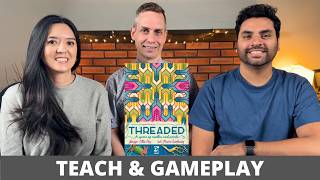
Threaded has captured the attention of board game reviewers with a refreshing theme and clever mechanical design. Reviewers consistently praise the game's commitment to its needlepoint theme, with Dr. Brian McDonald of Brains on Games noting that the game successfully appeals to both experienced gamers and newcomers who are drawn to the craft aspect. While the game's resource management constraints and limited player interaction are not for everyone, critics acknowledge these as intentional design choices that reinforce the theme rather than oversights. The consensus leans positive, with Brains on Games calling it a real winner and a gateway game that might pull in non-gamers, and Allies or Enemies recalling being blown away by an early playtest. Before You Play's playthrough, sponsored by Osprey Games, walks through the full rules.
Core Mechanics That Define Threaded: A Game of Needles and Points
Worker Placement with the Planning and Activation Phases
At its heart, Threaded employs a two-phase turn structure that distinguishes it from many other worker placement games. Players first place their assistants in a planning phase, seeing where others intend to go before any actions resolve. Only after all assistants are placed does the activation phase begin, where actions resolve in alphabetical order by shop. This clever sequencing mechanism means players must anticipate and adapt their strategy based on their placement relative to others, creating tension without direct confrontation. Dr. Brian McDonald emphasizes how important this timing is: while placing workers, each player has to weigh their distance from the first player, whether they are getting the last draft, and how to time things out to get what they want.
Thread Management and the Needle Mechanism
The needle serves as the mechanical heart of Threaded, directly reflecting the needlepoint craft itself. Players can hold a maximum of four threads in their basket and six threads on their needle. Crucially, threads on the needle must be threaded from either end, matching real needlepoint technique. To complete a tapestry, players must use threads in the exact sequence required by the pattern, and they can only access them from one end of the needle. This seemingly simple constraint creates substantial strategic depth. Players must carefully arrange their threads in anticipation of future tapestries, managing sequences across the needle while dealing with the limitation that removing threads from the middle forces them to discard the outer threads to scraps. The Cardboard Herald describes this as a game of "preparation, sequencing, and perfectly threading the needle," where the mechanical restriction becomes thematic rather than punitive.
The Threaded: A Game of Needles and Points Experience
A Beautifully Committed Thematic Journey
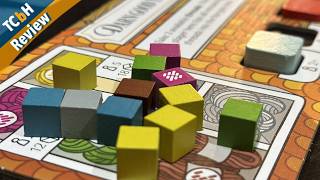
What sets Threaded apart is how thoroughly it commits to its needlepoint theme. Rather than applying a theme as window dressing, Osprey Games has designed every element to reinforce the experience of embroidery work. The game includes a crafting kit allowing players to create their own first player marker using yarn and a needle, adding a hands-on element that reviewers found delightful. The table presence is strong, with colorful cubes representing threads and an elegant bargain bin tower mechanism that adds visual interest. The Cardboard Herald notes that Threaded "evokes the thematic implications really well," making mechanics feel natural rather than abstract. Even the scrap exchange rate, which reviewers describe as generous, makes sense thematically as crafters salvaging useful bits from their discards.
Strategic Depth Within Accessible Rules
Threaded proves that simplicity in rules does not mean simplicity in decision-making. Players face constant meaningful choices about commission card synergies, thread acquisition timing, and sequence planning. The game offers low overhead in terms of learning curve, making it accessible as a gateway game, yet once in play, the depth emerges from managing limited resources and sequencing constraints. Games take thirty to forty-five minutes, staying lean while delivering satisfying strategic decisions throughout. Reviewers appreciate that despite the straightforward ruleset, the game demands planning and tactical thinking about when to commit to specific tapestry sequences and how to time the collection of commission cards that will eventually score points.
What Makes Threaded: A Game of Needles and Points Stand Out
The Needle Mechanics as Thematic Brilliance
Rather than mechanically restricting players with arbitrary rules, Threaded grounds its limitations in authentic craft technique. Players cannot simply pull any thread they want from their collection; they must work from the ends of their needle in sequence. This design choice elevates the game beyond being merely about needlepoint into authentically feeling like needlepoint. Reviewers note that this commitment to mechanical authenticity is unusual and praiseworthy. The game's designer, Ellie Dix, chose to make sequencing central, and reviewers recognize this as a deliberate artistic choice that unifies theme and mechanics.
Gateway Appeal Without Compromise
Many games that successfully attract non-gamers do so by oversimplifying mechanics. Threaded strikes a different balance. Dr. Brian McDonald observed that even players unfamiliar with needlepoint found the game engaging, the bright artwork and clever mechanisms appealing across the table. The game appears light in its presentation but delivers genuine strategic decisions. This makes it an ideal game for bringing people into the hobby who might never have considered worker placement as "their kind of game."
Potential Drawbacks
Resource Restriction May Frustrate Some Players
The intentional scarcity of storage space and the rigid sequencing on the needle are not without cost. Some players prefer having abundant options and the ability to pivot strategies mid-game. The Cardboard Herald calls the game rigid in the way some spatial arrangement games can be, and reports that the meticulous sequencing of thread broke the brain of a partner who routinely plays Gloomhaven and Ark Nova with no problems; that partner did not hate it, but was not eager to play again soon. If a player values flexibility and the ability to recover from bad luck or miscalculation, Threaded's unforgiving resource constraints may frustrate. There is little safety net for poor planning; the game rewards those who think several steps ahead.
Limited Player Interaction and Interaction Styles
While the game avoids direct attacks, player interaction is constrained. You cannot significantly disrupt opponents beyond blocking board spaces through standard worker placement. If your enjoyment of games depends on rich interactive opportunities to affect other players' plans, Threaded may feel isolating despite shared table time. Players largely pursue parallel paths toward their own commission card synergies. Dr. Brian McDonald acknowledges this as a design choice, noting that despite simple rules, "there's not too much player interaction," though the reviewer did not consider this a serious drawback. Others may view it differently based on their preferences.
If You Enjoy Threaded: A Game of Needles and Points
Reviewers draw few direct comparisons for Threaded. Brains on Games notes that Osprey Games is best known for wargames such as Undaunted, which makes Threaded a notable change of direction for the publisher; players who trust Osprey's design sensibility may want to look at both. The Cardboard Herald's household offers a useful calibration in the other direction: comfort with heavier games like Gloomhaven and Ark Nova did not guarantee comfort with Threaded's sequencing puzzle, so players who enjoy tight, narrow rule sets with rigid obstacles to navigate are the natural audience.
What Reviewers Are Saying
"It's bright. It's colorful. You've got this fun tower where you're dropping cubes into. I think this is really a gateway game. I think people who maybe aren't into the board gaming hobby, but who do needle point maybe would get sucked into a game like this and then all of a sudden, oh my gosh, worker placement. This is great."
— Dr. Brian McDonald, Brains on Games
"Threaded really commits to the bit in a way I appreciate. Altogether it's pretty abstract, but you get why you're doing what you're doing, and it evokes the thematic implications really well, which in turn makes understanding what the game wants you to do pretty simple."
— The Cardboard Herald
"I actually played a really early playtest of this and I was blown away then and that was basically just like drawn on scraps of paper, but it was a good game then. And it really didn't change that much to where it is now except that now it looks beautiful."
— Allies or Enemies