


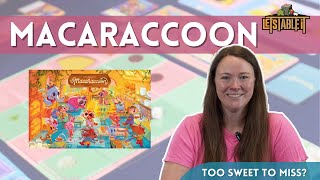




Macaraccoon Deep Dive
What the Community Thinks About Macaraccoon
Macaraccoon has captured the attention of board game reviewers as a standout title that successfully merges thematic charm with light but satisfying gameplay. Reviewers consistently praise the game for its inviting aesthetic and accessible design, describing it as a title that works equally well for families discovering modern board games and for experienced gamers seeking a quick, tactical play session. Meeple University's Taran notes that the game strikes an uncommon balance: "the action choice was simple enough to be gateway but intriguing enough to appeal to gamers," a sentiment echoed across multiple channels. The consensus is that Macaraccoon from publisher Memesys Culture Labs nails its design goals without attempting to reinvent core mechanics, instead refining familiar systems through excellent production and thematic integration.
Core Mechanics That Define Macaraccoon
Recipe Building with Transparent Cards
At the heart of Macaraccoon lies a novel approach to recipe fulfillment. Players construct dishes by stacking transparent acrylic cards in a precise order, creating a visual satisfaction that reviewers highlight as the game's signature innovation. Each recipe requires a specific sequence: bases at the bottom, spreads in the middle, and toppings on top. As Meeple University explains, "It looks simple on the surface, but it's very clever little mechanism where you are stacking them up." The transparent nature of the cards means players can see the entire layered structure as it builds, adding a tactile and visual element rarely seen in card games. You must place ingredients carefully, as they can only go on the top or bottom of an existing stack, never in the middle, creating meaningful spatial puzzles that grow more complex as your plates fill.
Set Collection Through Resource Management
Collecting the right ingredients at the right time forms the core loop of Macaraccoon. Players navigate a 4x4 kitchen grid, always taking ingredients adjacent to the moving empty space, then moving to fulfill customer orders to score hearts (victory points). The sugar cube economy sits at the center of this system, offering flexibility that keeps the game flowing. These versatile cubes allow players to skip past unwanted ingredients, jump ahead in the customer queue, activate special critter powers, or fuel combo turns through "sugar rushes" that grant extra actions. Reviewers note how this currency design prevents the game from feeling punishing while maintaining meaningful choices. Grant Lyon points out that "the transparency cards that need to be in a very specific order make this feel different than other recipe fulfillment games," demonstrating how the Recipe and Set Collection mechanics reinforce each other through the game's production design.
The Macaraccoon Experience
Cozy and Inviting
Macaraccoon wraps its mechanics in warmth and comfort. The fictional town of Sugarmouth, where retired bake master Raccoon has left a legacy for players to claim, creates a low-stakes, nurturing atmosphere. Reviewers consistently mention the game's charm and adorableness, from the punny critter names like Choco Chipmunk and Jello Pant to the food-themed artwork. kovray notes that "the theme is just so inviting. You just want to be a part of this universe." This coziness extends to the gameplay experience. Turn structure is straightforward, downtime is minimal, and no single turn feels punishing when things don't go according to plan. The game plays in 45 to 60 minutes, quick enough to fit into a casual game night without becoming a sprint or overstaying its welcome.
Whimsical and Playful
The raccoon-chef theme carries a playful, fantastical quality that prevents the game from ever feeling heavy or competitive in tone. Critters with charming names staff a magical kitchen filled with edible-looking components, and the overall presentation encourages lighthearted engagement rather than serious optimization. An Unknown Channel reviewer notes the game "looks so sweet, you can practically taste it," describing how the aesthetic invites engagement. kovray's Ia and Tyler open their review with a relatable moment about a raccoon putting cotton candy in water and watching it disappear, grounding the whimsy in familiar, funny moments. This lighthearted energy means losing feels fine, and winning is presented as joining a legacy rather than crushing opponents. The combination of simple turn structure, forgiving resource economy, and inviting theme creates a play experience that feels more like gathering friends for a treat than competing for dominance.
What Makes Macaraccoon Stand Out
Transparent Acrylic Cards as Mechanism
The use of transparent cards as the central production component elevates Macaraccoon beyond typical recipe games. These acrylic layers stack together to create visibly layered recipes, turning ingredient collection into a satisfying visual achievement. Reviewers consistently call out this choice as clever and underused in board game design. An Unknown Channel reviewer states, "the acrylic order cards...stack together to make layered recipes, and it's such a satisfying, underused mechanism." The transparency serves a dual purpose: it reinforces the recipe-building theme while creating a physical component that players can admire as they play. Beyond aesthetics, the transparent nature directly supports gameplay, making it immediately clear what ingredients form each plate and whether an order can be fulfilled.
Sugar Cube Economy and Combo Turns
The sugar cube system drives both accessibility and depth. These tokens function as a flexible resource that grants experienced players a path to powerful combo turns while remaining entirely optional for newer players. kovray demonstrates this elegantly in their review, explaining how building up sugar over multiple turns allows for "sugar rushes" that chain extra actions together, creating cascading turns where each action generates the resources for the next. An Unknown Channel reviewer captures the balance perfectly: "It keeps the game moving and prevents it from feeling too punishing" while simultaneously giving "more experienced players just enough decision space." The sugar economy teaches new players gradually, as the combo mechanic isn't immediately obvious but becomes increasingly satisfying as familiarity grows.
Potential Drawbacks
Light Strategic Depth
Macaraccoon is fundamentally a light game, and some players seeking deeper strategic challenge may find the decision space limited once they internalize the optimal sugar cube usage. An Unknown Channel reviewer acknowledges this directly: "the game is lighter than it might first appear. If you're looking for a deep strategy game, this probably won't hit that mark." The actions themselves are simple: take an ingredient, serve an order, or activate a critter power. Experienced gamers might resolve their turns quickly and feel the game lacks the complexity they typically pursue. However, reviewers position this as a feature rather than a bug, emphasizing that Macaraccoon succeeds precisely because it knows what it is and executes that vision cleanly.
Prototype Status and Component Clarity
At the time of these reviews, Macaraccoon existed in prototype form heading toward crowdfunding, meaning some mechanical or production elements remain subject to change. Meeple University's Stella and Taran explicitly note they're "going to crowdfunding shortly," and kovray mentions "this is a prototype, so everything you see here may be subject to change." Additionally, one reviewer observes that "the order cards can be a little tricky to parse sometimes, and it's not always obvious which ingredient is stacked where," suggesting that clarity in component layering could still be refined. These concerns are not criticisms of the core design but rather typical growing pains for any game transitioning from prototype to retail release.
If You Enjoy Macaraccoon
Reviewers recommend Sweet Mess as a direct comparison point. Meeple University draws the link explicitly, noting that both games feature animals collecting ingredients to create desserts and operate within a similar design philosophy: simple action choice paired with satisfying puzzle-like optimization. Both sit comfortably in the light, cozy category while offering enough mechanical depth to reward thoughtful play. Beyond Sweet Mess, Macaraccoon would appeal to fans of set collection games like Calico that prioritize aesthetic pleasure alongside gameplay, and to players seeking accessible family games with genuine decision-making such as Splendor. The transparent card stacking mechanism may also intrigue players drawn to tactile, component-focused games like Wavelength or 7 Wonders that emphasize the physical act of building.
What Reviewers Are Saying
"It looks simple on the surface, but it's very clever little mechanism where you are stacking them up, you're limited to three plates, and once you stack something on top that is out of order, you can't put it out of order, but once you've got something that's on top that you can't give to a customer, you can't separate it again."
— Meeple University
"The theme is just so inviting. You just want to be a part of this universe."
— kovray
"This is a very cute game with the artwork and the theme, and I think the transparency cards that need to be in a very specific order make this feel different than other recipe fulfillment games."
— Grant Lyon