






Traintopia Deep Dive
What the Community Thinks About Traintopia
Traintopia has struck a chord with reviewers who value quick-playing games that deliver accessible, engaging gameplay without demanding a steep learning curve. The consensus among players who have covered the game centers on its charm as a light-to-medium weight euro game that bridges casual and experienced audiences. Reviewers consistently highlight how the game maintains its appeal across different player skill levels, making it equally suitable for families introducing newer players to modern board games or for seasoned gamers looking for a 30-minute network-building experience between heavier titles.
Core Mechanics That Define Traintopia
Drafting and Network Construction
At its heart, Traintopia is a drafting game where players take turns selecting tiles and wooden pieces from a public offer to expand their personal train networks. Reviewers describe the drafting as smooth and fair; there is always something useful to grab, even for the last player in a round. Ryan Bethany Board Game Reviews highlights how "there was never any shortage of good choices. If you took a tile, where you're going to place it matters. Which track are you going to put it on?" This elegant turn structure means every decision carries weight without leaving anyone with worthless options. The tiles themselves layer onto the board with clean adjacency rules, allowing players to build increasingly complex networks of rail routes.
Resource and Passenger Management
The game's secondary layer involves managing passengers and money tokens, both of which feed into the scoring system. Commuters of different colors (green, yellow, and gray) each have terrain preferences, earning players points when placed on matching districts along their routes. White tourists instead seek out attractions and monuments, scoring based on what they pass. Money tokens can be hoarded for end-game scoring with trains or spent strategically to acquire bonus tiles or swap out objective cards. Mailbags act as multipliers, doubling the value of completed tracks. This multi-layered approach to point generation means players have numerous viable strategies; some might focus on long trains and money accumulation, while others prioritize passenger satisfaction and terrain matching.
The Traintopia Experience
Accessible Yet Strategic Depth
Reviewers consistently note that Traintopia walks an interesting line between gateway accessibility and genuine strategic decision-making. Playthroughs Free Me summarizes this duality: "This is both something that is easy enough for me to play with more casual gamers or non-gamers, or with my children, but we can also play this as gamers." The game teaches quickly, with turns that feel seamless because the core action is simple: draft a piece, place it on your board. Yet beneath that simplicity lies meaningful choice. Ryan Bethany Board Game Reviews captures this: "You take something, you take something, you take something, you take something. It's just really smooth on how that happened. It just turned over and then you just flip that card over, fill it up and start again." The turns flow so naturally that players never feel bogged down by complexity.
Charming Presentation and Quality Components
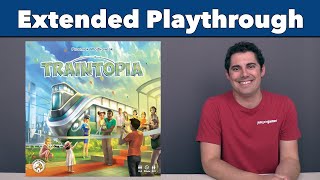
Beyond mechanics, reviewers praise the production values that Board & Dice has brought to Traintopia. The tiles are notably thick and durable, and the game includes finely detailed wooden trains and luggage pieces that feel premium to handle. Knights Around a Table comments on the small meeples: "There are green, yellow, gray, white, and some cards. They're quite adorable." The artwork on the box and cards leans toward a family-friendly aesthetic with colorful characters and a vibrant visual style, though some reviewers note this might mislead hardcore train enthusiasts into thinking the game is lighter than it actually plays.
What Makes Traintopia Stand Out
Multiple Paths to Victory
Traintopia avoids the trap of a dominant strategy. Victory points flow from many sources: passenger bonuses tied to terrain matching, tourist attractions, train money accumulation, track length bonuses, mailbag multipliers, and objective card fulfillment. Ryan Bethany Board Game Reviews observes: "There's points from all different colored meeples that you can draft, there's points from the trains, there's points from the train tracks. So there's just so many different ways that you can score." This abundance of scoring vectors means that players who pursue radically different strategies can all remain competitive, encouraging table diversity and replayability.
Beautiful Tile-Laying Puzzle Without Harsh Penalties
The tile-placement core is satisfying and forgiving. Unlike some tile-laying games where a single poor placement cascades into constraint, Traintopia allows flexible board states. Players can offset tiles and adjust their network trajectory mid-game. The only strict rule is that tracks must connect and not dead-end unnecessarily, which is easy to remember and enforce. Reviewers appreciate this balance between having enough structure to feel like a puzzle and enough flexibility to recover from a bad draw or suboptimal play.
Potential Drawbacks
Tile Offset Ambiguity and Spatial Reasoning Demands
A few reviewers note that while the game allows tile offsets for flexible placement, the exact rules around quadrant alignment could occasionally create confusion. Knights Around a Table touches on this when examining component design: "With tile games like this, I'm not too sure if offset like that is configuration on the back... with Carcassonne and lots of other tile laying games, that's a no-go." While not a major barrier, newer players building their first few networks might need clarification on placement legality, particularly when creating complex offset patterns.
Limited Novelty for Tile-Laying Veterans
For players deeply familiar with Carcassonne or other classic tile-placement games, Traintopia's core loop may feel familiar. Jungus Games reflects on this after playing: "I played Carcassonne three weeks ago and I think I would just always rather play Carcassonne. Traintopia is a fine game, it had some really neat ideas, but when it comes to a tiling game where I'm just putting square tiles down, I'm still pretty stuck on the classic." The game innovates through its passenger and scoring mechanics rather than through tile placement itself, which means devoted tile-puzzle enthusiasts might find the underlying architecture less compelling than games that push the tile-laying genre in new directions.
If You Enjoy Traintopia
Traintopia draws clear lineage to Ticket to Ride, with which it shares a network-building theme and focus on route completion. If Traintopia appeals to you, Ticket to Ride offers a similar "build routes and score points" fantasy but with even lighter rules and a focus on card drafting for routes. Ryan Bethany Board Game Reviews makes this comparison explicit: "I love train games. This gave me all those same feelings in a really really really short 30-minute package." Players who want more tile-placement depth should consider Carcassonne, which layers spatial puzzle-solving more deeply but at the cost of slightly more complex tile rules. Both comparisons suggest that Traintopia succeeds as a bridge game, offering enough novelty and mechanical variety to stand on its own while remaining approachable enough for players discovering modern board games.
What Reviewers Are Saying
"There was never any shortage of good choices if you took a tile for instance where you're going to place it why did you take it in the first place. So there's just so many different ways that you can score. There's points from all different colored meeples that you can draft, there's points from the trains, there's points from the train tracks."
— Ryan Bethany Board Game Reviews
"This is this is both something that is easy enough for me to to play with more casual gamers or non-gamers or or with my children and stuff but we can also play this as gamers."
— Playthroughs Free Me
"The turns were very seamless and very smooth. You take something, you take something, you take something, you take something, and that's it. And then it's over and then it's the next round, and it was really smooth on how that happened, on how it just turned over and then you just flip that card over, fill it up and start again. It was just really really seamless. I love games that give you tough choices and good choices."
— Ryan Bethany Board Game Reviews