






Dicey Devices Deep Dive
What the Community Thinks About Dicey Devices
Dicey Devices draws genuine enthusiasm from the board game community, but with real reservations. Reviewers appreciate its mad-scientist theme and the clever hybrid of dice banking mechanics with engine building, praising how the game combines complexity with strategic depth. The instant-win condition via death ray sets it apart from traditional point-based Euros. However, the game carries a significant caveat: dice luck plays an outsized role in determining outcomes, with limited mitigation available. As one reviewer noted, you can spend the game building an impressive tableau and death ray only to watch poor rolls render your carefully constructed engine useless. This tension between strategic planning and dice volatility defines the experience, and whether that appeals to you largely determines whether Dicey Devices clicks.
Core Mechanics That Define Dicey Devices
Dice Rolling and Banking
At its heart, Dicey Devices is a dice game, but not in the way many expect. Rather than pure randomness, the dice-banking mechanic gives you agency. Each turn you roll two lab dice and can either split them to activate different sections of your laboratory or combine them for higher values. Crucially, you can bank dice values to a future turn, storing them with inactive bots. This creates a push-your-luck dynamic where you weigh immediate activation against future flexibility. The banking system is the game's primary mitigation against bad rolls, allowing skilled players to recover from unfortunate rolls by building a reserve of stored values. Yet as reviewers point out, this mitigation is imperfect: banks take up space, banking limits exist, and when you need a specific number and fail to roll it, there is no guarantee your stored values will help.
Engine Building and Tableau Composition
Your laboratory is your engine, and it grows throughout the game as you acquire device cards from the scrapyard. Each card occupies a numbered section and generates resources, combos with adjacent cards, or enables special abilities when activated. As your tableau expands, your rows grow more powerful, activating more cards per turn and generating more resources. The strategic depth comes from card placement and combo selection rather than from the roll itself. Reviewers particularly enjoy this layer, noting that experienced players can construct tableaus that generate consistent advantage. The engine payoff feels satisfying when your cards activate in cascading chains, and the variety of available modules means no two games produce identical engines.
The Dicey Devices Experience
Retro Mad-Science Chaos and Theme Immersion
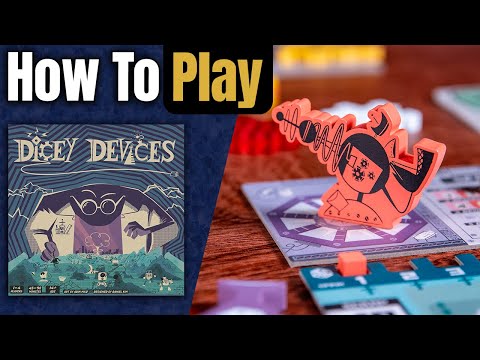
The mad-scientist setting is more than window dressing. Reviewers consistently highlight the theme as a draw: you are building a death ray with laboratory equipment and robotic minions, competing to incapacitate rival scientists. The visual identity reinforces this with bright, colorful components and a retro aesthetic that echoes games like Collab and The Loop. The presence of Eigor, your loyal assistant who can be deployed to aid revival, add revives, or boost your scrapyard presence, brings personality to the mechanical systems. The theme creates a sense of escalating tension as players slowly assemble their death ray modules, knowing that once complete, the game can end suddenly.
Risk and Reward of the Banking and Activation Window
Dicey Devices creates moments of genuine tension around dice placement and banking decisions. You must constantly balance activating your laboratory now for immediate resources versus banking dice for future turns when you might need specific values for defense or combo chains. Late in the game, this becomes acute: a player with a complete death ray and strong defense position still cannot guarantee their next attack will land if the dice rolls do not favor them. Reviewers describe this as frustrating at times, but also as the source of the game's dramatic moments. Games do not end on a score track but with a literal blast, and that instant-win condition creates a high-stakes endgame where luck and preparation collide.
What Makes Dicey Devices Stand Out
Instant-Win Condition in a Euro Format
Most Euros resolve through point accumulation, with the highest scorer winning at game end. Dicey Devices flips this: players compete to assemble death ray modules and execute a lethal blast that knocks out all opponents. This creates a fundamentally different tension arc. You are not comparing point totals at game end; you are racing to complete a combo that lets you eliminate opponents one by one. The mechanic feels fresh in a design landscape dominated by incremental scoring, and reviewers note it as one of the game's most memorable qualities. It also means player elimination, though the revive mechanic softens this by allowing knocked-out players to re-enter.
Module Variety and Tableau Building Freedom
The scrapyard offers a wide array of device cards, augments, and event cards, each with distinct effects. Device cards range from basic resources generators to complex combos that break normal rules. Special cards and events add randomness and surprise. This variety means your tableau can be built in many directions, and the cards you acquire determine your strategic path. Reviewers enjoy the planning aspect: knowing what cards are in the scrapyard, you can guide your bot majority toward specific sectors to purchase cards that synergize with your existing engine. The result is that each game creates a different puzzle, and no two players' laboratories look alike.
Potential Drawbacks
Dice Luck With Limited Mitigation
The most consistent concern voiced by reviewers is the weight that dice rolls carry. During the lab phase, you roll two dice and assign them to sections. Good rolls let you activate more sections and power your engine. Bad rolls leave you stranded. While dice banking provides some mitigation, reviewers note it is not enough. A reviewer captured the frustration candidly: you can roll all ones and twos while your opponent rolls all fives and sixes, and your elaborately constructed death ray with many modules will fail where their smaller ray succeeds. In short rounds, a lucky player can snowball advantages, and there is no catch-up mechanism beyond the chaos of multi-player dynamics. If you dislike games where luck can overpower preparation, Dicey Devices will test your patience.
Best at Three to Four Players; Two-Player and Higher-Count Imbalances
Reviewers identified clear scalability issues. At two players, the game becomes a bilateral blast race: whoever lands an early lucky hit and knocks out the opponent may win before the game really begins, since the knocked-out player rolls doubles only occasionally for revival. At three or four players, the dynamic improves because players can collectively mitigate one player's dominance. However, at higher player counts, the risk of multiple players ganging up on one target increases. The revive mechanic ensures you are never fully eliminated, but extended control can feel oppressive. The sweet spot is three to four players, and reviewers recommend avoiding two-player games unless you enjoy high-variance finishes.
If You Enjoy Dicey Devices
Reviewers consistently point to Collab and The Loop as natural companions, both sharing the mad-scientist theme and retro aesthetic that gives Dicey Devices its personality. Collab similarly leans on down-on-their-luck scientists sharing a workspace, while The Loop flips the premise into stopping a mad scientist's schemes. Fans of engine-building games with dice-driven variance and a high-stakes instant-win twist should find Dicey Devices a fitting addition alongside these titles.
What Reviewers Are Saying
"It's doing something very clever with its mix of area control and tableau building. I love tableau building. I really like dice placement. So it's really kind of designed for me as far as that goes."
— J the Hungry Gamer
"You have the best tableau, you do all kinds of cool stuff, get all kinds of bots, win all kinds of area control things, and just roll crappy and you get blasted and knocked out. And you can't wake back up unless you spend your scrap to wake up, or you have these great blasts and you just roll poorly and they keep defending against it, and that can get frustrating."
— J the Hungry Gamer
"There's definitely a good amount of luck here with all of the dice rolling, but there's also a good amount of complexity and strategy with the various card abilities and combos."
— Grant Lyon