













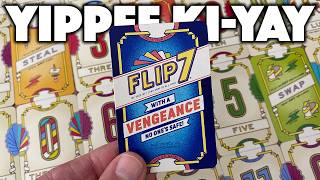
Flip 7: With A Vengeance Deep Dive
What the Community Thinks About Flip 7: With A Vengeance
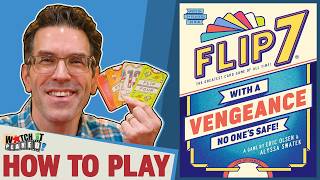
Flip 7: With A Vengeance has resonated strongly with board game reviewers as a successful evolution of its predecessor. Where Flip 7 earned praise for its addictive push-your-luck simplicity, the sequel doubles down on player interaction and takes clear aim at becoming a deliberately meaner experience. The consensus among reviewers is decidedly positive, though with an important caveat: this game is not for everyone. Several reviewers note that Flip 7: With A Vengeance works best with players who embrace confrontational gameplay and can laugh when their scoring plans get dismantled. Watch It Played's comprehensive tutorial and multiple casual review channels affirm the game's appeal, while reviewers at Board Game Co and Going Analog emphasize that the "meanness" is its defining feature rather than a design flaw. Grant Lyon called it a must-try for anyone who loved the original but wanted more table interaction.
Core Mechanics That Define Flip 7: With A Vengeance
Push Your Luck
Push Your Luck remains the heart of Flip 7: With A Vengeance. On each turn, players face the recurring decision to hit or stay, collecting cards that grant points. The deck follows a carefully balanced distribution: there is one 1, two 2s, three 3s, up through twelve 12s, and crucially, thirteen 13s. Getting a duplicate card causes the player to bust, losing all points accumulated in that round. Reviewers emphasize how this creates genuine tension. Each additional card drawn moves a player closer to a duplicate, but the variable distribution means that high-value cards are statistically riskier. A player holding a 13 cannot safely draw another 13, but with so many in the deck, the temptation to press remains fierce. This push-your-luck core is identical to the original Flip 7, making With A Vengeance accessible to anyone familiar with the base game while allowing players to gradually escalate their aggressive play strategies.
Take That Action Cards
The most significant new addition is the action card system, which transforms Flip 7 from a luck-pressing game into a table-warfare scenario. When a player draws an action card, they target another player (or themselves) to resolve its effect. Reviewers highlighted several brutal options: the Steal card lets you take any card from an opponent, the Swap card exchanges cards between any two players (potentially busting both), and the Flip Four forces a target to draw four cards in sequence. The Discard card removes a card from any player's display, while the Freeze (Just One More) forces a target to draw exactly one more card and then stay for the rest of the round. Grant Lyon and the Going Analog podcast both emphasized that these cards create "moments of vengeance"—satisfying instances when a player who has been dominating the round gets knocked out by a perfectly-timed action. Unlike modifier cards that merely drain points, action cards force opponents to make game-altering decisions in real-time, creating interaction that extends beyond simply passing cards around the table.
The Flip 7: With A Vengeance Experience
Chaotic, Explosive Laughs
Reviewers consistently described Flip 7: With A Vengeance as genuinely fun to play despite its confrontational nature. The Tantrum House crew's full playthrough captured the energy: gasps when someone draws the Unlucky Seven (which discards all prior cards), excited shouts when a Swap card creates simultaneous busts, and nervous laughter as players watch their hard-earned scores get whittled down by modifiers. One Unknown Channel host stated emphatically that even though he scored zero points over an entire game, he "still had a blast playing it." This suggests the game's appeal transcends the scoreboard. The action cards create memorable moments. When someone successfully uses the Swap to force two opponents into duplicate pairs simultaneously, the entire table reacts. It is not about personal success but about the shared experience of table chaos and creative player interaction. Reviewers noted that the game moves quickly enough that lopsided turns do not create long downtime; another dealer pass comes soon, giving everyone chances to mess with each other.
The Thrill of Vengeance and Payback
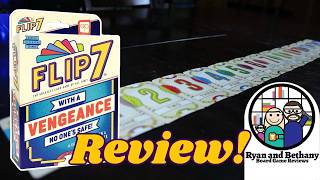
The game's title promises vengeance, and reviewers confirm it delivers. Ryan and Bethany Board Game Reviews noted that the "meanness" in With A Vengeance is intentional and structured, unlike games that feel unfair. When a player hands off a negative modifier or uses an action card strategically, there is a satisfying logic: "I saw you ahead, so I'm targeting you." Going Analog described watching someone who was "suffering the whole time while another player was relaxing on a beach getting rejuvenated at the spa," showing the game's wild variance. This variance, driven by who gets targeted and when, is not a bug but the intended experience. Reviewers appreciated that Flip 7: With A Vengeance does not hide behind randomness; it embraces direct player antagonism as a fun mechanism. However, Board Game Co's Alex Radcliffe cautioned that this requires table chemistry. Some players will thrive on the back-and-forth; others will find it exhausting. The game's forty-minute-to-longer playtime (compared to Flip 7's brisker pace) is a direct result of negative modifiers and action cards slowing score accumulation, meaning players should expect extended periods of payback and counter-payback.
What Makes Flip 7: With A Vengeance Stand Out
Intentional Design Escalation
Unlike many sequels that tack on mechanics, Flip 7: With A Vengeance was reportedly commissioned by Walmart as a "mean Uno" alternative, per the Going Analog podcast. This intentionality shows. The game did not add a few action cards and call it a day. Instead, designers scaled the entire experience: going from 12s to 13s in the number range, replacing Flip Three with Flip Four to intensify forced drawing, and swapping all positive modifiers for negative ones. Ryan and Bethany noted that this made house rules impossible; the game's structure actively prevents players from toning down the meanness externally. Every design choice reinforces the "vengeance" fantasy. Even the special cards (Lucky 13, Unlucky Seven, Zero) exist in service of chaos rather than balance. The Lucky 13 is the only genuinely helpful special card in a sea of setbacks, making it a prized draw. This calculated imbalance signals that Flip 7: With A Vengeance knows what it is and commits fully to its identity.
Scalability Across Player Counts
Both Flip 7 games scale to extreme player counts, but With A Vengeance handles high counts especially well. Grant Lyon noted the base game plays three to twenty-eight players with a single deck, and reviewers mentioned that the additional interaction actually becomes more valuable when sitting with a larger group. With more players, each person's turn cycle stretches longer, giving plenty of opportunities for others to target them in the interim. Board Game Co remarked that scaling up the score target (to 150 or 100 points instead of 200) keeps the game moving at higher counts while maintaining the chaotic energy. The action cards mean everyone stays engaged even when not actively playing, watching for opportunities to interfere. By contrast, some press-your-luck games lose traction with too many players because the downtime between turns becomes oppressive. Flip 7: With A Vengeance avoids this by giving every player reasons to watch what others are doing and plan their interventions.
Potential Drawbacks
Extended Play Time and Score Attrition
Several reviewers flagged that With A Vengeance plays longer than its predecessor, and not always in the best way. Board Game Co's Alex Radcliffe gave the game a 3.5 out of 5, noting that negative modifiers and score-reduction cards "drag down and slow down the game a little bit." Instead of exciting rounds where players race toward 200 points, games can devolve into grinding where modifier cards and divide-by-two effects mean players barely creep forward. The Going Analog podcast acknowledged this reality and noted many players house rule the target score downward to 100 or 150 points to recapture the original's brisk pace. This is not a flaw per se, but it signals that the game demands active table management. Players buying With A Vengeance should expect forty-five minutes to an hour in many sessions, not the advertised twenty minutes. Casual groups may find the extended grind less satisfying than Flip 7's quick rounds.
Table Selection and Group Chemistry
The most significant caveat reviewers raised is that Flip 7: With A Vengeance requires the right group. Ryan and Bethany emphasized that players must be comfortable with the "take that" nature, and several reviewers noted that some people simply do not enjoy games where opponents directly interfere with their plans. Board Game Co stated the game is "more surgical" in its player selection than the original, meaning some players will be delighted while others feel ambushed. Going Analog warned explicitly: "make sure you're not playing with people who get butt hurt easily." Grant Lyon did not phrase it as harshly but confirmed that players signing up for this game need to accept targeted attacks as part of the fun. Unlike Flip 7, where most interaction is incidental to luck, With A Vengeance puts confrontation front and center. Casual acquaintances may tolerate it; players who dislike direct player interaction will actively resent it. Groups strong enough to laugh together when their plans implode will have a great time. Those without that chemistry may find the game creates genuine frustration.
If You Enjoy Flip 7: With A Vengeance
If Flip 7: With A Vengeance scratches your itch for chaotic push-your-luck gameplay, you should absolutely revisit Flip 7, the original base game. With A Vengeance is marketed as a sequel, but Flip 7 stands perfectly on its own and offers a cleaner, faster experience focused on the press-your-luck core without the constant antagonism. Many reviewers appreciate both games and reach for them in different contexts: Flip 7 for quick parties, With A Vengeance for groups that explicitly want confrontation. If you enjoy the meanness and table warfare, Uno (especially mean house rule variants) shares the same appeal of simple rules masking cutthroat interaction. Both Uno and Flip 7: With A Vengeance reward players who read the table and time their attacks for maximum chaos. Beyond these, Alex Radcliffe recommended Can't Stop and Quacks of Quedlinburg for push-your-luck mechanics without the direct confrontation, though those games lack the "take that" elements that define With A Vengeance's appeal.
What Reviewers Are Saying
"I think Flip Seven with a Vengeance is the greatest card game of all time. It's a meaner version, and the meanness in this game is just fun. We play with four players, which is about when it starts to get fun, but higher player counts is when it gets really fun."
— Watch Review
"The Swap card is one of the worst ones. You can swap any two cards at the table. So I could benefit myself or I could look at Ryan and another person, make them swap cards and bust both of them. That is the big fun moment when you realize that you could really mess up the table."
— Ryan and Bethany Board Game Reviews
"This game has a lot of things going on, and everything is meaner. Instead of giving you cards that give you extra lives, that give you extra points, that multiply your score, instead you have cards that divide people's score, subtract their points, and make players more likely to bust. That slows down the game, but the meanness is satisfying and fun for the right group."
— Board Game Co