



Dice Kingdoms of Valeria Deep Dive
What the Community Thinks About Dice Kingdoms of Valeria
Dice Kingdoms of Valeria represents a standout entry in the roll-and-write genre, and reviewers consistently praise it as an approachable yet strategically rich experience. Daily Magic Games' design captures the essential appeal of the Valeria universe while introducing a fresh mechanical framework that resonates with board game communities across different experience levels. The consensus is striking: this is a game that works exceptionally well as both a family-friendly introduction to roll-and-writes and a satisfying strategic puzzle for experienced players. Reviewers highlight how the game achieves a delicate balance between accessibility and depth, with its beautiful artwork and clear iconography making the learning curve manageable without sacrificing engaging decisions. The simultaneous action system ensures that every turn matters for every player, addressing a common complaint in the hobby about downtime.
Core Mechanics That Define Dice Kingdoms of Valeria
The Dual Dice System
At its heart, Dice Kingdoms operates on an elegant split between shared resources and personal choice. Each turn, six dice are rolled, but the first two black harvest dice apply to every player simultaneously, allowing all participants to generate actions from the same roll. This creates the game's distinctive rhythm where everyone is constantly engaged, building their duchy based on the community roll before one active player gets exclusive access to the colored dice. The harvest phase ensures meaningful simultaneous play, while the subsequent action phase gives the active player a genuine strategic fork: choosing between the yellow die for recruiting citizens, the green die for building roads and exploring domains, or the red die for slaying monsters. The blue die acts as a modifier, permitting players to combine values for higher numbers, introducing an element of probability management within an otherwise deterministic system.
Cascading Combo Rewards
What truly elevates Dice Kingdoms is how filling in one box often triggers a chain reaction of subsequent actions. When players mark off certain symbols, whether citizen pips, roads, or wall spaces, they unlock additional benefits like gold collection, statue card acquisition, or monster-slaying attacks. Reviewers emphasize that these cascades form the game's emotional peak, where a single well-planned die allocation explodes into multiple rewards. This system rewards forward-thinking and mapping paths across the two-sheet player board, making each decision feel consequential. The game never forces a player to complete an entire path in one turn, allowing strategic flexibility in how goals are pursued. Over the course of a game, players accumulate small advantages through domain abilities that grant dice manipulation powers, creating a building sense of mastery and control as randomness is gradually mitigated.
The Dice Kingdoms of Valeria Experience
Strategic Puzzle Solving
Playing Dice Kingdoms is fundamentally an exercise in visual-spatial problem-solving. The game presents players with constrained options at every turn, forcing decisions about which action to pursue and where to invest effort on the map. Reviewers describe the experience as engaging without becoming paralyzing, since the roll-and-write format inherently limits the range of possible actions each turn. The satisfaction derives from recognizing how current choices set up future opportunities, particularly in recognizing which statue cards available for purchase align with personal strategies. Players discover that focusing too narrowly on a single path leaves them vulnerable when dice don't cooperate, while diversifying efforts creates resilience but slower progress toward any specific goal.
Accessible Entry Point for Families
Despite the mechanical layering, Dice Kingdoms proves remarkably teachable. The iconography system, color-coded dice paired with consistent symbol associations, creates an intuitive framework that even younger players can internalize quickly. Reviewers note that children as young as six or eight can participate meaningfully with minimal guidance after the initial ruleset explanation. The game becomes a shared puzzle-solving experience where family members work toward victory without anyone experiencing extended periods of exclusion. Parents appreciate that the game rewards both careful planning and the ability to adapt to random outcomes, teaching valuable decision-making skills without feeling educational.
What Makes Dice Kingdoms of Valeria Stand Out
Simultaneous Engagement and Inclusive Design
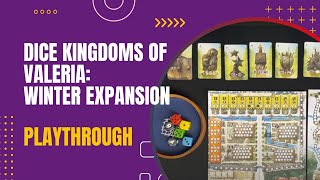
In an era of roll-and-write games where passive downtime is common, Dice Kingdoms ensures every player takes meaningful action on every single turn. The harvest phase means that even players whose turn it isn't are actively filling in boxes and advancing their position. This simultaneous play eliminates the frustration of watching others optimize their sheets while waiting for a turn, a quality that reviewers consistently identify as a major strength. Additionally, the game's modular nature with its winter expansion demonstrates commitment to variety without bloating the core design. Players cannot easily predict each other's progress because critical scoring opportunities hide in plain sight; the star tokens and domain bonuses don't broadcast themselves, allowing for surprise victories from players who focused quietly on their own strategy rather than chasing the obvious monument-building path.
Elegant Integration of Theme and Mechanics
Dice Kingdoms threads the Valeria universe throughout its mechanics naturally. Building a duchy, recruiting citizens, exploring wilderness, slaying monsters, and accumulating wealth all align thematically with what players are mechanically executing. The artwork reinforces this immersion without cluttering the functional information on the player sheets. The statue cards represent tangible goals worth pursuing, each aligning different strategies with meaningful scoring potential. This harmony between theme and mechanism creates a cohesive experience that feels purposeful rather than pasted-on, which reviewers identify as a departure from some heavier roll-and-write entries where mechanics and theme operate independently.
Potential Drawbacks
Complexity Relative to the Roll-and-Write Ceiling
For newcomers to the genre, Dice Kingdoms sits squarely in the middle of the complexity spectrum, demanding slightly more cognitive overhead than lighter roll-and-writes. Reviewers note that the distinction between harvesting, recruiting, building, and slaying requires careful reading of the sheets during the first few plays. The game presents more options than any single player can execute, which creates occasional decision paralysis as players weigh overlapping strategies. Later in the game, when players have filled in numerous boxes and unlocked domain abilities, the decision tree expands further, occasionally requiring pencils to pause and contemplate the optimal path forward.
Limited Direct Player Interaction and Comedown Risk
Because Dice Kingdoms emphasizes personal optimization on individual sheets, direct player-to-player interaction remains minimal. The only meaningful conflict comes from racing for statue cards when two players want the same card, creating moments of interference but not deep interaction throughout the game. This solitaire-like quality appeals to some but may disappoint players seeking dynamic negotiation or resource blocking. Additionally, reviewers note that the game's downtime can emerge when one player struggles with a particularly complex turn involving multiple cascading bonuses, as the chain of actions they must execute becomes mentally taxing and slows the table's pace.
If You Enjoy Dice Kingdoms of Valeria
Players drawn to Dice Kingdoms will find natural next steps within the Valeria universe itself, particularly Valeria Card Kingdoms, which shares the same setting and guild-based framework while operating through card-drafting mechanics instead of rolling dice. For those craving more sophisticated roll-and-write experiences, reviewers recommend Hadrian's Wall, which operates at a similar or slightly heavier weight with equally satisfying combo cascades and domain management. Players interested in exploring the broader roll-and-write landscape will find Explorers worth investigating for its modular board construction and terrain-collection mechanics, while Motor City offers a comparable level of departmental interconnection and spatial planning. For those who appreciate the family-friendly accessibility combined with hidden scoring, Twilight Inscription provides a more expansive experience with more player interaction through council voting systems. Families seeking lighter introductions to the genre might explore Cascadia or Welcome To, which reduce cognitive load while maintaining the satisfying pen-and-paper decision loop.
What Reviewers Are Saying
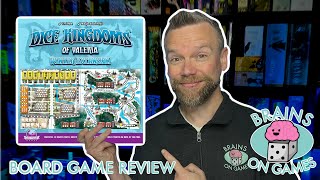
"As you fill in the domains here they're going to potentially give you some power to manipulate the numbers on the dice. If I Circle this one it has a picture of a red die it says plus or minus one that means I can add or subtract one from the number on this die. If I get all the way down here there's a red die that has an arrow on it and that means I can use the face on the opposite side so for example I could change a two to a five."
— Brains on Games
"The combos are incredible. I really like the simultaneous play because every time everyone's really doing something and there's so many opportunities to Branch your strategies because you're really not gonna all do the same thing which I really like. The art is beautiful. My favorite thing about this game too is because it has a lot of Combos and is a little bit more on the heavier side is they've laid it out so easy to be able to follow the symbols."
— Calorie
"This game was a surprise hit for us and the kids wanted to play the game again the next day and couldn't even wait for me to get home from work so they played it all together and they are six and eight. So I felt pretty proud of them that they're being able to play this game without my help after initially teaching it to them."
— Let's Table It