








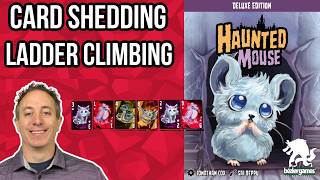


Haunted Mouse Deep Dive
What the Community Thinks About Haunted Mouse
Haunted Mouse has earned strong enthusiasm from reviewers across multiple channels. The consensus centers on how Bezier Games transformed a self-published design into a polished experience while preserving the heart of the original mechanic. Justin from Board Game Animal gave it a 9.5 out of 10, calling it one of the best climbing and shedding games the reviewer has played. Reviewers consistently praise the game's ability to balance simplicity with surprising tactical depth, and they note how well the charming mouse theme and gorgeous artwork combine with engaging mechanics to create something that works across different player experience levels.
Core Mechanics That Define Haunted Mouse
The Locked Hand with Strategic Flexibility
Haunted Mouse presents a twist on the card-shedding formula by dealing players eight cards that cannot be rearranged in the traditional sense. Once dealt, the cards stay in their original order. However, the game provides escape valves. When players draw new cards, they can place them anywhere in their hand. This creates an interesting tension: players work within constraints but retain agency through positioning and clever timing. The result is a game that feels restrictive at first glance but actually offers considerable control to skilled players managing their hand composition.
The Bait System
The bait mechanic stands as the defining innovation of Haunted Mouse. Before each round, every player selects one card from their hand and places it face down as public bait. Once revealed, any player can use any bait card from any other player in their melds, not just their own. This creates a fascinating push-pull dynamic: placing strong bait cards helps you by offering flexibility but simultaneously helps opponents by reducing the number of cards they need to shed. The bait system forces constant calculation. Using a strong set from another player accelerates that player toward victory while helping your own hand. The decision to play bait or draw becomes central to strategy, especially since cards placed as bait must eventually be shed alongside your hand cards to reach the winning condition.
The Haunted Mouse Experience
A Tactical Race with Meaningful Decisions
Haunted Mouse creates a racing experience where each decision carries weight. Players compete to shed all their cards first, earning cheese pieces for their ranking: three for first, two for second, one for third, and zero for fourth. The first player to collect seven cheese pieces wins immediately. This scoring structure transforms the game into a sprint, where every meld choice matters. The bait cards and lock hand mechanic force players into situations where they must balance immediate progress against medium-term board development.
Quick-Playing Charm
The game's light but engaging atmosphere comes from its thematic presentation and tangible components. The cheese wheel and bright yellow Swiss cheese wedges provide satisfying physical feedback. Rounds play quickly without sacrificing decision-making, and the game scales reasonably well from two to five players, though reviewers note that three to four players offer the best balance of bait card availability and game pacing.
What Makes Haunted Mouse Stand Out
Gorgeous Art and Appealing Production
Artist Sepu's contribution elevates the production significantly. Reviewers specifically highlighted the artwork as beautiful and distinctive, with the game's cute aesthetic drawing players based on art alone. The cheese components are tactilely satisfying, and the overall presentation creates an inviting table presence. Designer Jonathan Cox noted asking Bezier to keep the game cute, and that request was honored in the final product.
Elegant Layering of Simple Mechanics
Haunted Mouse achieves its tactical depth through accumulation. No single mechanic appears complex: the lock hand is straightforward, bait cards are a simple concept, and the meld system follows familiar card-game patterns. Yet combining these elements creates a rich decision space. Players constantly navigate tradeoffs between hand manipulation, bait card usage, and helping versus hindering opponents. The game does a great deal with limited mechanical moving parts.
Potential Drawbacks
Luck Factor in Higher Player Counts
With five players, fewer rounds occur before someone reaches seven cheese pieces. This compressed timeline means luck of the draw plays a more significant role since there is less time for skill-based decisions to equalize initial hand variance. Players dealt poor opening hands have fewer rounds to recover through clever play. The luck factor matters less in two-to-four player games where additional rounds provide more opportunity to overcome an unlucky draw.
Rules Clarity on Going Out
The rulebook could have been clearer about a central rule: players must shed all bait cards along with hand cards to go out. This requirement is mentioned in general gameplay sections but is not explicitly restated in the end-of-round section. Multiple reviewers encountered questions about this rule during first plays, suggesting the rules needed tighter specification to prevent confusion at the table.
If You Enjoy Haunted Mouse
Players who appreciate Haunted Mouse's lock hand mechanic may enjoy Scout, which shares the mechanical restriction. Reviewers noted similarities between Haunted Mouse's bait system and Tichu, particularly in how partner mechanics and player interaction create tactical opportunities. Those drawn to the race-to-shed structure would find satisfaction in Spring Cleaning, the original self-published design that Bezier Games reimplemented for Haunted Mouse. The game's quick playtime and party-game energy appeal to audiences who enjoy Rebel Princess, another Bezier Games title with similar light-but-tactical DNA.
What Reviewers Are Saying
"It is simple to teach, really fun to interact with all of the different elements on the table, and think enough to keep calling you back to play it again and again."
— Board Game Animal
"So it's a very cute game. It's a remake of an older game, and but it's it's that in itself, the whole concept of having bait is super cool because now you can make some crazy hands with that."
— Going Analog
"What happens is that once like three or four or five of these little twists stack up, and mechanically they're very simple, it just makes for a very rich experience for what otherwise is a very light card game. They did a lot with a little here."
— GameBoyGeek