




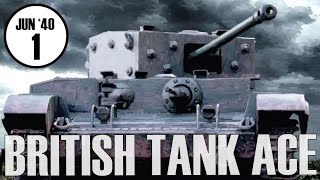
British Tank Ace: 1940-45 Deep Dive
What the Community Thinks About British Tank Ace: 1940-45
British Tank Ace: 1940-45 presents itself as a rare achievement in solitaire wargaming: a game that marries rigorous tactical depth with genuine narrative drama. Designed by Gregory Smith, the same creator behind Hunters and Silent Victory, the game positions the player as a lone tank commander fighting across North Africa, Italy, and Europe from 1940 through 1945. What emerges from multiple playthroughs is a game that works equally well as a tactical puzzle and as a personal story. Reviewers consistently note that British Tank Ace rewards both long-term strategic thinking (building prestige to access better tanks) and moment-to-moment tactical decisions (positioning, ammo selection, crew management). The game's greatest strength is how it transforms abstract mechanical systems into vivid, memorable experiences: crews develop names and personalities, tank upgrades feel like meaningful progression, and the tension of combat never fully disappears, even after dozens of missions.
Core Mechanics That Define British Tank Ace: 1940-45
Track Advancement Through Prestige and Experience
British Tank Ace structures progression through two interlocking advancement systems. Prestige points, earned by achieving significant combat objectives (destroying three enemy vehicles in a single mission), unlock access to better tanks. A newly minted commander starts in a Crusader A9, a lightly armored tank with weak firepower. Reaching prestige level two opens the door to the Matilda, the legendary "Queen of the Desert." This progression creates a compelling long-term goal: players spend entire campaign months working toward that single breakthrough mission that will grant the prestige needed to upgrade. Experience points, earned through successful missions, fuel crew development. Accumulating four experience points allows a player to purchase skills like gunnery (a permanent minus-one die modifier to hit rolls) that transform a crew from competent into formidable. This dual-track system ensures that advancement feels earned and that each campaign develops its own narrative arc. Early missions emphasize survival and small victories; mid-campaign play shifts toward ambitious objectives; late-game crews operate with enhanced capabilities that make previously perilous situations manageable.
Combat: Damage-Based Attrition Across Multiple Rounds
Combat in British Tank Ace unfolds as a series of tactical exchanges rather than a single dramatic exchange; players and enemies exchange actions across multiple combat rounds. Each action involves rolling to hit, then rolling to penetrate armor, then rolling for damage. Armor values, penetration values, and range modifiers create a tactical landscape where positioning, ammunition choice, and knowledge of enemy vehicle specifications matter deeply. Hull-down positions reduce incoming damage; buttoned-up status degrades shooting accuracy; close range grants penetration bonuses but brings infantry into dangerous range. Crew members can be wounded in escalating degrees (light wounds pass after a single mission, serious wounds cause months of hospital time). The game even models the stress of bailing out of burning tanks, with different crew positions facing different survival odds. This emphasis on attrition means that staying alive through a campaign becomes an achievement; tank crews develop genuine bonds because players have invested dozens of missions and personal narratives into their survival.
The British Tank Ace: 1940-45 Experience
Moment-to-Moment Tension and Suspense
No two missions in British Tank Ace feel identical. Random mission generation, combined with variable enemy force composition and unpredictable weather and terrain, means that each session creates fresh tactical problems. Reviewers describe a palpable sense of dread before critical rolls: will the suppressed enemy anti-tank gun hit, will the tank become immobilized in unfavorable terrain, will a critical crew member survive the bailout sequence? The game generates dramatic beats organically through its systems. A dust storm forces a battle at close range, eliminating long-distance advantage. A crew member dies during a catastrophic tank loss, forcing a six-month hospital absence and the recruitment of new team members. Reviewers consistently note that this tension escalates across a campaign, as players become emotionally invested in the survival of named crew members and the preservation of hard-earned prestige.
Satisfaction of Tactical Problem-Solving
Beyond the drama, British Tank Ace offers the quiet satisfaction of solving puzzles. Players must decide whether to charge forward, backpedal to extended range, angle the hull for better protection, or focus fire on the most dangerous target first. Mission objectives and enemy deployments shift strategically based on die rolls; adapting to these surprises defines the experienced player. When a plan succeeds (destroying an anti-tank gun before it can fire, using a counterattack to earn an extra experience point, unlocking the Matilda at exactly the right moment in the campaign), the payoff feels proportional to the mental investment. The game respects tactical competence while acknowledging that luck and chance are inescapable elements of warfare. A clever retreat from close range to medium range removes an entire category of threat (infantry anti-tank rifles). A decision to fire at an acquired target with a previous-targeting bonus turns marginal odds into probable hits. These moments teach the game's systems while reinforcing the agency of the player.
What Makes British Tank Ace: 1940-45 Stand Out
Crew-Centric Narrative and Character Development
British Tank Ace is unusual among wargames for the weight it places on individual crew members as characters. Players name their gunner, driver, loader, and machine gunners. These soldiers accumulate kills, receive medals, and occasionally die in fiery tank explosions. When a serious wound removes the commander from action for 24 missions (representing six months of hospital time), the player experiences genuine loss. The game then provides an entirely new crew drawn from volunteers, forcing an adjustment period. This mechanic becomes emotionally resonant when the player has guided a crew through dozens of successful missions. A gunner who repeatedly saves the day earns a place in campaign legend. The war trophies system (collecting Italian rations, helmets, pistols) adds levity and personality to the recovery phase after each mission. These small touches elevate British Tank Ace from a system to a narrative experience.
Masterful Rules Architecture and Componentry
Compass Games' presentation of British Tank Ace demonstrates uncommon care. The 32-page rulebook separates core rules from optional rules and historical notes. Reviewers praise the clean organization and clarity of section headers. Most critically, the game includes eight sequence-of-play cards that condense the turn structure into easily followed steps. These cards transform what could be a search-through-the-rulebook nightmare into a smooth flow. The counters are well-designed (distinct vehicle types, clear armor and penetration values). The player aids include double-sided tank mats for all 22 playable tank types, campaign-specific charts for each theater (North Africa, Italy, Europe), and mission logs that track prestige, experience, and service record. The thick log sheets contain 140 mission slots across each theater, emphasizing the scope of a full campaign that most players will never reach the end of. The designer's notes and historical context add flavor without cluttering the core experience.
Potential Drawbacks
Procedural Complexity and Table Consultation
British Tank Ace demands frequent reference to tables. Each combat round requires checking multiple charts: to-hit modifiers, penetration odds, wound results, fire and bailout sequences, event tables, terrain effects, weather impacts. While the rulebook is well-organized, the sheer volume of options can slow play, particularly early in a campaign when a player is still memorizing common results. Reviewers note that the core rules span 25 pages, and while the combat example on page 22 is helpful, learning the game requires patience. The procedural nature of play (roll here, consult this table, apply modifiers, cross-reference a second table) differs from games with more streamlined mechanics. A single mission can stretch to an hour or more if the player is learning, though experienced players report that missions stabilize around 15-20 minutes per engagement once familiarity sets in.
Immobilization and Attrition as Pacing Obstacles
The random immobilization table, intended to model terrain difficulty, can interrupt campaign momentum unexpectedly: a tank becomes immobilized during a maneuver and must spend time in repairs, causing the player to miss the next mission. While this reflects the reality of armored warfare, it can frustrate players chasing specific objectives. Similarly, serious wounds remove commanders from play for dozens of missions, and a catastrophic mission loss that kills crew members and forces the tank to be abandoned can derail emotional investment in an ongoing campaign. The game's honesty about casualty and breakdown reflects historical authenticity, but this design choice demands that players embrace contingency rather than pursuing fixed goals, which may frustrate those seeking a more deterministic, goal-directed experience.
If You Enjoy British Tank Ace: 1940-45
Players drawn to British Tank Ace's blend of tactical depth and narrative cohesion will find similar satisfaction in American Tank Ace, designed by the same architect, which follows parallel mechanics through the U.S. Army's campaigns with fresh theater-specific details and vehicle rosters. Those captivated by the solitaire opposition system and thematic immersion should explore Hunters and Silent Victory, both by Gregory Smith: Hunters models asymmetric cold-war naval tension, while Silent Victory presents submarine warfare in the Pacific theater, and both share British Tank Ace's commitment to solo play against procedurally generated opposition and crew-driven campaign narratives.
What Reviewers Are Saying
"In this World War II tactical solitaire game, which is the brother game to American Tank Ace, you take control of a British tank and try to survive campaigns in North Africa, Italy, and Europe. Designed by Gregory Smith, who is also the designer of the Hunters and Silent Victory, the game strings together short missions of 10 to 20 minutes into hours long campaigns."
— Zilla Blitz
"The solitary rating for this game is an obvious 10 out of 10 as it's built specifically for the solitaire gamer experience. Layout wise, things are clean and well organized with clear section headers and an ample amount of graphic support. Outside of the combat sections, which have some moderate complexity, a lot of the rules content is more procedural and informational than it is conceptual."
— Zilla Blitz
"We have had our first crew member killed in action. Two crew members that are killed obviously won't come back, but the other three crew members are assumed to have gone on to a different tank. We need a new crew. Volunteers, we need a new crew and we are going to be 24 missions out with a broken arm."
— Zilla Blitz