






Your Best Life Deep Dive
What the Community Thinks About Your Best Life
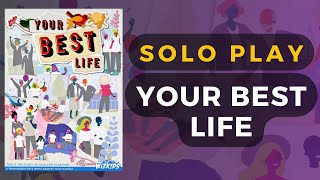
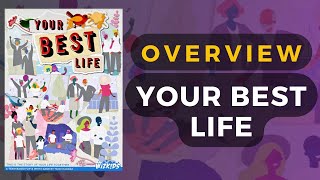
Reviewers across multiple channels are drawn to Your Best Life as a surprisingly personal experience wrapped in an accessible flip and write framework. Danielle, who has published both solo playthroughs and comprehensive overviews, praises the game's quick pace and clean mechanics, noting that a full solo experience takes under 20 minutes. What resonates most with reviewers like Jenna from The Board Game Garden and the team at kovray is not just the puzzle of managing resources, but the opportunity to build a character and tell a story. The narrative dimension makes Your Best Life feel less like a point-optimization puzzle and more like a life simulation where choices carry thematic weight. Across all reviewers, the flexibility to play solo, as a couple, or in teams of up to eight people is celebrated as genuinely valuable rather than merely novel.
Core Mechanics That Define Your Best Life
Flip and Write Action Selection
Each round, a set of action cards is revealed, and players choose one to take their actions from. Cards show various icons: knowledge, money, time, health, relationships, and career options. When you select a card, you mark off corresponding tracks on your personal sheet, filling sections from left to right. The elegance lies in the bonus action, where after resolving all icons on your chosen card, you get to take one additional icon action again. This creates small moments of engine-building satisfaction even in a light game. Danielle highlights the dry erase component as integral to the experience, making it practical to reset and replay without material degradation. The simplicity of the mechanic means new players understand it immediately, yet the personal board layout ensures every player's situation remains distinct.
Stress and Happiness Management
Underneath the life-choice fantasy sits a tension system that defines moment-to-moment decisions. Many action cards come with stress icons, requiring players to roll stress dice. The more stress you accumulate, the more your happiness drops. But stress can be relieved by choosing relaxation actions, and happiness itself multiplies the final score at game end, creating a feedback loop where managing your well-being matters. Jenna from The Board Game Garden notes this as creating "comboy feels" - the satisfaction of balancing competing priorities. You are not just chasing vacations and career advancement; you are managing burnout. This layer transforms the game from pure optimization into something that mirrors real life tradeoffs, where a lucrative but stressful career path genuinely costs you happiness points, and time spent on relationships and health has measurable value.
The Your Best Life Experience
Building Your Character Story
At the start, you define your character: hometown, hobby, career, and background. As you play, these choices become anchors for narrative meaning. When you invest in education or creativity, it connects to who your character is. When you pursue vacations or family, the game reflects your priorities. Jenna from The Board Game Garden spent time naming their character "Rosalie Sage," a dance teacher from the garden-themed town of Fernville with gardening as a hobby, choosing thematic alignments down to the character's name. This creative element turns a 45-minute game into a storytelling experience. Jenna described leaning into the character as the invitation to "play as yourself" and "create this little story in your head" of the person you're being, knowing their job and their goals in life. The game does not enforce these choices mechanically, but the invitation to weave personal narrative through gameplay creates an experience that feels more like interactive fiction than abstract euro design.
Couples and Solo Play Flexibility
Your Best Life scales to accommodate radically different play styles within the same rules. Solo players multiply their final score by two to account for playing as a single person rather than a team. Couples share resources and pools, making collaboration literal. Up to eight players can sit at a table, mixing singles and couples. Danielle notes the elegance: the same rules apply everywhere; the difference is purely in how you aggregate your results. This means teaching the game is effortless, but the experience can range from intimate two-player moments to chaotic group storytelling. For solo players in particular, the game delivers a satisfying arc: character creation, ten rounds of meaningful decisions, a climactic final round, and then confronting your total score against the reference table in the rulebook. The solo mode is not a side experience; it is fundamental to the game's appeal.
What Makes Your Best Life Stand Out
Low Rules Complexity, High Thematic Resonance
Your Best Life is one of the rare flip and write games where understanding the rules takes fewer than five minutes, yet playing feels narratively rich. Danielle describes learning it as watching a brief overview; the icons are intuitive, the flow automatic. Yet within that simplicity, every decision carries weight because of the theme. Do you take the lucrative career path that brings stress, or the lower-paying role that lets you maintain relationships? Do you save for a house or spend on vacations? These are not arbitrary point calculations; they reflect genuine life priorities. Reviewers appreciate that a game about happiness and life achievements does not require a rulebook mastery or cognitive load to feel thematically aligned. The mechanics get out of the way and let the narrative flourish.
Replayability Through Character Variation
Because the action cards are dealt from the same deck each game and the goals remain consistent, mechanical replayability might seem limited. But reviewers find that the character creation step transforms each playthrough. Jenna describes rushing to another round because the joy of building a new character and living a different life carried them forward. You could play as an ambitious entrepreneur focused on business and wealth, or as a spiritually-minded artist prioritizing family and experiences. The same cards reveal their value differently depending on your character story and the goals you select. Ilia and Tyler note that leaning into character narrative drives decision-making in unpredictable directions; two players with identical starting hands will diverge radically based on their character's implied priorities. In this way, Your Best Life becomes a canvas for personal expression rather than a puzzle with a correct solution.
Potential Drawbacks
Limited Mechanical Depth for Heavy Gamers
The flip and write format and lightweight rules mean that Your Best Life lacks the kind of economic systems, worker placement, or engine-building complexity that appeal to experienced eurogame players. Danielle's score of 160 points on their first solo play and Jenna's 226 points on theirs suggest that optimization ceiling is reachable in a few plays. If your primary draw is solving increasingly intricate puzzles or competing against sophisticated algorithms in solo mode, Your Best Life will feel thin. The game excels because it prioritizes accessibility and narrative over mechanical crunchiness. But players seeking a thinking challenge will find the decision space relatively constrained.
Luck Dependency in Stress Rolls
Choosing action cards with stress icons requires rolling dice, and poor rolls can derail a carefully laid plan. Danielle notes a round where they rolled four stress on two dice, plunging their happiness into negative values and derailing their strategy. While stress management is thematic and creates dramatic moments, the luck factor means that a poorly-timed roll can overshadow your character choices. Some players may find this frustrating; others embrace it as part of the life simulation. Reviewers do not report this as a breaking flaw, but it is worth acknowledging that randomness can undercut the narrative arc you are building if the dice turn harsh.
If You Enjoy Your Best Life
My City (the roll and build version) shares Your Best Life's ability to deliver a campaign-like progression and character progression within a compact format. While My City is a city-building puzzle and Your Best Life is a life-story narrative, both reward replayability through variant setups and challenge escalation, and both distill larger game experiences into efficient play sessions. If you liked how Your Best Life let you create a character and watch their story unfold, you may appreciate how My City does something similar with building design and progression. Both games prove that lighter titles can carry surprising thematic weight when designed with intention.
What Reviewers Are Saying
There is some comboy feels to it. I do have to confirm how the minus three joy plus four joy works, but yeah, I think a very cool concept and I think it is definitely interesting to also play multiplayer because then you have the ability to kind of play as a couple and you get to share certain things which is cool.
— Danielle
You having your like character, you can play as yourself, you can kind of create this little story in your head of like the person that you're being, and you know their job and like their goals and stuff in life.
— Jenna from The Board Game Garden
Where this game really shines is the theme, because even by the end of it there's variant in this game you can tell a whole story and you can invite other players to like your big milestone events.
— Ilia and Tyler from kovray