












Nanolith Deep Dive
What the Community Thinks About Nanolith
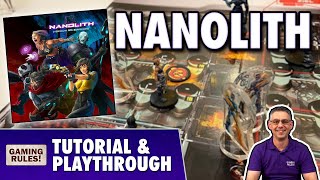
Reviewers across multiple channels express enthusiasm for Nanolith as a distinctive entry in the cooperative dungeon crawler genre. Consensus centers on the game's clever dice placement mechanic and commitment to narrative storytelling. Gaming Rules! and Hungry Gamer both highlight the strength of the central mechanics, while Meet Me At The Table praises the immersive cyberpunk world-building. Critics acknowledge the game's demanding difficulty and constant pressure from spawning enemies, but these are treated as thematic choices rather than flaws. The most consistent point of agreement: Nanolith succeeds because it treats story and mechanics as equal partners, not one serving the other.
Core Mechanics That Define Nanolith
Dice Placement
Each turn, players roll five dice and place them into slots on their character board to activate abilities, weapons, and skills. Different abilities demand specific die values or combinations: a four or higher for a basic melee attack, pairs for special techniques. The elegant constraint is that players cannot break dice into constituent values; a rolled six cannot become a three and a three. This forces meaningful trade-offs: accept the roll you got, or spend stress to modify one die by one value per round. Reviewers note that this system creates decision-dense turns where resource management and tactical planning merge seamlessly. The mechanic ensures that luck shapes options without determining outcomes entirely.
Stress and Nano Abilities
Rolling ones costs stress. Playing dice in yellow-highlighted slots costs stress. Taking damage from enemies costs control, but here is where Nanolith's core innovation emerges: stress is not merely punishment. When a character accumulates enough stress, they take damage, their stress meter resets, and they unlock a powerful nano ability, an ultimate power that costs no actions and can be activated outside the normal turn structure. These abilities range from tank rushes that hit everything in a path to healing spells that restore multiple allies. The longer a campaign proceeds, the faster these abilities recharge. This creates a dynamic where players actively pursue stress in tense moments, deliberately endangering themselves to unlock game-changing powers. Reviewers emphasize this as the mechanic's breakthrough insight: making the "bad" outcome of stress accumulation desirable reshapes player psychology and keeps tension escalating as the campaign unfolds.
The Nanolith Experience
Narrative Depth in a Combat-Heavy World
Nanolith embeds story in layers. An opening comic in vivid cyberpunk art sets the world: humanity accepted an alien gift of nanotechnology, then weaponized it, triggering apocalypse. The four heroes awaken with fragmented memories and must uncover the truth. Between encounters, players read story snippets that reveal character backstories. Some scenarios offer tableau images, illustrated scenes where players choose which location to investigate, triggering branching vignettes. A few passages unfold as mini choose-your-own-adventure sequences. The game also includes longer story beats that unlock hidden cards and open new narrative chapters. Reviewers from Gaming Rules! to Hungry Gamer emphasize that this multi-format approach works: no single story beat overstays its welcome, and the variety prevents fatigue across a long campaign.
Crisis Management Under Pressure
Scenarios rarely ask players simply to defeat every enemy. Instead, they impose objectives such as reaching a person in peril or surviving a set number of rounds, while enemies continually spawn from designated locations. Every turn new biomutants and security droids arrive, forcing players to balance rescue goals against defensive needs. As reviewers note, this creates a tone distinct from traditional dungeon crawls: players are not conquerors steadily clearing a battlefield, but desperate survivors racing against overwhelming odds. The relentless churn of reinforcements becomes thematic. This pressure is intense; some players welcome it as narrative tension, while others find it exhausting. The design is deliberate rather than accidental: the game offers frantic problem-solving instead of leisurely puzzles.
What Makes Nanolith Stand Out
Electrostatic Stickers and Resettable Upgrades
Nanolith ships fully sleeved, and upgrade stickers are electrostatic: they adhere lightly to sleeves and peel away cleanly, leaving no residue. As players earn experience through scenario completion, they purchase sticker upgrades that reduce weapon activation costs, extend attack range, boost healing output, or increase defense values. This legacy-light system lets players feel tangible progression without permanent component destruction. By mid-campaign, characters have accumulated visible changes: a medic's nano ability now heals more targets, a tank's armor improves. Reviewers single this out as a standout production choice that reinforces the upgrade fantasy without creating waste or preventing replays. Woodpecker Games' commitment to sustainable component design sets a standard other publishers have yet to match.
Coherent Cyberpunk Storytelling
Most dungeon crawlers treat story as garnish. Nanolith treats it as the main course. The arrival of alien technology, the weaponization of nanotech, hoarding factions, cults worshipping strange entities, and characters regaining memories are not disconnected events but threads of a cohesive narrative. Comics punctuate key moments with cinematic art. Character ability card backs include personal story snippets hinting at each hero's past. Side objectives unlock lore-critical hidden cards. Reviewers praise this because the narrative generates stakes: reaching an objective reveals something that matters to the world and to the characters being controlled. This is rare in the genre and makes the lengthy campaign investment feel purposeful rather than repetitive.
Potential Drawbacks
Unforgiving Dice and Specific Activation Requirements
Combat resolution depends on rolling dice to meet enemy defense thresholds, typically close to a coin-flip proposition. More punishing is the requirement that abilities need exact die values or combinations. Rolling all low values when a four or a pair of sixes is needed means an entire turn of limited options. Players can burn stress to modify one die by one value, but this comes at a cost. Late in a campaign, reviewers report scenarios where they rolled poor values multiple times in succession, feeling unable to execute planned strategies. While Hungry Gamer noted this didn't break enjoyment, it creates a tonal mismatch for players seeking agency: an elaborate turn plan can crumble because the dice do not cooperate. This isn't a mechanical flaw so much as a design choice that some will embrace and others will resent.
Mandatory Four-Character Play and Limited Narrative Choice
Nanolith requires playing all four heroes throughout the entire campaign. There is no companion mode to simplify the game if one player is absent. This adds management overhead: four character boards, four sets of dice, four distinct ability sets to track. While each character is relatively simple, running them simultaneously demands attention. Additionally, tableau sequences that appear to offer meaningful choices, such as investigating one location or another, ultimately feed into the same story beats. The branching feels more like an illusion than a genuine fork; the game is largely on-rails. Reviewers who wanted emergent narrative or solo simplification noted this as a constraint. For others, the fixed structure is an asset: a focused story lands stronger than a branching mess.
If You Enjoy Nanolith
Readers drawn to Nanolith's dice placement should explore Infinity Defiance, which shares the reinforcement spawning tension and features its own upgrade economy. Those captivated by the cyberpunk setting and character-driven narrative may appreciate Gloomhaven, though it trades Nanolith's story-book integration for a more modular campaign. Players seeking another story-rich alternative with escalating stakes should consider Chronicles of Dunagor, which similarly weaves narrative into dungeon-crawl mechanics through tableau-based exploration.
What Reviewers Are Saying
"The way that comes together is very cool. Every time you use your last die, the enemies are going to get a little bit of a boost, a little bit of a bonus. And I really think the way that comes together is very cool."
— Hungry Gamer
"You're hurting yourself to do these incredibly, incredibly powerful abilities. And it is a very cool balance."
— Hungry Gamer
"When I first heard it was Cyberpunk, I was like, all right, Cyberpunk, I know what that is. But actually, this is a different twist on Cyberpunk."
— Gaming Rules!