


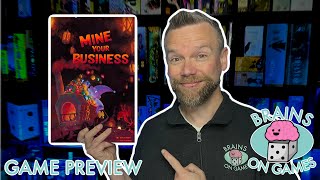


Mine Your Business Deep Dive
What the Community Thinks About Mine Your Business
Reviewers describe Mine Your Business as a compact puzzle that rewards planning. Brains On Games, hosted by Dr Brian McDonald, previewed a copy sent by Envy Born Games and called it a light, puzzly card game that is quick to learn but hard to master. Dr McDonald admits to having played it a bunch of times without working out the best way to win, often finishing a point or two behind, and reads that losing streak as a sign the game is worth returning to.
Board Games for One, hosted by Mike, is more enthusiastic about the package. Mike covers the solo, cooperative and multiplayer modes in a solo-focused walkthrough, calling the game a cool, simple design that players will enjoy. In a later year-end roundup of solo games, Mike places it among the games that would not be put forward for game of the year, while still recommending it. The two channels agree on the core appeal and differ in emphasis: Board Games for One focuses on the goblin and the range of play modes, while Brains On Games focuses on spatial planning.
Core Mechanics That Define Mine Your Business
The year-end roundup credits the game design to Art Casey, and Envy Born Games is the publisher named in the Brains On Games review. Two mechanics drive nearly every turn.
Modular Board
The play area is a 4x4 grid built from a large deck of mine cards, and only 16 cards are in play at a time. Mike explains that you randomly lay out a mine from the mine cards, then place your gnome in the top left to start. Cards taken for loading are replaced at the end of the turn, so the grid changes steadily from game to game and within a single game. Brains On Games calls the board modular and credits that setup with the game's replayability, especially the variant where gold, coal and gems carry different point values.
Tile/Map Shifting
Each turn, a player takes up to three actions from a choice of four: move the gnome, rotate a card, swap cards, or load the cart. Brains On Games notes that a swap can move a whole tile and place the player in the middle of the map, while rotation builds the path that leads to the cart. Mike adds that actions can be repeated, so rotating twice or swapping twice is allowed. The path never stays fixed, because the mine cart advances one space each turn and the planned destination moves with it. Dr McDonald describes this as the reason the game is so puzzly and complicated.
The Mine Your Business Experience
Brainy Puzzle Tension
Play feels like holding a plan together against a clock you can only partly see. Dr McDonald describes a plan that might take three turns and nine actions to line up, while the cart keeps moving and the target shifts underneath it. The three-action limit forces tough trade-offs, and Dr McDonald found that the group often ran out of actions before anything could be loaded. Opponents can also rearrange your paths, so the planning never feels fully private.
Creeping Goblin Dread
The solo and cooperative modes add a goblin that moves through the mine on a deck of AI cards. On each goblin turn, Mike flips a card and checks whether the goblin stands on a matching icon. If the goblin lands on your gnome, the game is over. In the more advanced solo modes, a second AI gnome can steal the treasure under your cart and send you back to the start, which Mike calls pretty brutal. The result is a chase-like pace in which the options keep shrinking as the cart moves on.
What Makes Mine Your Business Stand Out
Variable Rules and Multiple Modes
Board Games for One lists three solo modes, a competitive multiplayer mode and a cooperative multiplayer mode, each with its own challenge level. The solo modes add one-time abilities that can swap your gnome next to the cart or grant two extra actions for a turn, and each ability is used once per game. Brains On Games highlights the modular set-up and the variable rules as the main source of replayability, and it names the resource-value variant as the group's favorite. Reviewers present this range as a reason to keep coming back to the table, not as padding.
Quick to Teach, Tight Sessions
Dr McDonald says the game is very easy to set up and very quick to teach, noting that the box covers one or two players with a 20 to 40 minute play time. Mike highlights a cheat sheet kept beside the play area during a sample round. Brains On Games recommends the game for kids age 12 and up, along with parents, couples and adults who want a short puzzle session. Both reviewers praise the artwork, and Dr McDonald expects the finished gnome-shaped components to look better than the generic meeples used for the review copy.
Potential Drawbacks
Two Copies for Four Players
A single box supports one or two players. Brains On Games notes that a four-player game requires two sets, and Dr McDonald admits the group never reached a higher player count during the review. Board Games for One makes the same point and treats the two-box requirement as a cost to weigh before buying. Both reviewers present this as a practical limit rather than a flaw in the design.
Spatial Puzzle Demands and Prototype Components
Dr McDonald says spatial games are the hardest to handle personally, finding that mental rotation skill was the weakest part of the performance, and wished for a play mat to keep the cards lined up. Both channels stress that the copies they played were prototypes, and Mike notes that the components may still change before release. Players who dislike reconfiguring paths in their heads may find the planning tiring, even if the rules are easy to learn.
If You Enjoy Mine Your Business
Players who enjoy Mine Your Business's goblin AI, with its icon-driven decisions, will find a similar readable opponent in Solar Titans. Mike describes a solo AI cheat sheet in that game built from if-then statements. Players who value the cheat sheet and the solo focus will appreciate Halls of Hegra, where Mike notes a helpful cheat sheet on the back of the rulebook and a siege structure that keeps each round tense. For players who want less swing and more controlled decisions, Bonnie and Clyde offers a push-your-luck feel that Mike describes as closer to a Euro game.
What Reviewers Are Saying
"It's one of those games where it's such a spatial puzzle that keeps changing. It's very easy to set up, it's very quick to teach and to learn, but there's strategy here."
— Dr Brian McDonald, Brains On Games
"The other thing that's going to mess things up when you're trying to plan ahead is that you've got another player who could be twisting your paths around as you're going. They might be collecting some of those resources that you're trying to get and then you wind up with a random card being put in place of one that you wanted or that you were trying to get to."
— Dr Brian McDonald, Brains On Games
"This is a prototype. It may be updated in the future, but it looks pretty darn well finished."
— Mike, Board Games for One