


Oh My Pigeons! Deep Dive
What the Community Thinks About Oh My Pigeons!
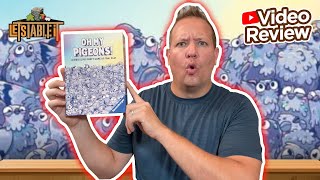
Oh My Pigeons! is a small party game from Ravensburger, and the reviewers who covered it describe it as a game that rewards the right table more than the right strategy. Board Game Brody calls it one of those silly party games that can be perfect with the right crew, and is clear that the pleasure comes from the social side of the game as much as from the cards.
The reviewers split on the question of how much player-on-player pressure they want. Board Game Brody enjoys the laughter but warns that the game is not for every group. kovray discussed Oh My Pigeons! in a Gen Con preview, and their interest came from the cover and tagline rather than hands-on play. The most enthusiastic hands-on report comes from Get into games, where the children in the group loved it.
Core Mechanics That Define Oh My Pigeons!
Dice Rolling
The die is where Oh My Pigeons! moves from card play into chance. Board Game Brody explains that certain cards tell a player to roll the die and then collect pigeons in some way or flick poo at another player. Each face of the die produces a different result: one takes three pigeons from the supply, another takes five, one steals a total of four pigeons from any mix of other players, and one steals two. The reviewer identifies this as the point where the excitement really comes in, because the roll decides whether the player gains pigeons from the supply or takes them from someone else.
Flicking
The flick poo face turns the die into a physical action. According to Board Game Brody, the player places the die near their board and flicks it at another player's board, hoping it knocks pigeons off their bench. Any pigeons knocked loose return to the supply, so the flicker gains ground while the target loses it. Brody notes that the target does not like getting hit by flying poo, which is part of why the table tends to laugh. Brody describes the rest of the components as simple, but says the plastic pigeons and the rolling and flinging of the die give the game its creative touch.
The Oh My Pigeons! Experience
Playful Spite Among Friends
Board Game Brody describes the table dynamic as a sort of friendly spite. Players go after whoever is currently ahead, while also looking for a line of cards that lets them fill their own bench before the leader can come back and pick on them. The flinging and the pigeon theft are what generate the laughter Brody mentions, especially when the group is one that enjoys teasing one another. The experience depends heavily on the people sitting around the table, and Brody presents that dependence as the defining feature of the game.
A Quick Race to a Full Bench
Every player begins with a bench of three pigeons and a hand of three cards, and the game is a race to fill that bench with plastic pigeons. Board Game Brody notes that players draw back up to three cards at the end of each turn, and that the first player with a full bench wins. If the deck runs out before anyone finishes, each player takes one last turn and the player with the most pigeons wins. That ending keeps the game moving to a conclusion, and Brody calls it a small but quick game that does not demand much thought.
What Makes Oh My Pigeons! Stand Out
Physical Components With Personality
Board Game Brody singles out the table presence of the game. The 36 plastic pigeons are the centerpiece, supported by 50 cards, a player board illustrated as a park bench, and a single die. Brody's point is that the production is restrained, yet the pigeons and the die give the game a creative character that a card-only party game would lack. The die in particular carries the flick poo action, tying the simplest piece in the box to the game's most physical moment.
Easy to Teach and Ready for Families
Brody frames Oh My Pigeons! as a small, quick game that can be played without much thought, which makes it a fit for a short session. Get into games reported the same ease of entry in practice. After playing with children, they described the game as a clear hit, and said the kids wanted to play again and again. Their comparison was specific: the game felt less irritating away from home, which suggests that a light, quick game can hold up well with younger players when the group is not replaying it constantly.
Potential Drawbacks
Targeted Aggression
Board Game Brody's main caution is that the game is built around targeting other players, and the reviewer is direct about it: if you do not want to be mean to someone at the table, or if that does not sound exciting to you, the reviewer suggests the game is probably not for you. For a group that prefers cooperative or low-conflict games, the constant pressure to pick on whoever is in front can feel uncomfortable rather than funny. Brody presents this as a question of fit rather than a design flaw.
A Lucky Roll Can Decide the Game
Brody describes the die results as the source of much of the excitement, but that same randomness can tip a session more than some players want. Get into games noted that a school playthrough felt less annoying than games played at home, crediting the difference to one particular result, a five, turning up far less often that time. The implication is that when the five comes up often, as it apparently does at home, it can dominate the outcome and frustrate players who feel the dice decided the round for them.
If You Enjoy Oh My Pigeons!
Players who enjoy the quick, silly chase of Oh My Pigeons! may find a similar feel in Piles. Get into games described it as a frantic, silly game in which players race to collect sets of similar clothing before the other person does. The shared appeal is the fast pace and the way a short game can end in a burst of excitement.
Players who like the party-game side of the game, with its quick laughs and simple rules, will find a similar energy in Contraband. kovray described it as a fun little party game about smuggling words past other players, and the preview framed it as a game for a group gathering.
Players who enjoy the push-your-luck tension of a roll will find a related feeling in Captain Flip. kovray called Captain Flip a push-your-luck game about building a pirate ship, noted that it is very simple to play, and said it can be enjoyed by anybody.
What Reviewers Are Saying
"Ultimately this is one of those kind of stupid games that works great with the right people. It comes down to picking on the player who is currently winning."
— Board Game Brody
"This is a game where you will need to Target other players. So this means that you have to be mean to someone else if that is something that you don't want to do or something that does not sound exciting, then this game is probably not for you."
— Board Game Brody
"And we played Oh My Pigeons and they loved it. And it wasn't as annoying as when we play at home."
— Get into games