



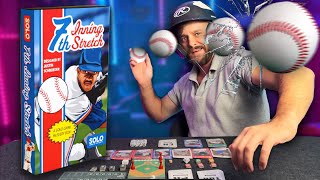

7th Inning Stretch Deep Dive
What the Community Thinks About 7th Inning Stretch
Reviewers agree that 7th Inning Stretch is a solo dice game that compresses a baseball season into a short, chaotic run, but they disagree about whether that chaos is the appeal. Mike, Board Gaming Every Dude is the most enthusiastic of the three. Mike presents the game as a natural fit for anyone who enjoys both baseball and board games, and describes it as a solo game of the month that is easy to recommend to fans of the genre. One Stop Co-op Shop calls it "good, goofy, chaotic fun" and credits the final version for adding mitigation options that make the game easier, but keeps it on a borderline list. That reviewer would still rather watch baseball highlights than play a baseball game, and prefers the designer's related title, Storybook Saga.
Tom Vasel, The Dice Tower offers the most critical take. Tom rates the game 5 out of 10 in a look-back review of an earlier version, says that as a baseball fan the dice manipulation did not land, and notes that the newer version does not appear to have changed much. The Dice Tower's critique is about the core feel of the dice, not the theme, and it is the clearest counterweight to the enthusiasm elsewhere in the coverage.
Core Mechanics That Define 7th Inning Stretch
Dice Pool Hitting
Offense runs on a pool of dice. According to Mike, a batter's resource line grants two dice and a modifier that lets a player nudge one die up or down by one. The player decides how many dice to roll and which to keep, and a hit is scored by pattern: two dice in ascending or descending order produce a single, three in sequence produce a double, and a run of four is a home run. Runners advance on a hit as the reviewer describes it, and a player can spend leftover dice on steal and advance rolls, where a failed double roll can cost only the lead runner. Defense works through the same dice. The opposing lineup rolls six dice and scores one run for each face value that does not appear, and the pitcher can spend an exhaustion token to reroll one of those opposing dice, limited to once per inning. This is the mechanic that gives the game its baseball shape: every at-bat is a short negotiation between the dice you have, the dice you can afford to roll, and the sequences you need to make.
Card Drafting Through the Season
The second core system is the draft. Each player card has two sides, a player side used on the bench and a team side used as a scheduled opponent. Mike explains that the player begins with one randomly drawn pitcher and nine randomly drawn batters, then drafts new players during spring training, at the trade deadline, and again before the playoffs. The season is structured in halves, where wins are tracked with a cube and stars accumulate toward a playoff threshold. The second half raises the stakes by awarding two stars per win, and a team that has not reached three stars is eliminated. Playoffs then move through semifinals and finals, each reduced by playoff hunt markers and harder by design. This link between drafting and the schedule is what gives the game its season-long arc.
The 7th Inning Stretch Experience
Late-Season Pressure
Reviewers describe a steady build toward the playoffs. Mike notes that the playoff hunt tightens as the season progresses, that playoff preparation reduces the hunt further, and that the finals card makes the series "just a little bit harder." The One Stop Co-op Shop reviewer, while calling the game goofy, acknowledges that the difficulty is real enough that the designers added mitigation options for players who want an easier game. The pressure is in the standings and the star count more than in any single roll, which is why the game rewards careful drafting across the whole season.
Goofy Chaos Over Simulation
The tone reviewers find most consistent is that 7th Inning Stretch is playful rather than rigorous. One Stop Co-op Shop describes the game as goofy and chaotic, and reports that playing it produces results that are "pretty crazy" to watch. Mike frames it as a game that plays like a dungeon crawler, where offense and defense are a sequence of challenges leading to a final boss, the playoffs. The Dice Tower's critique sits on the other side of this experience. A reviewer who loves baseball found that the dice felt like manipulation rather than strategy, so the same chaos that reads as fun for one group reads as a lack of control for another.
What Makes 7th Inning Stretch Stand Out
A Full Baseball Organization in a Solo Box
Mike emphasizes that the player runs the entire baseball organization: the manager who drafts players in spring training, and the team that actually plays the games. Mike also highlights that the game was the solo game of the month, which makes it a compact way to experience a season without a second player. Combined with a playtime of around 45 minutes, this makes the game an accessible option for solo players who want a complete arc from draft to championship.
Distinctive Two-Sided Player Cards
Mike singles out the card design, describing the player cards as having a 9s-style look and noting that the player and team sides each serve a distinct role in the draft and the schedule. The One Stop Co-op Shop reviewer also points to the dice system as a clean, quick mechanic that plays fast. Because each card does double duty, the game keeps its footprint small while still producing a varied season.
Potential Drawbacks
Dice Luck and Manipulation
The most serious objection comes from The Dice Tower. Tom Vasel loves baseball but found the dice manipulation at the heart of the game did not work, and rated the earlier version 5 out of 10. The review also notes that the newer version has not appeared to change much in the core dice system. Mike and One Stop Co-op Shop both see the dice randomness as part of the fun, but The Dice Tower's concern is that the game asks players to trust dice results more than their decisions. Players who prefer control over their outcomes should expect this to be the main sticking point.
Baseball Simulation Depth
One Stop Co-op Shop states that if the goal is to play a baseball game, they would rather watch baseball highlights. That reviewer's concern is not that the game is bad, but that it is a dice game with a baseball theme rather than a detailed baseball simulation. Mike's video also includes a caveat that the review copy was a prototype and that players should judge the artwork and components by the images on the Game Found page. Anyone expecting a deep baseball sim should approach the game as a fast, thematic dice experience instead.
If You Enjoy 7th Inning Stretch
Mike compares the game's structure to Dungeon Crawlers, pointing out that the game gives you offense and defense while you work toward a central challenge. In 7th Inning Stretch, that challenge is the playoffs, so players who enjoy the progression of a dungeon crawler will recognize the rhythm of moving through opponents toward a final encounter.
One Stop Co-op Shop recommends Storybook Saga as a related title from the same publisher, Barrett Publishing, and describes it as the same designer's work. That reviewer notes that Storybook Saga uses a similar dice system and says they liked it better, citing its lighter storybook theme and its playful mechanics. Players who enjoy the dice-driven feel of 7th Inning Stretch but want a more whimsical theme may find Storybook Saga a natural next step.
What Reviewers Are Saying
"Obviously if you are into baseball games and board games this one is a home run for you. You basically have offense and defense, you are playing against opponents in order to get to a certain place where you get to go against the big baddy, which in this case is the playoffs."
— Mike, Board Gaming Every Dude
"This one is good, goofy, chaotic fun. If you've seen my plays, it's pretty crazy. And they did add in the final version some very much appreciated mitigation options if you want to play the game easier."
— One Stop Co-op Shop
"I love baseball, but this dice manipulation game, even though there's a card in it now, for a Tom Vaselino, I didn't like. I haven't played the new version, but I don't think it's changed much."
— Tom Vasel, The Dice Tower