





Yosemite Deep Dive
What the Community Thinks About Yosemite
Yosemite presents itself as a lightweight two-player game about photographers competing in Yosemite National Park, but reviewers consistently describe a clever design that operates at a much deeper level than its rulebook suggests. The game's elegant simplicity on paper becomes deceptively intricate once players experience how movement patterns interact with disruption mechanics and hand management. Reviewers praise it as a tight, high-interaction game where every decision carries immediate consequences for both the current turn and future plans. What starts as a straightforward grid-movement experience transforms into a game about reading your opponent's intentions and building hedges against disruption, making it an unexpectedly complex puzzle for a compact box.
Core Mechanics That Define Yosemite
Pattern Movement
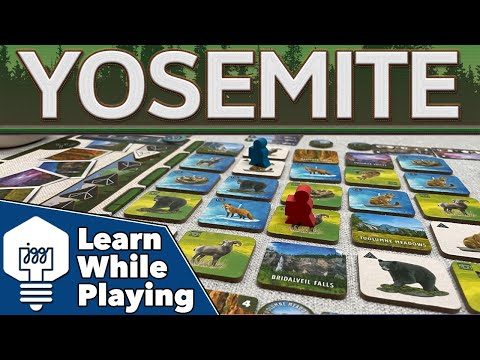
Each animal on the grid defines a unique movement pattern that players must follow. Cougars leap to the board edge in one direction; bighorn sheep stride any distance in a straight line; rattlesnakes move one or two spaces orthogonally or diagonally; foxes glide up to three spaces in flexible directions; bears move exactly two spaces and can reposition the opponent. Reviewers highlight how these patterns create puzzle-like positioning challenges where controlling which tiles you land on becomes the core strategic lever. Players must anticipate which squares each piece can and cannot threaten multiple turns ahead, forcing constant reassessment of board state.
Token Pairing and Disruption
When a player activates an animal tile, the color of that tile determines the bonus: white tokens advance the camping track, blue tokens grant fish for flexible movement, and green tokens enable photo claims. This pairing forces tradeoffs between collecting tiles and taking specific actions, and it becomes weaponized through disruption. Three animal movements (cougar, black bear, rattlesnake) allow players to move their opponent to places they do not want to be. Reviewers emphasize that these are not punishments that feel arbitrary; instead, they reward strategic positioning and force opponents to either spend accumulated fish or resign themselves to suboptimal turns. The game becomes a dance of threat and counter-threat.
The Yosemite Experience
Tight Two-Player Tension
Reviewers describe Yosemite as a game where every move reverberates. Because the board is only five-by-five and both photographers share the same grid, positioning is perpetually contested. Players cannot execute plans in isolation; they must constantly monitor what their opponent is accumulating and whether they can afford to pursue high-value photo sets or must instead disrupt. This creates what reviewers call high-crafting gameplay, where denying your opponent a path to victory is sometimes more valuable than accelerating your own score. One reviewer noted that it takes multiple plays to shed the reading-the-rules frame and recognize that the flexibility reviewers expected actually dissolves once play begins and placement constraints collide with opponent pressure.
Surprising Strategic Crunch for a Filler Box
Yosemite appears deceivingly simple: move according to an animal, take the tile, resolve its bonus, and refill the grid. Reviewers repeatedly emphasize their surprise at the hidden depth. One reviewer captured this perfectly: on first reading, the rules felt merely adequate, but during actual play, the moment-to-moment decisions became genuinely clever. Fish accumulation becomes crucial because it is the only way to escape opponent disruption, yet spending fish reduces your hand size and delays photo completion. Reviewers found themselves recalculating plans after every opponent turn, revising which animals they wanted to land on, and reconsidering whether landmark tokens were worth defending or better left to deny their opponent bonus points.
What Makes Yosemite Stand Out
Elegant Rules Masking Razor-Sharp Play
The game's true appeal lies in the distance between its surface simplicity and its tactical complexity. Reviewers describe rules that teach quickly but interactions that require multiple plays to internalize. Unlike games where complexity emerges from intricate mechanics, Yosemite achieves crunch through the collision of straightforward systems. The five animal movements, three action types, and two-player head-to-head dynamic combine to create a game where sequences matter; players spend as much mental energy anticipating where they will land next turn as where they want to move right now. This economy of mechanisms appeals to designers and tactical players who prize efficiency of theme and rule count.
Clever Disruption Without Cruelty
Movement-based disruption could easily feel punitive, but reviewers note that Yosemite's disruption mechanics reward foresight and punish over-extension. Because fish provide a safety valve, a disrupted player can choose to spend resources to recalibrate rather than suffer a forced bad turn. This creates a negotiation of resource spending that reviewers found surprisingly engaging. Denying an opponent their intended animal is meaningful because it costs the opponent time and fish, not because it locks them into a single losing path. The game thus sustains competitiveness while preserving agency.
Potential Drawbacks
Rules Presentation May Confuse Early Learners
Multiple reviewers noted that the rulebook does not emphasize which actions happen most frequently, resulting in initial confusion about turn order and decision priority. New players may spend their first game adjusting mental models as the correct sequence clicks. One reviewer stated that it took a couple of sessions before the animal movements became instinctive enough to plan ahead confidently. This initial friction is not insurmountable but represents a barrier to casual play.
Niche Appeal for Committed Two-Player Enthusiasts
Yosemite's entire design is optimized for exactly two players in head-to-head competition. The game does not offer solo modes or scalability to larger groups. Reviewers who thrive in multiplayer chaos or who prefer cooperative experiences may find the tight bilateral tension exhausting rather than exhilarating. Because blocking and disruption are core, the game can feel adversarial in ways that some players appreciate and others avoid.
If You Enjoy Yosemite
Players who love tight two-player abstracts with movement puzzles should explore Rhino Hero, a dexterity game with spatial awareness demands. If the pattern-movement aspect appeals, abstract grid games that emphasize spatial thinking and long-term positioning will resonate. Yosemite is fundamentally a game for two players who enjoy reading each other and building plans that survive contact with an opponent's ambitions.
What Reviewers Are Saying
"When you play it, oh, that's just actually really clever because it actually, it can't really read it in the rules that there's a lot of hidden strategy until you play it. I really really enjoy this game."
— Meeple University
"It was better than I expected from the rules when I read the rules in the contract fulfillment is not always my sort of thing. Movement, you always seem to have a lot of flexibility, but actually once playing it and seeing how you can disrupt your opponents and move them to places that they don't want to be, and how you can hedge against that by getting fish tiles which kind of slow you down because they're not worth points directly, but they essentially let you counteract what your opponent's doing to mess you up, so lots of really clever elements in this game."
— Meeple University
"Every single move could affect your next plan and the next plan and your opponent's plan, the time you land, the things that you get. And it's a set collections, contract fulfillment, as as it say, when you actually get that particular contract, you have to look at the opponents - what do they have? Can stuff that moves around or not? It's very, very... it's open drafting, I guess, a bit everything. It's a very hate crafting as well. It's it's amazing game, very high crafting."
— Meeple University