
Game Info
Year
2022
Players
3-4
Age
12+
Playtime
90 min
Complexity
2.2/5
Collection
Ratings
Creator Score
Mechanic profile
Not enough video data yet
Vibe profile
Not enough video data yet
Description
Standalone Catan set in the Pleistocene where players guide humans to gather resources migrate and settle new areas
Featured Videos
Rules Teach

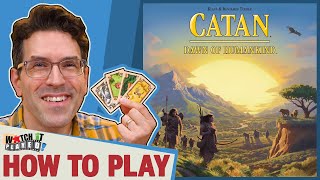
Catan - Dawn Of Humankind - How To Play
Ask a Rules Question
Images
GID0452677.jpg

GID0452677_thumb.jpg
All mentions
Browse transcript mentions, sentiments, pros/cons, mechanics, topics, quotes, and references.
Total mentions: 3
This page: 3
Sentiment:
pos 3 ·
mix 0 ·
neu 0 ·
neg 0
Showing 1–3 of 3
Video aQsk3xgnXBQ
Watch It Played News at 7:05 sentiment: positive
video_pk 89633 · mention_pk 238396

Click to watch at 7:05 · YouTube ↗
Overall sentiment (raw)
positive
Pros
- fun
- cool to be getting a chance to play like revamped older versions
Cons
none
Thematic elements
- guiding the first humans on their journey as they migrate throughout the world while developing their technology and culture
- the world
Comparison games
- Settlers of Catan
- Settlers of the Stone Age
Mechanics (from transcript analysis)
- Resource Management — will not only be angrily trading resources but also according to cosmos games guiding the first humans on their journey as they migrate throughout the world while developing their technology and culture.
- technology development — developing their technology and culture.
Video topics + discussion points
No key topics recorded for this video.
Quotes (from this video)
- it's been a massive week of reprints reskins and new additions but it's the same old me hello i'm matthew and welcome to the board game news
- it will straight up kill you yes absolutely yes
- I'm unreasonably excited about this game
- this is what i want in my life
- frodo's cool vest or sean beans in it
- can you believe it wow
- I have no idea what that is is it cool
- all i know is that in the 90s cartoon gambit was the coolest x-man right that on the show had an absolutely banging thing june
- richard garfield's name always gives me confidence but so does reiner kenitzias
- all i can tell you is that dream factory is a brilliant game
- I'm a big fan which is what us fans of katan call ourselves okay
- the expansion looks amazing
- it certainly is contempting like tempting
- the selection process for the shbielda jairus awards is veiled in an almost secret society type mystery
- my guess was savannah park so i was big time wrong
References (from this video)
No references stored for this video.
Video hnbxiFb4DlY
watch it played Discussion at 11:04 sentiment: positive
video_pk 78543 · mention_pk 191330

Click to watch at 11:04 · YouTube ↗
Overall sentiment (raw)
positive
Pros
- New game in the Katan line.
- Explores the prehistoric era and human journey.
- From Katan Studios.
Cons
none
Thematic elements
- Journey of the human family tree
- Prehistoric era, Africa to the globe
Comparison games
- Settlers of Catan
- Catan: Struggle for Rome
- Catan: Starfarers
- Settlers of America
Mechanics (from transcript analysis)
- exploration — Players guide the journey of the human family tree from its roots in Africa to the far reaches of the globe.
- Resource Management — The host humorously mentions 'all the sheep that I need' in reference to Katan's resource focus.
Video topics + discussion points
No key topics recorded for this video.
Quotes (from this video)
- i looked away from the internet for like 10 days and all of a sudden there's more announcements than a sentient bulletin board in a megaphone factory
- hello i'm matthew and this is the watch it played gaming news
- you know life moves pretty fast if you don't stop to look around once in a while you might fly your cargo plane through a portal transporting you to a rugged landscape filled with bizarre creatures scheming gods and untold peril
- so yeah i just also i like katan and i'm excited about this
References (from this video)
No references stored for this video.
Video sa80sBg3sDU
watch it played Rules Teach at 0:13 sentiment: positive
video_pk 66456 · mention_pk 161914
Click to watch at 0:13 · YouTube ↗
Overall sentiment (raw)
positive
Pros
- Step-by-step setup and rules explained with explicit examples.
- Demonstrates both the 3-player and 4-player board configurations.
- Includes a handy in-rule reference for setting up the game and learning the rules.
Cons
none
Thematic elements
- exploration, adaptation, survival, trade among tribes
- Journey of humanity across continents from Africa, 150,000 years ago
- educational, tutorial-like
Comparison games
- The original Catan
Mechanics (from transcript analysis)
- Advance progress markers — Pay resources to advance on clothing, construction, food, and hunting tracks; higher costs yield greater benefits and can unlock tokens.
- Convert Explorer to Camp — If an Explorer is on a campsite, you can return resources to the supply and convert the Explorer and campsite token into a Camp on a new intersection, flipping it to show VP.
- Create Explorer — Pay one hide and one meat to create an Explorer and place it on an empty intersection adjacent to one of your camps.
- Exploration tokens — Resolve exploration tokens which can remove terrain resources or grant adaptation tiles; the outcome is kept in the player's supply and affects future turns.
- Move and explore — Pay one hide or one meat to move an Explorer up to three intersections, ending on an empty intersection; Explorers can be retraced on a move.
- Production phase with dice — Active player rolls two dice and players gain one resource from the supply for each of their camps adjacent to a terrain that matches the roll.
- Resolve threats — When resolving a threat, you move the Neanderthal or Smilodon to a region and then a camp-adjacent player loses a resource; threats also affect future resource production.
- Seven rule (no production on 7) — If a 7 is rolled, players discard down to seven cards, an active player must move a threat, and production resources are skipped for that roll.
- Track Advancement — Pay resources to advance on clothing, construction, food, and hunting tracks; higher costs yield greater benefits and can unlock tokens.
- trade — Active player can trade resource cards with any other players, offering what they want and what they will give up, with trades continuing throughout the phase.
- Trading — Active player can trade resource cards with any other players, offering what they want and what they will give up, with trades continuing throughout the phase.
Video topics + discussion points
No key topics recorded for this video.
Quotes (from this video)
- let's learn how to play
- the game is played over a series of turns
- there are no spaces printed with a number seven
- the active player can trade resource cards with any of the other players
- no matter what exploration token you've collected after resolving it flip it over again and keep it in front of you
References (from this video)
No references stored for this video.
Transcript Navigation
Showing 1–3 of 3