



Grid of Shadows Deep Dive
What the Community Thinks About Grid of Shadows
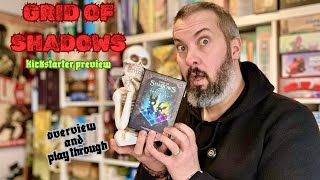
Grid of Shadows is a fast bluffing card game from Big Cheek Games. Players work to empty their hands by placing cards on a 3x3 grid, and the table decides whether to believe them. The coverage so far is early. The videos are previews of a prototype copy, and the presenters say that components and rules may still change before the Kickstarter campaign goes live.
The most consistent point across the videos is that the rules are easy to learn. The publisher's own rules overview describes the gameplay as "pretty straightforward," and the Get into Games rules walkthrough calls it "pretty easy." Beyond that, the videos differ in tone. The publisher's overview is promotional and calls the game "fantastic," while the Get into Games walkthrough stays focused on how the game plays. The Get into Games podcast also reports that its hosts were sponsored to play Grid of Shadows and played it often during January, but the episode offers little evaluation of the design. Viewers should therefore treat the current conversation as a set of first impressions from people who have seen a pre-release copy, not as settled judgments of the finished product.
Core Mechanics That Define Grid of Shadows
Betting and Bluffing
Bluffing is the center of Grid of Shadows. On a turn, a player places one or more cards face down onto the grid and names the number and color they claim to be playing. The cards played together do not have to match each other in color, and the claim is what other players judge. The publisher's overview frames the central question directly: "Did I actually play two sixes right here on the table? Do the people around the table that I'm playing with believe that I did that? Are they brave enough to call lights?"
When a player calls "lights," the cards are revealed. A liar picks up the played cards and draws one extra card from the deck as a penalty. An honest player forces the caller to pick up the cards instead. Get into Games describes the same tension, noting that a player can let a claim pass, in which case play continues around the table, and that a challenge carries real consequences either way. Because a wrong call and a wrong bluff both cost cards, every decision to challenge becomes a small wager on what the other player is holding.
Hand Management
Each player starts with seven cards, and the win condition depends on emptying that hand. Reviewers emphasize that the question is not only which card to play but also when. The Get into Games walkthrough shows players weighing which cards to dump and which to hold, and a player who wants to shed the most cards at once must consider the timing of each play against the state of the grid.
Hand management also interacts with the card abilities. Each card numbered one through ten carries its own effect, and several effects only trigger if the player was the last to play on that number. The result is that a card's value depends on sequencing as much as on its face. The publisher's overview notes that the grid also offers an alternative to playing: a player may flip a grid card and show a different number, but doing so brings a penalty of taking a card into hand.
The Grid of Shadows Experience
Tense Bluffing and Escalating Risk
The feel of a hand comes from the moment a claim is challenged. Players must decide whether to accept a play they doubt, and each reveal can swing a lot of cards between hands. The walkthrough shows the pattern clearly: a claim is made, nobody looks closely, and a challenge reveals a bluff or an honest play, and the penalty rises with each mistake. The game rewards players who read the table and punishes those who bluff too often.
Playful Table Talk and Social Confrontation
Grid of Shadows also feels like a social game. The Get into Games walkthrough is full of teasing, exaggerated accusations, and running jokes about who is lying. Players call each other out, argue over whether a reveal was fair, and react to big penalties with mock outrage. The publisher's overview frames this as the point of the design, describing the game as one of "deception, bluffing, and sabotage." The social pressure is part of the appeal, and the videos suggest that the game works best with a group willing to challenge one another openly.
What Makes Grid of Shadows Stand Out
Ten Card Abilities on a Simple Frame
The publisher's overview points out that each numbered card has its own ability, giving players ten effects to learn and use against one another. The walkthrough shows how abilities can stack. One card forces another player to pick up cards each time a card is played on top, and a card that draws two and swaps one with the grid creates a different kind of decision. Reviewers describe the abilities as the main source of variety, while the core loop of playing, calling, and picking up stays the same.
A Final Challenge That Reverses the Board
When the draw deck runs out, the game does not simply end. Two cards that were set aside during setup are placed face up on the grid, and the table then plays a final round in which each card must match both color and number. The publisher's overview describes this as the game's second ending condition, and the playthrough shows how the reveal changes the state of play. A player who empties their hand wins outright, and if everyone passes, the lowest total in hand takes the win. The format gives late-game turns a different kind of tension from the opening rounds.
Potential Drawbacks
Prototype Components and Missing Turn Markers
The Get into Games walkthrough notes that the prototype copy lacks a first player marker and a player marker to track turns. The hosts had to decide the first player by the rulebook's "last player in the room" rule, and they joked about it. Since the video describes the copy as a prototype with "slight differences and tweaks" expected at launch, these gaps may be resolved in the final product. Still, the omissions show that turn tracking depends on the table staying attentive, which matters in a game with frequent calls and pickups.
Rules Clarity During Play
Several moments in the walkthrough show players pausing to work out what an ability does. Questions come up about how many cards to draw when effects stack, whether a player can flip a grid card without holding the matching number, and how many cards to pick up after a challenge. The hosts resolve these questions reasonably, but the pauses suggest that new groups may need time to learn the card text before the game flows. Because the abilities are central to the design, clear reference material and a well-written rulebook will likely matter a lot at launch.
If You Enjoy Grid of Shadows
The videos do not compare Grid of Shadows directly to other titles, so these recommendations focus on shared experience. Players who enjoy calling bluffs in a quick card game may appreciate the two-player pastry game from Blue Fox Games that Get into Games discussed at a convention. It has a bluffing element in which a player must decide whether to give a card away or keep it for points, and the hosts described it as a good portable option for date nights. Players who like the lighthearted social confrontation of Grid of Shadows may also enjoy any game built around table talk, accusation, and risk, where the fun comes from reading faces as much as from the rules.
What Reviewers Are Saying
"But did I actually put two blue sixes down? That's the element of deduction, deception that you want to put amongst the players around the table."
— Get into Games
"Did I actually play two sixes right here on the table? Do the people around the table that I'm playing with believe that I did that? Are they brave enough to call lights?"
— Grid of Shadows
"Grid of Shadows, which you were also sponsored to do some playthroughs. Yeah, we played a lot of that."
— Get into Games