








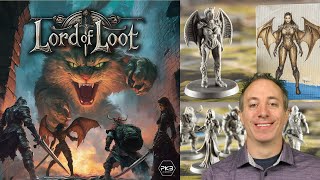
Lord of Loot Deep Dive
What the Community Thinks About Lord of Loot
Community reviewers embrace Lord of Loot as a thoughtfully designed cooperative adventure that delivers surprising depth from a lean ruleset. The consensus is overwhelmingly positive, with reviewers praising the game's elegant mechanics and the memorable moments it creates at the table. Board Game Critique describes the experience as combining "quick turns, almost no downtime, even with four of us" with substantial decision-making weight. J the Hungry Gamer highlights the game's accessibility, calling it "easy to set up, easy to play, easy to learn," while TheGameBoyGeek emphasizes its family-friendly appeal without sacrificing engagement. That said, reviewers acknowledge real tradeoffs, particularly around the randomness inherent in dice combat and a tendency toward midgame pacing slowdowns. The consensus gravitates toward three to four players as the sweet spot, where the cooperative puzzle of quest completion and item trading shines brightest.
Core Mechanics That Define Lord of Loot
Bag Building
One of the most tactile and memorable systems in Lord of Loot is the backpack puzzle. Players physically fit tokens and items into a dual-layered board with a cutout backpack space, and nothing can be carried if it overlaps the defined area. This creates meaningful inventory decisions that ripple through the entire game, forcing tough choices about what to hold, what to trade away, and what to leave behind. Board Game Critique called this "Backpack Tetris deserves its own standing ovation," capturing how the spatial constraint becomes both a design feature and a source of delightful table moments. The mechanic also incentivizes cooperation, as teammates can hold items for one another, enabling collaborative planning that extends beyond the quest objectives themselves.
Quest-Gated Boss Combat
The core innovation that defines Lord of Loot's gameplay loop is the requirement that heroes complete all of a boss's quests before dealing any damage to that boss. This turns the early game into something more akin to a pick-up-and-deliver puzzle than a traditional dungeon crawl. Each boss has unique quest chains, from herding stubborn magical beasts to collecting precious artifacts, and only after fulfilling these conditions can the final battle commence. Meanwhile, the boss can attack and damage heroes throughout, creating a constant tension between pursuing quests and staying safe. This design choice, published by PKB Games, keeps the game's narrative and mechanical focus locked on the objectives, ensuring that every victory feels earned and that the path to each boss feels like a meaningful journey rather than a random grind.
The Lord of Loot Experience
Power Fantasy and Progression
Reviewers consistently emphasize how satisfying the game's progression curve feels. Heroes begin at level one, constrained to wooden weapons, and gradually unlock iron and then gold equipment as they defeat stronger foes. This simple leveling system creates a palpable sense of growth. Board Game Critique captured a standout moment, describing a run that went from scraping by with a fish and a stick to demolishing a troll with a frosted gold sword rolling three orange dice plus bonuses, a moment exciting enough to wake a sleeping cat in the room. The power fantasy delivers not through overwhelming complexity but through the tangible experience of upgrading weapons, learning new spells, and feeling genuinely stronger as challenges mount.
Cooperative Momentum and Tense Moments
The game thrives on moments of collective decision-making and shared risk. Turns move quickly, with minimal downtime, allowing players to stay engaged and reactive. The trading system, combined with the backpack constraint, forces natural communication about who needs what item and when, creating impromptu negotiations that feel organic rather than scripted. Board Game Critique recounted one unforgettable sequence: the moment a party member dropped coins to bait a boss, only to be pinned between a troll and a vampire, then drank a potion and rolled exactly the shields needed to survive with a single heart remaining, before finally squeaking out the win after completing the quest. These stories emerge from the game's elegant interplay of luck, planning, and player agency.
What Makes Lord of Loot Stand Out
Simple Rules, Surprising Depth
J the Hungry Gamer observed that there is a lot more to this game than its very simple core gameplay would suggest. Heroes only have four actions available, plus a couple of free actions, but the variety baked into the different quests, the different bosses, and especially the different spells pulled from a shared bag gives the ruleset far more meat than its small footprint implies. The spell system deserves particular mention here. These recipes let players spend collected resources to trigger effects, and they are free actions, enabling clever sequencing and synergies. The variety of spells in the draw bag means each game surfaces different tools, keeping replays fresh despite the streamlined core.
Scalable Difficulty and Replayability
The game ships with multiple bosses, each with different quests and difficulty levels, allowing groups to tailor the challenge. Board Game Critique noted that boss picks matter, and an advanced rule that adds imps to occupied spawn fields ramps up the pressure nicely. Since each boss combination creates a different puzzle, and the modular map tiles introduce exploration variance, the game avoids feeling static. The boss selection alone transforms the strategy space from one encounter to the next, encouraging players to revisit the kingdom under new circumstances.
Potential Drawbacks
Dice Luck and Randomness
Combat resolution relies on dice, and the outcomes can feel brutal. Reviewers acknowledge that a bad streak of rolls can snowball into frustration, particularly during crucial boss encounters. While spells and potions offer some mitigation, the randomness remains a core mechanic, not a solvable problem. Board Game Critique was direct about this, warning that groups who dislike variance in their games should steer clear, recalling a cold streak against one boss that made the whole table groan. Players who prefer tight, deterministic puzzle games may find the luck element at odds with their preferences, though many groups wear this as a feature rather than a bug.
Midgame Pacing and Setup Friction
Several reviewers noted that the middle stretch of play, after the initial exploration excitement and before the final boss pushes, can feel like a grind. Board Game Critique named the issue directly, noting that across a roughly 90-minute session the middle third sometimes felt like grinding gear while waiting for quests to unlock. Additionally, the game's setup involves organizing multiple cloth bags, tokens, and modular pieces, which takes time on the first play and can feel tedious to some. Once the game is in motion, those components shine, but the initial friction is real.
If You Enjoy Lord of Loot
Spirit Island delivers a heavier, more strategic cooperative experience where planning and card synergy dominate. If Lord of Loot scratched the itch for cooperative decision-making and thematic progression, Spirit Island will appeal to those seeking deeper puzzle-solving and more deterministic control. Chronicles of Aval sits closer to Lord of Loot's weight, offering a similar balance between accessibility and hidden rewards, though with a different mechanical suite. Finally, Gloomhaven serves those who want the cooperative dungeon-crawling fantasy with substantially more campaign depth and legacy elements, at the cost of added complexity and table time. All three capture different facets of what makes Lord of Loot engaging, depending on a group's appetite for weight and narrative.
What Reviewers Are Saying
"exploring a vast land filled with treasures, powerful weapons, and dangerous monsters. You'll be leveling up your hero, mastering magic, and cooperating with your party of heroes to complete daring quests and earn epic rewards."
— TheGameBoyGeek
"Backpack Tetris deserves its own standing ovation. Dual layered boards, cutout backpacks, and you literally need your stuff to fit. No abstract I carry 10 items nonsense."
— Board Game Critique
"there is a lot more to this game than you would think there's going to be based on the very simple core gameplay. There's four actions you can do. do those four actions and there's a couple of free actions that you can do. But because of the variety that is baked into it, the different quests that you're doing and the different things that you can do, particularly when you talk about the different spells that you can get, because there's a whole bag of spells you can be pulling things out of, it really does make for a game that has more meat than it really should for the size of the rule set."
— J the Hungry Gamer