
Game Info
Year
2024
Players
2-6
Age
13+
Playtime
30 min
Complexity
2.3/5
Collection
Your Tier
Loading…
Mechanic profile
Not enough video data yet
Vibe profile
Not enough video data yet
Description
Tactical card game where players are mages using spell cards and color-matching to reduce opponents health
Featured Videos
Ask a Rules Question
Images
GID0452740.jpg

GID0452740_thumb.jpg
All mentions
Browse transcript mentions, sentiments, pros/cons, mechanics, topics, quotes, and references.
Total mentions: 4
This page: 4
Sentiment:
pos 2 ·
mix 0 ·
neu 0 ·
neg 0
Showing 1–4 of 4
Video EDBjk2ms2NE
Meeple University Rules Teach at 0:58
video_pk 70499 · mention_pk 215642
Click to watch at 0:58 · YouTube ↗
Pros
none
Cons
none
Thematic elements
- mage duels using spells
- backyard mage battles
- tabletop fantasy combat
Comparison games
none
Mechanics (from transcript analysis)
Mechanics unknown.
Video topics + discussion points
No key topics recorded for this video.
Quotes (from this video)
- The time for one versus one backyard mage battles is over.
- two to six players must band together, use their spells cooperatively, and defeat it.
- The basic aims of play are unchanged.
- The players win if they do enough damage to reduce the tyrant's health to zero.
- Your hand limit is now always four cards, never five.
- And your spell book is limited to three cards instead of four.
- For the purposes of spell effects, your rival is now the tyrant, not the other players.
- The four chromatic spells from the base game are not used.
- If the tyrant's draw deck is empty, then shuffle the discard pile to form a new draw deck.
- The game ends and the players lose if all mages are eliminated.
- If the tyrant runs out of health before either of these things occurs, then the players win.
- The cooperative egos and the fractured arcana card are specifically geared towards this cooperative play.
- The heal effect is also fully cooperative.
- A terrifying tyrant is attacking the land of Alar,
References (from this video)
No references stored for this video.
Video SoPFEf_UeXM
Meeple University Rules Teach
video_pk 69859 · mention_pk 166748
Pros
none
Cons
none
Thematic elements
none
Comparison games
none
Mechanics (from transcript analysis)
Mechanics unknown.
Video topics + discussion points
No key topics recorded for this video.
Quotes (from this video)
- Play your spells like Gandalf and charge them at the right time as mages.
- Welcome to Meable University.
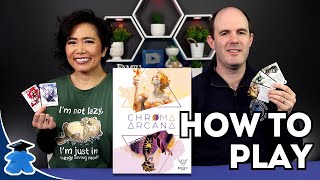
- Chroma Arcana is a two-player battle game in which players take on the roles of mages fighting against each other in a world of multicolored magic.
- The aim of the game is to attack your opponent and eliminate their health.
- The game ends immediately as soon as any one player's health is reduced to zero.
References (from this video)
No references stored for this video.
Video SoPFEf_UeXM
Meeple University Rules Teach at 0:07 sentiment: positive
video_pk 69859 · mention_pk 215640
Click to watch at 0:07 · YouTube ↗
Overall sentiment (raw)
positive
Pros
- The game has a clear objective: drain the opponent's health.
- The setup involves assembling a deck of cards for battle.
- Players can choose main and minor colors to build their decks.
- The turn structure is clearly defined into four main steps: Focus, Prepare, Cast Magic, and Refresh.
- Spells have effects that can deal damage, heal, discard sand, add sand, discard active spells, or force predictions.
- Wards and edicts have triggered effects that can provide passive abilities or block damage.
- Minions have sand tokens that are removed each turn, and if they lose their last sand, they are discarded.
- The game provides options for blocking damage, including discarding active minions or using potion cards.
- Ego cards provide passive effects to players throughout the game.
- The game ends immediately when a player's health is reduced to zero.
Cons
- The first four bullet points of the turn steps won't occur on the first turn.
- Players must discard a spell to make space in their spell book.
- If a player runs out of cards to draw, they must sacrifice one health.
- If both players lose their health simultaneously, the game is a tie.
- Spells that are charged or overcharged but not cast in time must have their charge tokens returned, unless they are uncharged.
- Players cannot hold over a fully charged spell to a subsequent turn.
- A ward is discarded after the first time it's used, unless an effect saves it.
- A player can have at most one active minion.
Thematic elements
- mages fighting against each other
- a world of multicolored magic
Comparison games
none
Mechanics (from transcript analysis)
- area of play — Spells are placed in a spell book, and active spells (minions, wards, edicts) are placed in an active spells area.
- Card Drafting — Players will draft their decks when they become more familiar with the game.
- Card Play — Spells are cast by removing charge tokens and resolving their effects.
- Combat — The primary goal is to attack the opponent and eliminate their health, often through spells that deal damage.
- damage prevention — Optional defensive effects allow players to block incoming damage.
- Deck construction — Players assemble a deck of cards for battle, initially using specific combinations from the rulebook, and later drafting their decks.
- Discarding — Cards are discarded from hand, spells can be discarded to make space, and minions/wards/edicts are discarded when their effects end or they lose all sand.
- hand limit — Players can keep no more than two cards at the end of their turn.
- Hand Management — Players manage cards in hand, playing spells or charging them, and discarding down to a limit at the end of their turn.
- Health tracking — Players track their health, with the game ending when one player's health reaches zero.
- Mulligan — Players have one chance to mulligan their hand after the initial draw.
- player powers — Each player has a unique character and individual player power for the game.
- Press Your Luck — Overcharging spells can make them more powerful, but holding onto charged spells is not allowed.
- Resource Management — Players use cards to charge spells and manage charge tokens.
- Set Collection — Players collect sets of spells based on main and minor colors to build their decks.
- Spell Cancellation — Potion cards can be used to cancel the casting of an opponent's spell.
- token placement — Charge tokens are placed on spells to charge them, and sand tokens are placed on minions.
Video topics + discussion points
No key topics recorded for this video.
Quotes (from this video)
- Play your spells like Gandalf and charge them at the right time as mages.
- Welcome to Meable University.
- Chroma Arcana is a two-player battle game in which players take on the roles of mages fighting against each other in a world of multicolored magic.
- The aim of the game is to attack your opponent and eliminate their health.
- The game ends immediately as soon as any one player's health is reduced to zero.
References (from this video)
No references stored for this video.
Video 8m001caKf50
MLE University Game Preview at 0:05 sentiment: positive
video_pk 67360 · mention_pk 163454

Click to watch at 0:05 · YouTube ↗
Overall sentiment (raw)
positive
Pros
- Described as accessible (light to medium complexity) for players
- Many card combinations and deck interaction
- Chromatic wild cards allow flexible charging
- Asymmetric powers add variety
- Expansion expands player count and adds coop play
Cons
none
Thematic elements
- mages battling to be the strongest
- Arabian fantasy world
- asymmetric powers and minions supported by spell-casting duel
Comparison games
none
Mechanics (from transcript analysis)
- charging spells — Spells require charging via charge tokens before they can be cast
- chromatic wild cards — Chromatic cards are wild and can charge any color cards
- Deck construction — Drafting/constructing a deck to fuel spellcasting and effects
- expansion content — Expansion Tyrant Hunt adds cooperative play for 1-6 players
- focus phase — Preparation step that uses focus effects from previous rounds
- Hand Management — Managing hands of cards to plan spells and actions
- hand refresh / draw rules — Refresh phase, draw back to five cards; may keep up to two cards
- Health tracking — Players start with nine health and lose health through damage
- minions and dominions — Summoning minions and dominions that provide ongoing effects
- round structure — Rounds include focus, charging, casting, and refresh until a player is defeated
- take-that — Direct actions or effects targeting opponents
Video topics + discussion points
No key topics recorded for this video.
Quotes (from this video)
- "Magic timing is key you cast a SP automatically when it reaches each charge cost"
- "wow that's what I call"
- "The components featured in this video are prototype so rules and I work are not final"
References (from this video)
No references stored for this video.
Transcript Navigation
Showing 1–4 of 4