



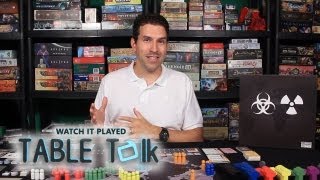

Tomorrow Deep Dive
What the Community Thinks About Tomorrow
Tomorrow from Conquistador Games draws intense interest from the board gaming community, though not for reasons players expect when first opening the box. Watch It Played's comprehensive coverage acknowledges the elephant in the room: this is a game that asks players to simulate global depopulation through biological and nuclear warfare, and the community response reflects serious engagement with that premise. The game ships with warning labels on both the box and the rulebook, accompanied by a full-page designer's statement explaining why this theme matters. Reviewers recognize the game as playable and mechanically sound, yet acknowledge that its core concept creates a genuine moral question for players to answer before sitting down: can a player distance themself enough from the subject matter to see this as a strategic puzzle rather than a simulation of atrocity?
Core Mechanics That Define Tomorrow
Depopulation Through Disease and Nuclear Strikes
At its heart, Tomorrow is a game about destroying opponents' populations through three primary attack types. Biological weapons are disease cards that players deploy face-down, which opponents can block with Espionage before the target is revealed. Once resolved, a disease kills pawns in a target territory and spreads to adjacent regions based on die rolls. Nuclear weapons are devastating but counterintuitive: while they eliminate pawns, they move the death marker backwards, actually slowing humanity's progress toward salvation. Espionage cards serve as the primary defensive tool, blocking not only diseases but also cyber attacks and theft. Military actions allow players to invade minor powers on the map by placing control tokens there. The tension between offense and defense, combined with the ability to block actions aimed at someone else entirely, creates a negotiation layer where players can offer protection in exchange for favors.
Political Capital and Strategic Territory Control
Conquistador Games designed Tomorrow around a dual-victory system: players must collectively move the death marker down the threat track to save humanity, but they win individually by accumulating the most political capital. Political capital comes from controlling minor powers on the board (earning strategy cards), destroying enemy pawns, keeping a player's own population alive in their home territory, and resolving special card effects. The endgame scoring is complex and deliberate, with bonuses for home population, controlled territories, destroyed pawns, and penalties for nuclear attacks launched. This creates constant tension between helping the group toward collective survival and maneuvering for personal advantage.
The Tomorrow Experience
The Weight of the Theme and Moral Discomfort
Tomorrow is explicitly designed to make players uncomfortable. The rulebook opens with a warning about simulating forced depopulation and a designer's statement explaining why this theme was chosen. Reviewers note that the moral weight is intentional and not something to ignore. The experience of playing Tomorrow is partly about confronting the premise: each player is a world leader choosing to attack other nations' populations to save humanity from overpopulation and resource depletion. This framing is bleak and serious, and the game does not soften it with lighthearted artwork or whimsical language. Players report that the abstract wooden components actually help create emotional distance, allowing them to view the situation as a puzzle to solve rather than a moral failing, but that distance requires deliberate mental effort.
Strategic Negotiation and the Illusion of Alliance
Once players accept the premise, Tomorrow becomes a high-stakes negotiation game. Turn order is controlled by the European Union player or the Cyber card holder, creating asymmetrical power that shifts throughout the game. Players cannot invade each other's home territories with military actions, but biological and nuclear weapons have no such restrictions. This asymmetry forces negotiation: a player might observe an incoming disease attack and offer to block it in exchange for the target nation leaving their own pawns alone for several turns. These deals are temporary and breakable, creating a dynamic where trust is constantly tested. The ability to block another player's attack even when not the target adds another layer of diplomacy, as players can offer protection and demand payment.
What Makes Tomorrow Stand Out
No Player Elimination and Defensive Espionage
Unlike many negotiation games, Tomorrow does not eliminate players from the game even if they lose all their population pawns. Nations continue to exist as influential powers, allowing fully depopulated players to play action cards, block attacks, and potentially win by controlling minor powers and accumulating political capital. This keeps all players engaged throughout the entire game and prevents the table from fracturing into active players and spectators. Espionage adds texture to player interaction by allowing any player to block any attack, not just the target nation, which means alliances can form dynamically and a third party can become kingmaker.
The Doomsday Clock and Shared Failure Condition
Tomorrow includes a built-in lose condition that affects all players equally: if the death marker does not reach the final space on the threat track by the end of the ninth turn, all players lose immediately and collectively. Humanity does not survive. This creates a fundamentally different dynamic than competitive games where one player's loss is another's gain. In Tomorrow, if players do not cooperate enough to reduce global population sufficiently, the entire table fails. Reviewers note that nuclear weapons pose a particular trap: using them early feels powerful but moves the death marker backwards, potentially dooming the group. This transforms nukes from a simple attack option into a moral and strategic choice with group consequences.
Potential Drawbacks
A Theme That Demands Moral Acceptance
Tomorrow's core premise of simulating forced global depopulation is not for every table. The warning labels and designer's statement acknowledge that the game may offend or disturb players who cannot or do not wish to distance themselves from the subject matter. Reviewers discuss how the theme becomes more challenging when grounded in real historical parallels: genocide, mass casualty warfare, and overpopulation are not abstract philosophical problems in human history. While the wooden components and abstract design create emotional distance, that distance requires the player to build it mentally. Groups that prioritize comfort and shared enjoyment over pushing boundaries may find Tomorrow's premise too heavy, and that is a legitimate reason to avoid the game.
Nuclear Weapons as Strategic Trap and Group Punishment
The nuclear strike mechanic creates a significant tension within Tomorrow that reviewers highlight as a potential frustration point. Nuclear weapons kill far fewer pawns relative to their cost compared to biological attacks, yet each nuclear strike costs the attacker political capital and costs the victim political capital if they still control the territory attacked. Most critically, nuclear strikes move the death marker backwards, directly undermining the group's collective goal of saving humanity. Launching nukes too early in frustration or desperation can doom the entire table, which means players must resist the temptation to use them and accept that restraint is often strategically superior to aggression. This can feel punishing to players who expect military power to be effective.
If You Enjoy Tomorrow
Tomorrow appeals to players who love negotiation and bluffing games with high stakes and genuine social pressure. The game rewards players who can read the table, make credible deals, and adapt when alliances shift. The political capital economy creates complex scoring where destroying enemy pawns is only one of several paths to victory, meaning that dominating militarily does not guarantee a win. Players who enjoy games like Diplomacy, where negotiation is as important as the underlying mechanics, will recognize Tomorrow's DNA. The shared loss condition sets it apart from pure competitive negotiation games, adding weight to every deal made and every attack blocked. For groups comfortable with heavy themes and willing to engage seriously with dark subject matter, Tomorrow offers a uniquely tense and interactive experience that lingers in conversation long after the game ends.
What Reviewers Are Saying
"In the World of Tomorrow overpopulation and consumption has left the world's political leaders and scientific community with no alternative but to engage in the radical depopulation of the planet in order to save humanity from extinction to this end nations will engage in cyber military and biological warfare in an attempt to reduce the world's population to a sustainable level but only one nation will emerge as the new superpower."
— watch it played
"Negotiation is another important part of this game so when you see that biological attack coming you might turn to another player and say listen we both know that attack's going to be targeted at you I could step in here and help you out but why don't you leave my population alone for a couple of turns so making and breaking deals can be important."
— watch it played
"I think if the components looked more realistic then that might start to push the barrier on what would offend me and what wouldn't because it becomes even more of a fictional setting when you when the components that you're using become even more and more abstracted."
— watch it played