Game Info
Year
2022
Players
2-4
Age
10+
Playtime
45 min
Complexity
2/5
Collection
Your Tier
Loading…
Mechanic profile
Not enough video data yet
Vibe profile
Not enough video data yet
Description
A light, family-friendly strategy game themed around the U.S. Postal Service in which players compete to be the best mail carrier in town.
Featured Videos
Rules Teach
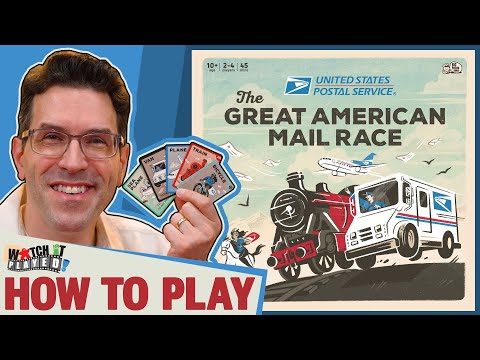
USPS: The Great American Mail Race - How To Play
Ask a Rules Question
Images

GID0452888.jpg

GID0452888_thumb.jpg
All mentions
Browse transcript mentions, sentiments, pros/cons, mechanics, topics, quotes, and references.
Total mentions: 2
This page: 2
Sentiment:
pos 0 ·
mix 0 ·
neu 1 ·
neg 0
Showing 1–2 of 2
Video sk3ztkd2jss
watch it played Rules Teach at 0:00
video_pk 68247 · mention_pk 164626

Click to watch at 0:00 · YouTube ↗
Pros
none
Cons
none
Thematic elements
none
Comparison games
none
Mechanics (from transcript analysis)
Mechanics unknown.
Video topics + discussion points
No key topics recorded for this video.
Quotes (from this video)
- the game is played over a series of turns starting with the first player and then going clockwise around and around the table
- on your turn you'll perform exactly three actions that you must divide between taking transport cards and playing transport cards
- the player with the most points at the end of the game will win
References (from this video)
No references stored for this video.
Video sk3ztkd2jss
watch it played Rules Teach at 0:09 sentiment: neutral
video_pk 68247 · mention_pk 184925
Click to watch at 0:09 · YouTube ↗
Overall sentiment (raw)
neutral
Pros
none
Cons
none
Thematic elements
- mail delivery race using different transport modes
- various historical and modern methods of transporting mail
- competitive race to deliver mail
Comparison games
none
Mechanics (from transcript analysis)
- Action economy — On your turn you perform exactly three actions, divided between drawing transport cards and playing them; you must draw first.
- assisting deliveries — If you pass over an opponent's van, you can assist by taking or exchanging cubes and delivery cards to benefit yourself or the opponent.
- Card Play — Played cards are revealed, resolved, and discarded to a shared pile; the bicycle card returns to the hand and can be used up to two times per turn.
- Deck Manipulation — You may draw from face-up cards or the top of the deck, replacing face-up cards as you draw.
- delivery and stamping — Capture delivery cubes, attach mailbox standees, and stamp a delivery slip to mark progress; bonuses apply for delivering in one turn, hometown deliveries, and fragile parcels.
- Draw and replace — You may draw from face-up cards or the top of the deck, replacing face-up cards as you draw.
- End Game Bonuses — After the final transport card is revealed, players take final turns and score based on stamped symbols, column bonuses, regions stamped, and remaining cubes in vans.
- End-game scoring — After the final transport card is revealed, players take final turns and score based on stamped symbols, column bonuses, regions stamped, and remaining cubes in vans.
- exact landings for pickups — To pick up a mail cube, you must end your move exactly on its space.
- movement by card type — Movement is dictated by the symbol on the card, allowing roads, trails, water, airports, seaplanes, balloons, rockets, and trains with exact spaces.
- Pick-Up and Deliver — To pick up a mail cube, you must end your move exactly on its space.
- postcards and deliveries — Postcards are collected and stamped differently; delivery cards come in letters or parcels and can be delivered when landed on matching spaces.
Video topics + discussion points
No key topics recorded for this video.
Quotes (from this video)
- the game is played over a series of turns starting with the first player and then going clockwise around and around the table
- on your turn you'll perform exactly three actions that you must divide between taking transport cards and playing transport cards
- the player with the most points at the end of the game will win
References (from this video)
No references stored for this video.
Transcript Navigation
Showing 1–2 of 2