







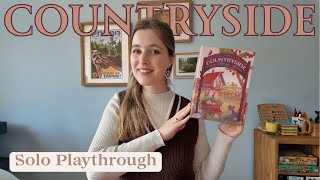
Countryside Deep Dive
What the Community Thinks About Countryside
Countryside has captured reviewers' attention as a cozy, approachable tableau builder that delivers warmth and satisfying engine-building moments. Released in 2025 by Nanox Games, this pastoral farming game has drawn consistent praise for its thematic elegance and pastel aesthetic, though consensus centers on what it executes well rather than what it innovates. The game occupies a comfortable space: not groundbreaking, but genuinely pleasant to play, with mechanics that reward careful sequencing and combo-building. Reviewers from Meeple University to Tantrum House consistently highlight its serene theme and production quality, even when other titles in a given month ranked higher on their personal lists.
Core Mechanics That Define Countryside
Tableau Building
Countryside is fundamentally a personal tableau builder where players grow a farm by acquiring and placing cards onto landscape locations. Designer Peter Prince structures the core loop around selecting cards from a market display, each time taking adjacent cards to manage what's available to opponents. Cards represent crops, animals, staff, and buildings, and each placement must match a location's icon type to resolve its effect. The beauty of this system lies in how it forces players to commit to a focus: do you chase crops, animals, dairy products, or a balanced approach? Once placed, cards trigger cascading effects, creating combos where, for example, a cow in a barn generates milk, which can be processed and sold. This interconnected web of card synergies defines the decision space and rewards planning several turns ahead.
Personal Worker Placement
Rather than placing workers on a shared board, Countryside uses a personal worker placement system tied directly to the player's own location cards. Each turn, players spend a meeple to unlock an action from one of their unblocked locations. As players complete goals tied to their tableau, they unlock better actions on the same location, creating a unique twist: completing goals doesn't just score points; it actively improves your future options. This feedback loop means workers and goals feed into each other, making both feel equally valuable. The system keeps gameplay intimate and low-conflict, since you are mostly working within your own space, which aligns perfectly with the cozy pastoral theme. Players reset their workers at the end of their personal turn, much like a farming day ending, reinvigorating the cycle.
The Countryside Experience
Cozy, Warm Pastoral Comfort
The standout experiential quality reviewers consistently note is the coziness that permeates Countryside. The game's warm pastel color palette, combined with its farming theme, creates an atmosphere of serene productivity rather than cutthroat competition. Even when players compete for limited cards or race to complete goals, the tone remains gentle. There is no direct attack, player elimination, or significant player interaction beyond resource scarcity. Instead, the experience feels like tending your own farm while neighbors tend theirs nearby, each absorbed in their own growth. This sense of peaceful focus, where the puzzle is personal and the pressure is self-imposed rather than imposed by opponents, defines the emotional core of play. Reviewers describe it as genuinely cozy, and that warmth appears to be the game's most distinctive quality.
Satisfying Combo Chains and Engine Building
Beneath the cozy exterior lies a satisfying puzzle of resource conversion and chain reactions. When you play a rooster card, it reactivates all your chickens, generating additional eggs. When you play trees, you can later use a beekeeper to generate honey from those trees. The game rewards players who identify these synergies early and build deliberately toward them. Reviewers highlight this as a major draw, comparing the feel to Oh My Goods, a design known for clever production chains. The satisfaction comes not from overwhelming opponents but from executing your own engine smoothly, watching resources flow through your tableau in elegant sequences. This quality keeps the game engaging for players who enjoy optimization and synergy-spotting, even though Countryside plays light enough for casual audiences.
What Makes Countryside Stand Out
Production and Aesthetic Cohesion
The game's visual presentation is immediately striking. The box cover draws players in at first glance, and the warm, cohesive pastel design extends throughout the components. Each card features lovely illustrations by Alice Fevier and Lena Poppen Sheller that reinforce the pastoral theme without overwhelming the functional clarity of the card layout. This aesthetic consistency means the game looks as cozy as it plays, a rarity in the hobby. Reviewers consistently comment on how pretty and thoughtfully designed the box and components are, suggesting that Countryside succeeds in merging visual appeal with thematic resonance. In a crowded market, this kind of cohesive presentation can be a significant draw for players seeking an experience that feels intentional and complete.
Goals That Evolve With Your Tableau
While goal cards appear simple on the surface (collect three cherries, discard coins for points, gather various resources), the genius lies in how achieving goals unlocks new actions. Completing enough goals advances you on a track, which progressively opens stronger worker placement options. This creates a virtuous cycle where progression feels earned and snowballs naturally toward game end. The system ensures that players pursuing their own goals don't feel left behind, and it gives meaningful decisions about which goals to prioritize. Reviewers note that there is usually enough variety in available goals that competition for them remains gentle, though with more players, card availability can tighten. This design ensures that the game scales reasonably well across its player count range and maintains meaningful choices throughout.
Potential Drawbacks
Familiar Mechanics Without Breaking New Ground
Countryside draws from a deep well of established Euro game design: tableau building appears in countless titles, personal worker placement has precedents, and card combos are ubiquitous in the hobby. Reviewers universally note that the game does not attempt to revolutionize any of these mechanics. One reviewer summed it up directly: it does not do that much that is new, but what it does is quite well. For players seeking innovative designs or unusual twists, Countryside may feel safe or even conservative. The game is a competent, polished execution of familiar ideas rather than a bold exploration of new territory. This is not necessarily negative, but it does mean Countryside will appeal most strongly to players who value craft and thematic coherence over mechanical novelty.
Icon Recognition and Rules Overhead
Despite its light weight, Countryside includes several distinct icons representing different card types, locations, goals, and resources. Initially, icon recognition can create a barrier to entry: distinguishing between similar symbols or remembering what each location's special rule does takes a first game or two. Reviewers mention that once you have played through these early turns and become familiar with the icon language, the game becomes much more intuitive, but that learning curve exists. The combination of goal cards, location cards, resource baskets, and special mechanics means there is more overhead than the simple appearance might suggest. This is most noticeable in a first game, after which the barrier drops significantly and the game flows smoothly. For players comfortable with symbol-heavy designs, this is a non-issue; for those preferring text-heavy or purely intuitive games, it may require patience during the first session.
If You Enjoy Countryside
Countryside's closest mechanical cousins include Oh My Goods, where production chains form the heart of the puzzle; Concordia, which offers peaceful Euro gameplay focused on personal engine building; and Through the Ages, which uses a similar resource-conversion basket system. Players drawn to Countryside's cozy pastoral theme may also enjoy Everfell, Cloud Age, or other games that prioritize aesthetic warmth alongside accessible gameplay. For those seeking more aggressive competition, Mansions of Madness or Eldritch Horror offer deeper theme and player interaction but trade away the serene experience. Countryside also shares DNA with Nana and Railroad Inc., both mentioned by reviewers as games their play groups enjoy. The recommendation hinge is simple: if you value a calm experience focused on your own progression, beautiful production, and satisfying combo moments, Countryside is worth exploring. If you need direct conflict or innovation in core mechanics, look elsewhere.
What Reviewers Are Saying
"It does feel cozy. Obviously, it's got a very warm pastel feel to it, and that's the that's the coziest thing of all here. Yes, it is it is cozy because you are trying to maximize your production, right?"
— Meeple University
"I think it's very fun, very satisfying to like make the combos happen. And yeah, I think it's very clever uh how all the cards like work together, so you have the chickens that just lay eggs, but then you have the rooster which will activate the chickens again so you get more eggs."
— Watch Review
"What I would say is it doesn't it doesn't necessarily do that much that's new. What it does is quite well. Quite well linked together and linked together and it does it well. Doesn't necessarily do anything new. It's got a little bit of a a barrier to entry as well with how many icons there are that look quite similar. So getting used to all of that is definitely going to take a play, but once you're through with that, yeah, there's there's some nice combos to be played here."
— Meeple University