



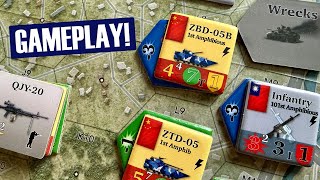


Rising Dragon: Platoon Level Combat in the Invasion of Taiwan Deep Dive
What the Community Thinks About Rising Dragon: Platoon Level Combat in the Invasion of Taiwan
Rising Dragon has captured the attention of serious wargamers with its ambitious scope and proven mechanical foundation. Reviewers consistently praise the system's elegance and the thematic boldness of its Taiwan invasion setting in 2034. The consensus centers on designer Greg Porter's ability to expand the proven Armageddon War system into a new theater without compromising what makes the core mechanics compelling. However, reviewers also acknowledge a significant learning curve; some describe initially "bouncing off hard" before the system clicked into place after deeper engagement. The game appears to land as a sophisticated offering for experienced tactical wargamers rather than a gateway title, with nearly universal appreciation for Flying Pig Games' production quality and map design.
Core Mechanics That Define Rising Dragon: Platoon Level Combat in the Invasion of Taiwan
Chit-Pull Activation System
At the heart of Rising Dragon lies its continuous chit-pull activation system, which replaces traditional turn structure with a rolling sequence of formation activations. Players draw formation chits from an opaque cup; when a chit is drawn, all units in that formation immediately activate. The system maintains constant forward momentum: once all chits have been drawn, the two most recently activated chits return to the cup while the rest cycle back, ensuring no clean reset points between turns. This creates what reviewers describe as a "one long engagement feel," where damaged units remain degraded until their formation draws again, potentially staying crippled through multiple enemy activations. Reviewers praise this approach for simulating combat chaos more authentically than predictable turn order, citing the tension of not knowing when relief or reinforcement will arrive. The mechanic has been extensively playtested through Armageddon War, giving Flying Pig Games' implementation a proven foundation.
Dice Combat System
Rising Dragon employs a custom three-color dice system where firepower minus defense determines the base number of dice rolled, then modifiers adjust both quantity and quality. Black dice represent normal fire, red dice indicate heightened damage potential, and green dice represent weakened attacks. What reviewers find elegant about this system is its intuitive visual language combined with mathematical depth: color quickly communicates dice quality without consulting tables, yet the modifier interactions create profound tactical interdependencies. Terrain, weapon type, range, defensive posture, and movement all shift dice pools or quality in subtle ways. Counter fire introduces a critical choice for defenders: shooting back gives attackers additional dice but risks greater incoming damage in return. Reviewers emphasize that while the system appears complex when first encountered, most modifiers quickly become invisible to experienced players, and the core logic of matching unit types to target types emerges naturally from play.
The Rising Dragon Experience
Constant Tactical Tension
Reviewers consistently highlight the psychological experience of never knowing when your turn will arrive or when enemy formations will activate consecutively. One reviewer noted that footage showed "one side activating three formations in a row and the entire tactical situation flipped; your defensive line gets shredded before you can respond." This unpredictability means units often remain damaged across multiple opponent turns, creating a persistent sense of vulnerability. Players must constantly weigh whether to hold defensive positions or risk counter fire, knowing that time is working against degraded units. Reviewers describe this as creating genuine tension throughout play rather than the more passive waiting of traditional turn systems.
Learning Curve Leading to Elegance
Multiple reviewers describe an initial rejection of the game's apparent complexity, followed by rapid comprehension once core patterns became visible. One reviewer explicitly stated: "When I first started playing, I bounced off of this hard. This is way too much with the dice rolls, all the modifiers, dice quality, dice numbers, counter fire, shields, explosions. It was like, wow, I couldn't. I was about an hour in. I'm like, yeah, this one might beat me." However, upon returning after a few days and investing another hour, "it all clicked. And after about another hour or so, I'm like, oh, this is actually isn't that hard at all." Reviewers emphasize that the system becomes "very elegant once you get up to speed to it," but they stress that first-time players should expect to spend meaningful time learning the interaction layers.
What Makes Rising Dragon: Platoon Level Combat in the Invasion of Taiwan Stand Out
Revolutionary Activation Flow for Modern Combat Simulation
The continuous chit-pull system fundamentally changes how tactical chaos feels at the table. Where traditional wargames offer predictable rhythm, reviewers note that Rising Dragon's activation structure ensures players are "constantly reacting" rather than planning and executing in isolation. One reviewer described this as "brilliant in practice," citing how traditional games allow players to "plan everything, execute, wait" in predictable cycles, whereas Rising Dragon's rolling activation demands real-time adaptation. This mechanic proves especially effective for simulating the fog of war and command delays inherent to platoon-level combat, where units don't recover in neat phases but rather become available for action as their formation draws.
Flying Pig Games' Unmatched Map Craftsmanship
Reviewers single out the mounted 22x33 inch hexagonal maps as among the finest in the wargaming industry. One reviewer stated: "Flying Pig Games, I think they have some of the best maps in the wargaming industry. Whenever I see their tactical maps, whether it's from the Black Swan Civil War games or the old school tactical World War II combat games, they just pull me in." Rising Dragon includes two independent maps representing urban and rural terrain, with large 150-meter hexes that reviewers describe as a "tactile joy to play," especially for players who appreciate physical component manipulation. The terrain variety, including roads, beaches, urban areas, water sections, altitude changes, and even an airstrip, creates distinct tactical environments that encourage varied scenario design.
Potential Drawbacks
High Complexity and Steep Initial Learning Curve
While reviewers praise the system's eventual elegance, they uniformly acknowledge that Rising Dragon demands substantial investment before mastery. One reviewer, after extensive playtime, rated the game a 7 out of 10 for complexity and emphasized: "You do need to spend some time learning the game." Combat resolution involves evaluating terrain modifiers, weapon type matching, range calculations, defensive posture, morale degradation, and counter fire optionality. The 80-page rulebook, while clearly written according to reviewers, contains 40 pages of core rules followed by advanced rules and scenarios. Reviewers suggest this game is not suitable for casual players or newcomers to wargaming seeking gentle learning curves; it is decidedly a title for experienced hex-and-counter players.
Taiwan-Specific Content Remains Undemonstrated at Kickstarter
Board Game Critique raised a significant concern during the Kickstarter campaign: no gameplay footage of Rising Dragon itself exists, only footage from the Armageddon War system that it shares. The campaign page promises naval units, amphibious landing mechanics, drone support weapons, urban combat scenarios, and sci-fi elements like robotic troops and AI-directed swarms, but provides "zero mechanical explanations." Questions about how destroyers function at platoon scale, whether land units can fire at ships, and how amphibious hovercraft integrate remain unanswered by footage alone. While Flying Pig Games' track record is solid, reviewers emphasize that players are backing "on trust" rather than demonstrated content integration. This uncertainty factored into one reviewer's willingness to rate the complete package at 7.2 out of 10 despite awarding the core system 8 out of 10.
If You Enjoy Rising Dragon: Platoon Level Combat in the Invasion of Taiwan
Reviewers consistently recommend Armageddon War to players curious about the system but hesitant about Rising Dragon. Armageddon War, designed by the same Greg Porter and published by Flying Pig Games, uses the identical chit-pull activation and dice combat systems, applying them to near-future Middle East conflicts. Since Armageddon War is already released with extensive reviews and gameplay footage available, players can verify their enjoyment of the core mechanical approach before committing to Rising Dragon's Taiwan setting. One reviewer recommended this path explicitly: "Buy it, play immediately, see if you like the system, then decide if Rising Dragon's Taiwan setting is worth backing." For players who already own and enjoy Armageddon War, Rising Dragon represents more scenarios in a system they've proven they like, with the added novelty of amphibious and naval elements.
What Reviewers Are Saying
"That continuous activation system is brilliant in practice. Traditional war games have predictable rhythm. You know when your turn comes, plan everything, execute, wait. But with rolling chit-pull, you're constantly reacting. The footage showed one side activating three formations in a row and the entire tactical situation flipped. Your defensive line gets shredded before you can respond, or you pound the same enemy formation twice consecutively."
— Board Game Critique
"Flying Pig Games, I think they have some of the best maps in the wargaming industry. Whenever I see their tactical maps, whether it's from the Black Swan Civil War games or the old school tactical World War II combat games, they just pull me in. I mean, the green sepia just looks so elegant and inviting. Just kind of makes me want to jump right in and play right away."
— Zilla Blitz
"It looks like a lot as we work through all of those modifiers the first time, but as with most of these games, most of those modifiers you immediately know that they're not there. It's a very elegant system once you get up to speed to it. Having said that, it is definitely complex."
— Solo Blitz