


Heroes of the Sanctum: The Strategy Card Game Deep Dive
What the Community Thinks About Heroes of the Sanctum: The Strategy Card Game
Reviewers agree that Heroes of the Sanctum: The Strategy Card Game, published by Firetap Games, packs far more play into its footprint than its size suggests. The praise centers on a solo or cooperative party experience with a puzzle that rewards careful planning, a diceless resolution system, and art that reviewers consistently single out.
Rob's Tabletop World presents the game with open enthusiasm. Rob calls it a must-have and says that being beaten by the game is part of why it stays fun. The Watch Review takes a more measured approach, working through four games at varying difficulties before concluding that the design is strong. That review singles out the diceless resolution, the built-in difficulty adjustment through advanced hero sides, and the art, and it names tiny tokens as the one real complaint.
The two reviews differ mainly in emphasis. Rob says the game demands real planning but is not a brain burn, while the Watch Review warns that the number of possible action combinations can trigger analysis paralysis in players who tend to overthink. Both agree that the game delivers the feel of managing a full adventuring party with little bookkeeping, and both treat that as the core appeal.
Core Mechanics That Define Heroes of the Sanctum: The Strategy Card Game
Shared Sanctum Banner and Battle Lines
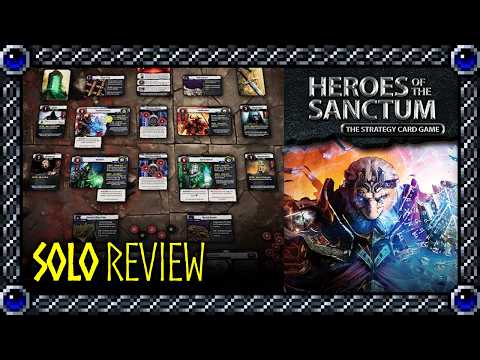
Each quest in Heroes of the Sanctum has a length, a difficulty, and setup instructions, and the party is formed from four heroes, each standing in its own battle line. Reviewers explain that the lines defend a common Sanctum banner in the middle of the table. The heroes themselves do not take damage. Instead, damage from enemies is added to the banner, and when the combined health value of the two heroes sharing that banner is reached, both heroes are defeated. Rob describes this as brutal, and it means a heavily hit hero can drag its partner down with it.
Enemies spawn into the battle lines throughout the game. If a threat is not dealt with, another one stacks deeper in the line, and the Watch Review notes that heroes can move to another battle line when repositioning. Region cards and proximity cards add environmental effects such as burn damage, and a quest tracker with a timer token and a scouting counter drives the pace. Quest cards list the turns when something bad happens, so the timer is a constant pressure on the party.
Strategem Cards and Action Economy
Each turn begins with a strategem card drawn from a deck that cycles to the bottom after use. The card determines which actions are available and the maximum number of action points the party can spend. Red actions cost two points and blue actions cost one. Reviewers highlight that the actions include attack, defend, heal, scout, use, taunt, assist, and move, along with wild options that can be any symbol. Once a hero spends an action, that action is covered, so no other hero can take the same action that turn. Each strategem card also carries its own effect, and some of those effects help the party while others hurt it.
Because each hero has only one action token, every hero can take at most one action per turn. Rob notes that moving can swap positions with an ally, but the ally then lands wherever the mover was headed, which makes positioning a real tactical question. The Watch Review describes the result as a pretty interesting puzzle of working out how each hero can perform the best action for the moment.
The Heroes of the Sanctum: The Strategy Card Game Experience
Controlling a Full Party With Minimal Upkeep
The Watch Review praises the game for delivering the feeling of an RPG party, with a healer, a defender, a spellcaster who deals damage, and a rogue assassin, each with distinct abilities. The reviewer notes that a party-based dungeon crawler usually carries heavy upkeep, but Heroes of the Sanctum delivers that experience with a minimal amount of bookkeeping. Heroes gain stat boosts when leveled, and each carries a passive ability and a unique ability that can be used once per game. Rob also enjoys getting the feel of the different characters and finding the ones that work best.
Tight Puzzle Satisfaction
Reviewers describe the game as a puzzle that asks players to think hard about every turn. The Watch Review calls it a brain burner and warns that players prone to analysis paralysis will spend a long time optimizing, even though each turn involves only four actions in total. Rob, by contrast, describes the game as requiring real planning rather than a brain burn, and says that getting beaten by it is what keeps it fun. That tension between a demanding puzzle and a game that stays playable is central to how reviewers describe the feel of the table.
What Makes Heroes of the Sanctum: The Strategy Card Game Stand Out
Big Game Value in a Small Box
The Watch Review compares the base box to Dragons of Etchin Stone for the amount of play it delivers relative to its size, describing it as a big board game in a small box. The footprint is roughly that of a standard play mat, which makes it a strong travel game. Rob makes a similar point, arguing that many large, expensive games lack the play and fun value found in smaller boxes like this one.
Exquisite Fantasy Art and Presentation
Art is one of the most consistent sources of praise. The Watch Review calls the fantasy art exquisite and says the graphic design is beautiful, while Rob describes the art as unbelievable and credits the team behind it for getting the work right. Rob also appreciates that the components are condensed and laid out in front of the player, so nothing is scattered across the table.
Potential Drawbacks
Tiny Tokens and Fiddly Play
The Watch Review identifies the size of the tokens as the only real negative, describing the game as fiddly because of them. The action tokens in particular are hard to handle, and the reviewer wishes the cards were bigger. The reviewer suggests that a premium add-on with a strategy deck as large as the box and bigger weight chips would be an easy purchase. The reviewer also points out that tokens a bit under 2 cm, the size used in the Lord of the Rings LCG, would likely still have fit in the box. To keep the quest tracker from shifting under the tiny tokens, the reviewer applied friction tape to the bottom.
Rulebook Reference Gaps
The rulebook is considered good but not perfect. The Watch Review says the approach resembles Fantasy Flight games, with a how-to-play booklet and a separate rules reference, but the reference is not fully comprehensive. Some information remains only in the how-to-play section, so players have to flip between the two. The reviewer had to check BGG to resolve a few nuances. Even so, the same review concludes that the core gameplay loop of flipping strategem cards, taking actions, spawning enemies, and interacting with region cards can be learned relatively quickly.
If You Enjoy Heroes of the Sanctum: The Strategy Card Game
Players who appreciate the big-game-in-a-small-box value that the Watch Review describes should look at Dragons of Etchin Stone, which the reviewer cites as the closest point of comparison for how much play fits into a compact box. The Lord of the Rings LCG is the other reference point the reviewer uses, as the token-size benchmark that Heroes of the Sanctum could have matched. Fans of tactical, card-driven party play with a fantasy theme will find that Heroes of the Sanctum sits comfortably alongside these titles.
What Reviewers Are Saying
"I love when I get my butt kicked by a game cuz if I win it too easy, you're not going to play it again."
— Rob, Rob's Tabletop World
"This really feels like a big board game in a small box. But it also has small footprint to boot."
— Watch Review
"I really wish that these cards were bigger. In fact, if they offered a premium add-on that is the strategy deck as big as the box size with weight chips, bigger weight chips instead of these tiny tokens, I would buy that in a heartbeat."
— Watch Review