/pic7824022.jpg)
THE SITUATION
1812: Most of Europe is under Napoleon´s control, and Napoleon is poised to invade Russia and force them to comply with his Continental System and block British trade.
In the face of overwhelming force, the Tsar reluctantly decide to fall back and adopt a scorched earth strategy. Faced by an elusive foe, the French were forced into advancing ever deeper into Russia and all the way to Moscow itself, even though their logistic system was falling apart under the strain.
The infamous retreat back from Moscow was the culmination of the campaign and the turning point of the Napoleonic Wars. Will Napoleon and the hitherto undefeated Grande Armeé crush the Russian army and capture Moscow, or will they be punished for their hubris in the vast expanses of Russia?
THE GAME
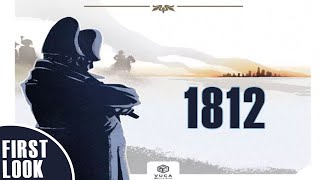
1812: The Fateful March is a 2-player game that simulates Napoleons invasion of Russia at the operational level.
It is an easy to play card-driven system that utilizes secret order placement which ensures constant tension and little to no downtime.
As befits the historical campaign, the game features a strong focus on logistic planning and march attrition with a set of simple but highly narrative mechanics.
—description from the publisher

- Strong two-player focus that shines in head-to-head play
- Rich thematic flavor with historical card art and flavor text
- Grand campaign scope with multiple scenarios, including a thorough grand campaign and shorter scenarios
- High production quality: detailed map, counters, leader portraits, and well-designed play aids
- Hidden information mechanics (orders and strength) create meaningful tension and replayability
- Card deck design and flavor text strongly convey historical context and flavor
- Readable rulebook with a well-structured sequence of play that supports learning and gameplay
- Solitaire play is discouraged; solo play may feel forced or require house rules
- Learning curve is non-trivial; rulebook and sequence of play can be dense for new players
- Complexity is non-trivial; some players may prefer lighter wargames or non-card-driven systems
- Reliance on memory for card effects and season-specific rules may slow early sessions
- grand strategic campaign with heavy emphasis on attrition, logistics, weather, and leadership decisions.
- June 1812 through early November 1812, the invasion of Russia by Napoleon Bonaparte's Grand Army.
- historical simulation flavor with strong emphasis on realism, large-scale campaign dynamics, and card-driven events.
Mechanics (from transcript analysis)
- attrition and weather modeling — an end-of-turn phase calculates losses based on weather conditions and supply status, echoing the harsh logistical realities of the campaign.
- dummy cards and deception — a dummy card mechanic allows bluffing about operations, adding psychological depth and misdirection to the planning phase.
- Events — ordering, initiative, and some actions are driven by a deck of event cards; some cards can shift initiative or disrupt plans, mirroring the historical volatility.
- fungible strength points as units — each strength point represents a sizable force (10,000 infantry or 5,000 cavalry); SPs are interchangeable and can be reallocated across engagements as needed.
- Hidden Deployment — players place orders face-down and can pull off-map strength behind screens; this creates ambiguity about enemy intentions and exact force composition.
- hidden orders and hidden strength pools — players place orders face-down and can pull off-map strength behind screens; this creates ambiguity about enemy intentions and exact force composition.
- initiative and card-driven events — ordering, initiative, and some actions are driven by a deck of event cards; some cards can shift initiative or disrupt plans, mirroring the historical volatility.
- leadership and leader abilities — named leaders provide special abilities that can influence how forces function, their movement, and engagements.
- Point to Point Movement — the map is a non-hex, connected network where strength points (SPs) move along tracks and roads between nodes; movement is constrained by supply and command.
- point-to-point map movement — the map is a non-hex, connected network where strength points (SPs) move along tracks and roads between nodes; movement is constrained by supply and command.
- seasonal card effects — cards reflect summer and winter conditions, altering probabilities and tactical considerations; some cards are seasonal-specific and only usable in certain conditions.
- supply and supply depots — supply constraints are central; supply depots and terrain influence retention and effectiveness of troops—mismanaging supply accelerates attrition.
- Two-player design — the game is explicitly designed for a head-to-head duel, with asymmetric information and mirrored components to evoke a bilateral strategic contest.
Video topics + discussion points
Quotes (from this video)
- This game shines as a two-player experience.
- These cards do a marvelous job both with their art and with this flavor text.
- I imagine as you're drifting into winter and your Napoleon's Army foraging for food you can feel almost the barren nature of the lack of resources for your troops.
- This is a solitaire unfriendly game for sure.
- Following that sequence of play is really going to help, easy to follow along and easy to learn.
- The six different scenarios that are in the game.
- I love the portraits they've got for all of the different leaders here too.
- The cards here look like they're really going to be a huge element in gameplay, bringing a lot of replay ability.
References (from this video)
- Beautiful components
- Approachable war game
- Interesting order placement mechanism
- Engaging battle system
- Too long
- Attrition phase slows down gameplay
- Can be a slog
- Napoleonic military campaign
- Napoleonic Wars in Russia and Eastern Germany
- Historical simulation
Mechanics (from transcript analysis)
- Card-driven game — Players use cards to determine actions and orders
- hidden orders — Players place order blocks facing themselves, hiding intentions
- Point to Point Movement — Units move between connected locations on the map
- point-to-point movement — Units move between connected locations on the map
Video topics + discussion points
Quotes (from this video)
- You can't have your Kate and Edith, too