/pic6705097.jpg)

/pic6705097.jpg)



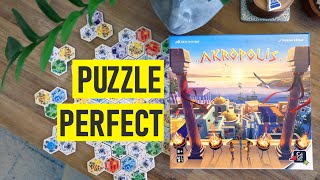























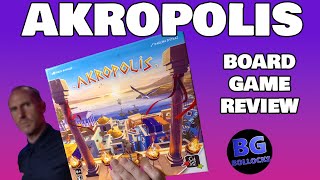

















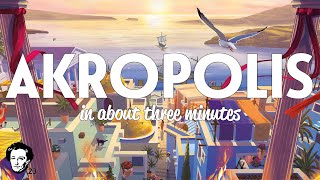




Akropolis Deep Dive
What the Community Thinks About Akropolis
Akropolis arrived in 2022 and quickly became one of the most talked-about lighter games of the year. Reviewers across the board praised it as a standout entry in a crowded field of tile-placement games, with several placing it among their top games of 2022. Chairman of the Board ranked it at number six in his definitive best-of-2022 list, calling it a game that "just works," and Board Game Spotlight called it one of both hosts' favorite games of that year. Might I Suggest A Game described it as a game that "really surprised me" at Gen Con, where it was reportedly flying off shelves. The consistent thread across all these voices is that Akropolis occupies a rare and satisfying niche: a game that is genuinely light to teach, fast to play, and yet rich enough in moment-to-moment decision-making to hold the attention of experienced gamers.
The consensus places Akropolis firmly in the "elevated filler" category. Before You Play described it as light in rule set and weight, yet noted it can cause "analysis paralysis because you're trying to min-max everything." Chairman of the Board, in his standalone review, called it "a real perfect filler especially considering the amount of time it takes." 3 Minute Board Games summed it up neatly as "a fun fast and thinky wee game." These reviewers are in strong agreement that the game's accessibility is one of its defining virtues, without sacrificing the meaningful decision space that keeps it interesting past the first few plays.
Core Mechanics That Define Akropolis
Tile Drafting and the Stone Economy
The core loop of Akropolis revolves around a shared market of tiles, where the leftmost tile is always free and each tile skipped to the right costs one stone. This simple rule creates a constant tug-of-war between economy and opportunity. As Chairman of the Board explained in his review, you need to make sure you have a "steady income of these stone cubes" because otherwise you become "completely subservient to the first tile in the row." Stone comes primarily from building upward and covering the quarry spaces on tiles, which means the act of growing your city vertically is also the act of fueling your future choices.
Before You Play observed that early in the game players tend to take free tiles without much thought, but as the game develops and scoring priorities crystallize, the stone economy becomes critical. Once a player commits to a color strategy, they need to fund the draft picks that serve that strategy. This creates a game-within-a-game where managing resources is just as important as managing the physical city. Might I Suggest A Game called the overall result "a surprisingly strategic tile-laying game that doesn't overstay its welcome."
Layer Building and the Vertical Multiplier
What genuinely distinguishes Akropolis from most tile-placement games is its third dimension. Players can stack new tiles on top of existing ones, provided the new tile straddles at least two tiles below. The payoff is significant: a district tile on the second level counts as two districts for scoring, and on the third level it counts as three. As Meeple University put it during their playthrough, "whatever you place, don't get too attached to what you place early in the game because it's more likely than not what comes late which is going to score a lot of points."
Chairman of the Board called the vertical dimension "one of the biggest things I really enjoy about this game," citing the tension around deciding when to start building upward, since covering tiles below can obscure symbols you may want to keep. 3 Minute Board Games illustrated this clearly: a single yellow tile worth two points at level one becomes worth six points at level three. Board Game Spotlight noted that covering quarry tiles when building vertically is also the only way to refill your stone supply, making every stacking decision carry multiple considerations at once. Before You Play described reaching the third level as genuinely difficult, especially when trying to maintain a large contiguous blue housing district, calling it one of the hardest parts of optimizing the game.
The Akropolis Experience
Fast, Snappy, and Satisfying
One of the most consistent praises across all reviewers is how efficiently the game moves. Chairman of the Board called the time investment "absolutely unreal," noting it "genuinely does take about 25 minutes" despite offering real decision space. He added that uptime is excellent because "turns are so snappy and their options are limited by the limited amount of tiles available." Board Game Spotlight echoed this during their playthrough: "Oh my goodness, we're almost done already. That's how quick this game is." Meeple University described it as "halfway between a filler and half of your night" in terms of weight, and said it was "really fun" and "really light rules but a bit of decision to make."
The game's pacing also benefits from the drafting rule that forces action. Because the free tile is always the leftmost one, players rarely grind to a halt agonizing over what to take. 3 Minute Board Games noted that this rule means "the game rarely grinds to a halt as people agonize over what tile to take." The result is a game that moves with energy and keeps all players engaged even when it is not their turn.
The Puzzle Feel and City-Building Satisfaction
Reviewers consistently described playing Akropolis as a satisfying spatial puzzle. Chairman of the Board said "the puzzle aspect of the game really does shine through nicely," and Might I Suggest A Game described that "great sense of accomplishment at the end when you make the best city." Board Game Spotlight captured the feeling of city growth vividly: "It just feels really great to build this really big epic sprawling city." The Meeple University hosts noted they found the game "pleasant" and "relaxing," which aligns with the broader community sense of Akropolis as a calm, low-pressure experience despite its real depth.
Before You Play reflected on the design after their playthrough, saying it is "weird, it's like nothing innovative but it works." They noted a resemblance to Quadropolis in its city-building with differentiated scoring by building type, but described Akropolis as "way simpler." Chairman of the Board also compared it favorably to Miyabi for its shared vertical-building mechanic. The combination of tactile tile placement, visible city growth, and a score that builds from multiple interlocking categories gives the game a satisfying engine feel.
What Makes Akropolis Stand Out
The Compound Scoring System
Each of the five district types scores by a different rule: blue residential buildings score for the largest contiguous group; yellow markets score for isolation (no adjacent yellows); red barracks score for being on the edge of your city; purple temples score for being completely surrounded; and green gardens score simply for being visible. Against these placement conditions, the plaza tiles act as star multipliers, and a district without a matching plaza star scores zero, no matter how many of that color you have placed.
Chairman of the Board praised this structure for creating real strategic tension: "I love the fact that if you're not getting the matching plaza tiles then they're all going to be worth nothing." The scarcity of plaza tiles means players may need to shift strategy mid-game, pivot to a different color, or even hate-draft to deny an opponent a key multiplier. Before You Play noted that early in the game "you kind of said no to the houses and just here you can have all of them because I was so focused on the other things," illustrating how committing to color priorities can mean deliberately ignoring others. 3 Minute Board Games noted that using the optional variant scoring rules is one way to dial complexity up a notch for groups ready for that challenge.
Accessibility Without Sacrificing Depth
Akropolis sits in a small category of games that genuinely work for both new players and experienced gamers. Chairman of the Board called it "definitely very approachable for new gamers as well as having enough going on here for more experienced gamers." Might I Suggest A Game described it as "a less mean version of an older game called Taluva," suggesting it shares strategic DNA with deeper abstracts while remaining lighter and friendlier. 3 Minute Board Games called it "a super family-friendly game that could be a fine filler for other groups."
The game also scales cleanly across player counts. Chairman of the Board noted it is "a very versatile game that scales extremely well." Before You Play observed that two-player games feel almost like building a perfect city, since players can often get what they want, while at higher counts the experience becomes more competitive and tense as desirable tiles are snatched before they reach you. The included variant scoring rules add optional layers of challenge without complicating the base game, giving the same box longevity across different audiences.
Potential Drawbacks
Tile Randomness and Luck
Chairman of the Board raised the only notable objective criticism in his review: because tiles are randomized in the display, some players may find great tiles available for free on their turn while others always face expensive choices to reach what they need. He noted this "could sometimes benefit some players more than others," though he was quick to add that "that's never really dampened my impression of the game" given how fast and breezy it plays. The stone economy does mitigate this to some degree, since spending stone to access a tile is a deliberate choice rather than a pure luck penalty, but the underlying randomness remains a factor.
Longevity and Repetition
Before You Play raised a mild concern about the game's longevity, noting "there are only so many ways to score it." However, they also pointed out that the game's short play time works in its favor: "you pull it out in like a month or so or a few weeks and it's kind of revitalized again just because of how snappy it is." 3 Minute Board Games added a similar note: "while it's fun enough I can't imagine playing ten games of it back to back to fill an evening." These are honest caveats from reviewers who clearly enjoyed the game, but the implication is that Akropolis works best as part of a broader collection rather than as a sole centerpiece game. The optional extended play rules (using all tiles rather than the player-count-adjusted set) offer one way to extend sessions for those who want more.
If You Enjoy Akropolis
Reviewers drew comparisons to several games that share Akropolis's appeal. King Domino is the most commonly cited step-down, with Chairman of the Board calling Akropolis "a stronger game than King Domino" while acknowledging it shares that entry-level friendliness. If Akropolis feels like the right weight, Cascadia and Miyabi are the natural step-ups: both were mentioned by Chairman of the Board as games that Akropolis sits close to in terms of strategic depth, though they take longer to play. Taluva was mentioned by Might I Suggest A Game as a spiritual predecessor with a similar placement-and-height concept but a more cutthroat feel. For city-building fans who want more complexity, 3 Minute Board Games recommended Suburbia, while Santorini was cited as another fast two-player abstract with spatial depth. Before You Play mentioned Quadropolis as a thematic cousin, sharing the city-building framework with differentiated district scoring but at greater complexity.
What Reviewers Are Saying
"Acropolis is one of the games at Gen Con that really surprised me. I hadn't really heard much about it before I got there, but when I sat down to play it I was equally surprised by how light it was and how deep it was. The game really zips along at a nice pace. I'd say it plays about 15 minutes per player, which I feel like is rare for a tile game, and because you have a shared market and a lot of different scoring conditions it felt like all the decisions you had to make were really important even though the decision-making process was fairly streamlined."
— Might I Suggest A Game
"The time investment for this game is absolutely unreal. It does literally take about 25 minutes to play. Considering the decision space and engagement of this game I think that is right up there with the best of them. You know most 25-minute games are little throwaway games where you don't put that much thought space into it. This one is very thinky, very puzzly, and it does take such a succinct amount of time, so that is massively impressive."
— Chairman of the Board
"The best thing about this game is this wonderful combination of being easy to teach and just deep enough to be challenging. Akropolis is lighter than many of the games we choose to cover on the channel but I'm glad we made an exception, as it really is a fun fast and thinky wee game, and due to the rule we have to pick up the first draft option unless you spend stone, the game rarely grinds to a halt as people agonize over what tile to take."
— 3 Minute Board Games