/pic7648379.jpg)
















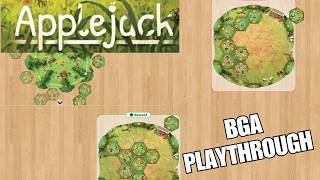









Applejack Deep Dive
What the Community Thinks About Applejack
Applejack occupies a curious space in the board gaming landscape. Its Board Game Geek rating of 6.8 reflects divided opinion: some prominent reviewers dismissed it outright, yet the game has developed a competitive following on Board Game Arena with consistent top players. The game has proven itself far deeper than its approachable exterior suggests, rewarding both casual players seeking a relaxing experience and dedicated strategists willing to invest in mastering its systems. Multiple reviewers describe it as one of those unexpected gems that reveals significantly more complexity and elegance with repeated plays.
Core Mechanics That Define Applejack
Tile Placement and Apple Collection
At its heart, Applejack is a spatial puzzle where players place orchard tiles onto their personal boards, developing contiguous groups of like-colored apples. Players are purchasing these tiles from a spiral marketplace using honey, the game's currency. The critical strategic insight is that apple groupings must reach at least four apples of a color to generate honey at game end. Reviewers emphasize that every apple added beyond the fourth apple in a group generates two points, making size and consolidation of groups far more valuable than spreading efforts across numerous small collections. The seven apple types introduce set collection elements, with bonuses awarded for achieving minimum group sizes across all colors simultaneously.
Beehive Matching and Income Generation
The beehive mechanic runs parallel to apple collection and drives moment-to-moment decision making. Placing tiles so that beehive symbols match adjacent hives generates immediate income in honey, the currency. This income is essential for acquiring expensive tiles, yet taking every beehive match available may commit players to suboptimal board positions. Reviewers describe multiple hive matches as the most satisfying plays, where a single tile placement connects to several existing hives and cascades into substantial honey generation. Understanding when to prioritize beehive income versus strategic apple placement separates casual play from competitive execution.
The Applejack Experience
Meditative and Replayable
Reviewers consistently describe Applejack as a contemplative, low-stress game perfect for quiet mornings or cottage weekends. One reviewer plays it while enjoying coffee and homemade cinnamon rolls, treating it as part of a relaxing ritual. The experience hinges on satisfying spatial puzzle-solving without the pressure of direct player conflict. Games resolve quickly, in around 30 minutes, yet present fresh puzzles each time. The randomized tile availability means no two games follow identical paths, and reviewers report wanting to play repeatedly, keeping it on their table for ongoing exploration.
Intellectually Engaging Without Feeling Artificial
A key point of tension among reviewers concerns whether Applejack achieves meaningful complexity through elegant rules or through rule accumulation. One skeptical reviewer described the mechanics as artificially complex, with too many independent scoring systems that feel disconnected from the farming theme. However, other reviewers praise how the compound scoring system forces genuine strategic tension: players must balance immediate honey income, orchard layout, and end-game apple groups. The die pips create shifting incentives across the game's three rounds, and blossom tiles offer multiple decision points. Rather than feeling bloated, the mechanics interact in ways that reward planning several turns ahead.
What Makes Applejack Stand Out
Elegant Rosenberg Lightweight Design
Applejack represents Uwe Rosenberg working in lighter territory compared to his heavier euro games like Agricola and Feast for Odin. Reviewers familiar with Rosenberg's catalog praise this as a fresh direction. The game captures the "easy to teach, hard to master" quality without the duration or weight of his other designs. It sits comfortably between Patchwork and Nova Luna on the complexity spectrum, offering intellectual satisfaction without overwhelming casual players. The quick playtime makes it accessible for repeated sessions, and reviewers note it serves as an ideal gateway to deeper tile-placement games.
Honey as Elegant Currency and Victory Point
The interplay between honey-as-currency and honey-as-victory-points creates constant tension. Spending honey to purchase tiles depletes the pool available for final scoring, yet certain tiles must be purchased to enable higher scores later. This resource management puzzle is the core appeal for reviewers who love the game. Blossom tiles and beehive income provide multiple honey generation paths, forcing players to weigh quick cash flow against long-term positioning. The mechanic grounds the theme naturalistically: bees are attracted to blossoms and hives, generating honey that funds expansion of the orchard.
Potential Drawbacks
Arithmetic and Bookkeeping Burden
The most frequently cited complaint centers on calculation overhead, particularly around scoring. Multiple apple groups of different colors must be counted every scoring opportunity, and the die value subtracts from group totals, affecting point calculations. At the final scoring, each apple group requires multiplication by two after subtraction. While playing online on Board Game Arena automates these calculations, physical play demands careful counting. One reviewer found this "so dumb," likening it to a counting nightmare that overshadows the elegance of the placement puzzle. Others acknowledge the complexity but view the calculations as manageable once players understand the system.
Randomness in Tile Distribution
The refilling mechanic and random tile availability introduce luck that some reviewers find frustrating. Players may fail to find needed apple colors for extended periods, or face situations where critical tiles appear only after a rival has already committed to a different strategy. The game mitigates this through advance planning: reviewers describe looking two or three turns ahead to anticipate available tiles and secure lanes before opponents do. However, the randomness creates moments where optimal play becomes impossible due to tile distribution, a quality that one reviewer found thematic but still limiting.
If You Enjoy Applejack
Reviewers who love Applejack often appreciate Patchwork, sharing its quilting puzzle and asymmetrical player boards. They enjoy Cascadia and Calico for similar patterns of spatial optimization and set-collection interplay. Players drawn to the beehive-matching system might explore other network-building tiles placement games. Those who love Rosenberg's body of work should experience both his heavier designs and this lighter iteration. The game appeals equally to people seeking competitive depth on Board Game Arena and casual players treating it as a meditative coffee-table experience.
What Reviewers Are Saying
"Applejack is one of those diamonds in the rough among lightweight board games that is somewhat easy to teach but hard to master."
— The Board Gaming Doctor
"For a game this simplistic the complexity is ridiculous. This is artificial strategic depth where the rules just create mechanisms that weigh into decision making."
— Board Game Dad
"I love this game. It is so Uwe. It is easy to learn, difficult to master, and it is one of those types of games that I cannot stop thinking about after playing it."
— Foster the Meeple